
Developer Tools Best in category 1 results Platform Engineering AI Tool

Popular AI tools in the Platform Engineering field of Developer Tools include Rely.io, etc., helping you quickly improve efficiency.

Rely.io

Rely.io

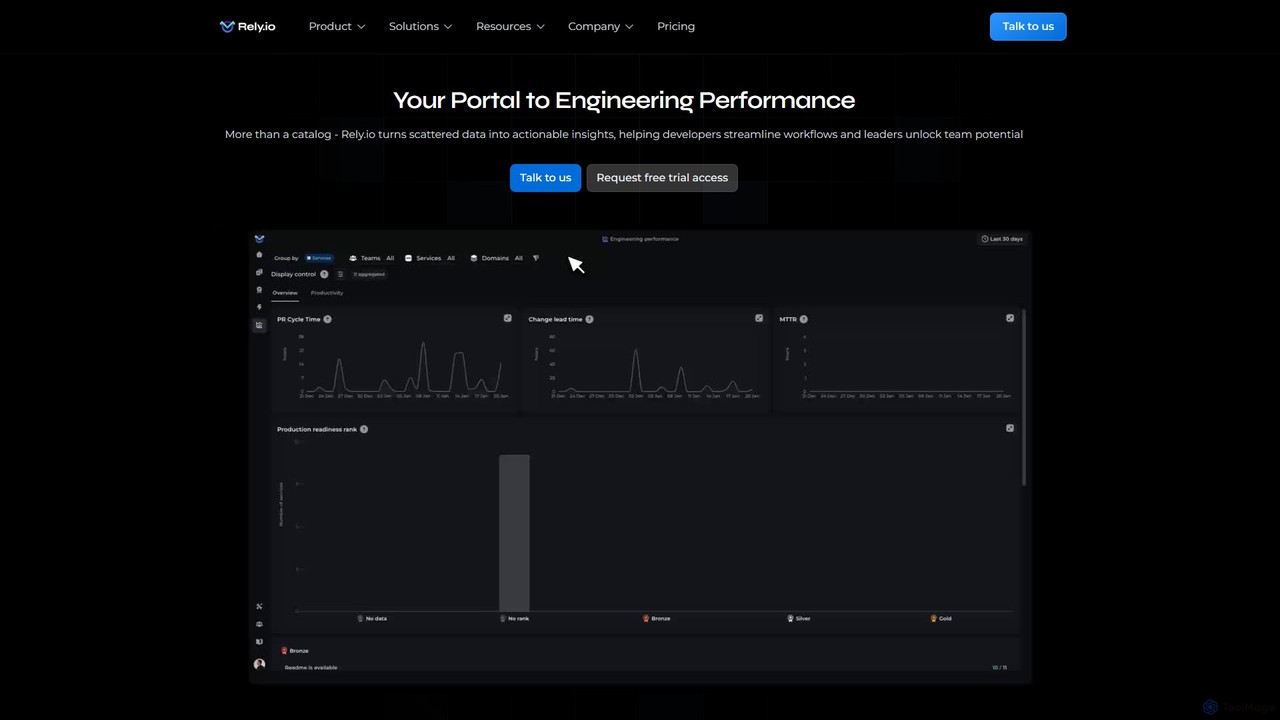
Rely.io is an Internal Developer Portal (IDP) for modern engineering organizations. It provides a unified software catalog, engineering …

3.3K

About Platform Engineering

Platform Engineering tools are designed to build and maintain internal developer platforms, enabling self-service capabilities for software development teams. These tools streamline the entire software delivery lifecycle by providing standardized infrastructure, automated workflows, and robust operational support. They empower developers to focus on writing code, accelerating innovation and improving overall system reliability within the broader developer tools ecosystem.

Core Features

  • Self-Service Portals: Offer developers a centralized interface to provision resources and deploy applications independently.
  • Infrastructure as Code (IaC): Define and manage infrastructure resources through code, ensuring consistency and version control.
  • Automated CI/CD Pipelines: Standardize and automate the continuous integration and continuous delivery processes for faster, more reliable releases.
  • Observability Integration: Embed monitoring, logging, and tracing capabilities directly into the platform for comprehensive system insights.
  • Policy Enforcement: Automate the application of security, compliance, and operational policies across all deployed services.

Use Cases

Platform Engineering is crucial for organizations scaling their development efforts, particularly those adopting microservices or cloud-native architectures. It benefits platform teams by reducing operational toil and developers by providing a frictionless path to production. Companies leverage these tools to standardize development environments, accelerate feature delivery, and enhance the overall developer experience.

How to Choose

When selecting Platform Engineering tools, consider their integration capabilities with your existing tech stack, the level of abstraction they offer to developers, and their scalability to meet future growth. Evaluate the extent of automation provided for infrastructure provisioning, deployment, and operational tasks. Assess the learning curve for your platform team and the developer experience for end-users, alongside community support and vendor reliability.

Platform EngineeringUse Cases

1

Enable Self-Service Infrastructure Provisioning

Platform teams can configure a self-service portal where developers can provision their own development, staging, or production environments with predefined templates. This eliminates manual requests and waiting times, allowing developers to spin up necessary resources instantly. For instance, a developer needing a new database instance can select it from a catalog, and the platform automatically provisions it according to company standards, saving hours of coordination and accelerating project timelines.

2

Standardize CI/CD Pipelines Across Teams

For large organizations with multiple development teams, Platform Engineering tools help create standardized CI/CD pipelines that all teams can adopt. This ensures consistent deployment practices, quality gates, and security checks across all applications. A platform team can define a golden path for deployments, allowing individual teams to integrate their code with confidence, reducing configuration drift and improving release reliability by 30%.

3

Automate Compliance and Security Policies

Platform Engineering tools enable organizations to embed compliance and security policies directly into the platform's infrastructure and deployment workflows. This means that every service deployed automatically adheres to regulatory requirements and security best practices, such as data encryption or access controls. By automating policy enforcement, companies can reduce the risk of human error, streamline audit processes, and ensure continuous compliance without manual oversight, saving significant time for security and compliance teams.

4

Improve Developer Experience (DX) and Productivity

Platform Engineering focuses on creating a seamless and enjoyable experience for developers. By providing well-documented, easy-to-use tools and standardized environments, developers spend less time on setup, configuration, and operational tasks. This allows them to concentrate on core feature development, leading to higher job satisfaction and a significant boost in productivity. For example, a new developer can onboard and deploy their first application within minutes, rather than days, thanks to a well-designed internal platform.

5

Streamline Microservices Deployment and Management

For architectures based on microservices, Platform Engineering tools provide the necessary abstractions and automation to manage the complexity of numerous independent services. This includes automated service discovery, load balancing, and scaling. A platform can simplify the deployment of new microservices by handling container orchestration, networking, and resource allocation, allowing development teams to deploy and iterate on services rapidly without deep Kubernetes expertise, reducing deployment time by up to 50%.

6

Enhance Observability and Incident Response

Platform Engineering tools integrate comprehensive observability features, including centralized logging, metrics collection, and distributed tracing, into the platform. This provides developers and operations teams with a unified view of application health and performance. During an incident, these integrated tools allow for rapid identification of root causes, faster debugging, and more efficient resolution, significantly reducing mean time to recovery (MTTR) and minimizing service disruptions by providing immediate, actionable insights.

Platform EngineeringFrequently Asked Questions