ToolMage
Sign in

Best 1 Quantum Computing AI tools for Developer Tools

Popular Quantum Computing AI tools in Developer Tools include Quantum Copilot, helping you work more efficiently.

Quantum Copilot
Freemium

Quantum Copilot

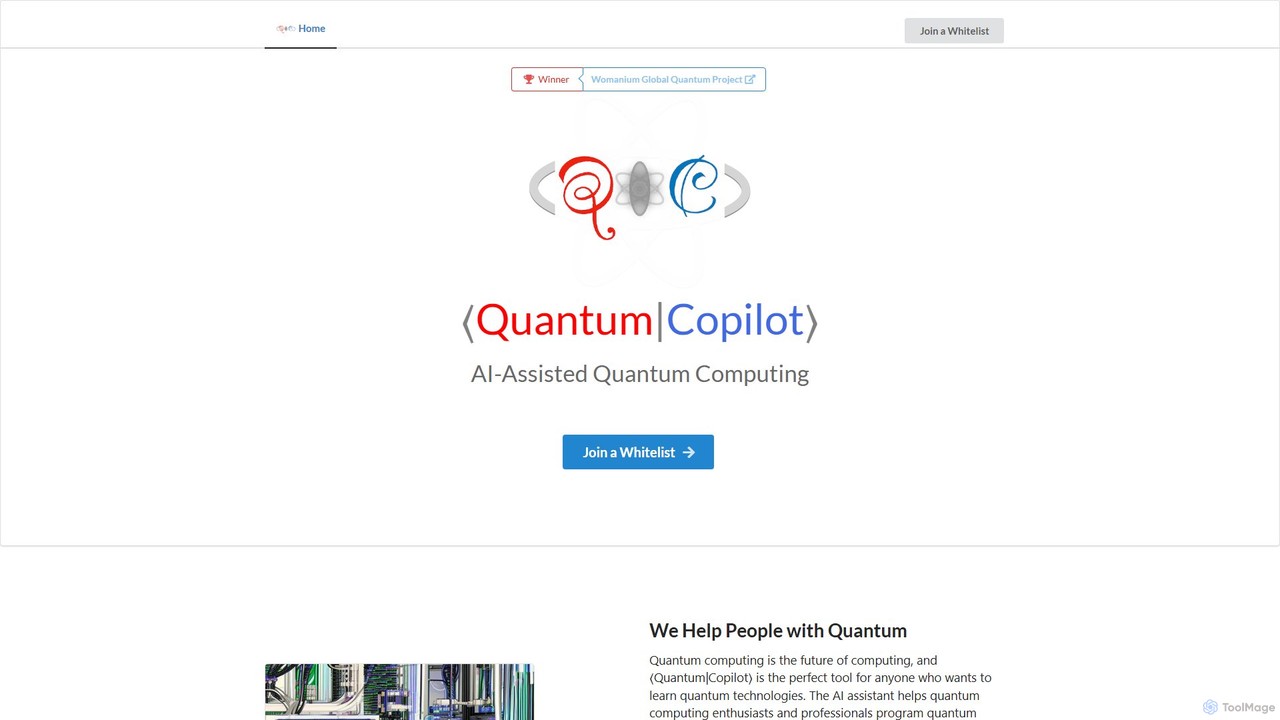
Quantum Copilot is an AI-assisted platform designed to simplify quantum computing. It enables users, from beginners to experts, to program quantum computers, generate algorithms, and run simulations using natural language. It supports various quantum languages and execution on real hardware.

Quantum Computing
Visits 6.5KFavorites 149Likes 140

About Quantum Computing

Quantum Computing tools are a specialized category of developer resources for designing, simulating, and executing algorithms on quantum processors. These tools leverage quantum-mechanical principles like superposition and entanglement to solve complex problems that are intractable for classical computers. They are pivotal for researchers and developers in fields such as drug discovery, materials science, and advanced financial modeling. By providing access to quantum hardware or high-fidelity simulators, they enable the exploration of quantum solutions without requiring direct physical access to a quantum computer.

Core Features

  • Quantum Circuit Design: Provides interfaces to visually or programmatically construct quantum circuits using qubits and logic gates.
  • Algorithm Simulation: Allows for testing and debugging quantum algorithms on classical computers before execution on actual quantum hardware.
  • Hardware Access & Execution: Offers APIs to send quantum programs to real quantum computers or cloud-based quantum processing units (QPUs).
  • Quantum Machine Learning (QML) Libraries: Includes specialized libraries for building and training machine learning models that run on quantum systems.
  • Performance Analysis: Delivers tools to analyze results, visualize qubit states, and debug errors in quantum computations.

Use Cases

Quantum Computing tools are primarily used in academic research, corporate R&D labs, and specialized sectors like pharmaceuticals, finance, and aerospace. They are applied to tackle complex optimization problems (e.g., logistics), simulate molecular interactions for drug development, and design novel materials with unique properties.

How to Choose

When selecting a Quantum Computing tool, consider the following: Does it provide access to real hardware or only simulators? What programming languages and SDKs does it support (e.g., Python with Qiskit or Cirq)? Evaluate the quality of documentation and community support. Finally, assess if the tool is general-purpose or specialized for specific domains like chemistry or finance.

Quantum Computing use cases

1

Simulating Molecular Structures for Drug Discovery

A computational chemist in a pharmaceutical R&D lab needs to accurately predict the properties of a new drug molecule. This task is exponentially difficult for classical computers due to complex quantum interactions. Using a quantum computing platform, the chemist constructs a quantum algorithm like the Variational Quantum Eigensolver (VQE) to model the molecule's electronic structure. They run the simulation on a cloud-based quantum processor, obtaining a highly precise calculation of the molecule's ground state energy. This result helps predict the molecule's stability and reactivity, accelerating the identification of promising drug candidates and significantly reducing the need for time-consuming physical experiments.

2

Optimizing Financial Portfolios with Quantum Algorithms

A quantitative analyst at an investment firm is tasked with optimizing a large portfolio to maximize returns while minimizing risk. This is a complex optimization problem with a vast number of potential asset combinations. The analyst uses a quantum computing SDK to formulate the problem as a Quadratic Unconstrained Binary Optimization (QUBO) model. They then run it on a quantum annealer or a gate-based quantum computer using an algorithm like QAOA. The quantum processor explores many possibilities simultaneously, identifying a set of asset allocations that may offer a better risk-return profile than those found by classical optimization methods, potentially leading to superior investment strategies.

3

Developing Quantum Machine Learning Models

An AI researcher is exploring novel machine learning architectures to solve problems that are difficult for classical neural networks. Their goal is to create a proof-of-concept Quantum Machine Learning (QML) model. Using a library like PennyLane or TensorFlow Quantum, they design a quantum-classical hybrid model. The quantum part, a parameterized quantum circuit, is used as a feature extractor. They train this model on a specialized dataset using a quantum computer simulator. The process involves iteratively adjusting the circuit parameters to minimize a loss function. The result is a novel model that demonstrates a potential quantum advantage for a specific classification task, contributing to cutting-edge AI research.

4

Designing New Materials with Atomic-Level Simulation

A materials scientist aims to design a new catalyst for a more efficient industrial process. Instead of costly trial-and-error lab experiments, they use a quantum computing tool to simulate material properties at the atomic level. They create a quantum model of the proposed material's molecular structure and use a quantum algorithm to calculate its electronic properties and potential catalytic activity. By running these simulations for various candidate materials on a quantum simulator, they can quickly screen out unpromising options and identify the most viable candidates for physical synthesis. This approach drastically accelerates the discovery cycle for new, high-performance materials.

5

Testing Cryptographic Vulnerabilities with Shor's Algorithm

A cybersecurity researcher is investigating the threat that future quantum computers pose to current encryption standards like RSA. The security of RSA relies on the difficulty of factoring large numbers for classical computers. The researcher uses a quantum programming language to implement Shor's algorithm, which is known to factor integers efficiently. They run the algorithm on a quantum simulator for small numbers to verify its correctness and study its resource requirements. This research doesn't break current encryption but provides valuable data on the number of stable qubits required, helping the industry understand the timeline for quantum threats and driving the development of quantum-resistant cryptography.

6

Solving Complex Logistical Optimization Problems

An operations research analyst for a large logistics company needs to optimize delivery routes for a fleet of hundreds of vehicles across a city, a variation of the Traveling Salesperson Problem. The number of possible routes is astronomical, making it difficult for classical solvers to find a truly optimal solution. The analyst maps the problem to a quantum optimization algorithm, such as the Quantum Approximate Optimization Algorithm (QAOA). They use a quantum computing service to run the algorithm, which explores a vast solution space more effectively. The result is a set of near-optimal routes that can significantly reduce fuel costs and delivery times compared to solutions found with classical heuristics.

Quantum Computing FAQ

What is Quantum Computing?

Quantum Computing is a fundamentally new type of computing that uses the principles of quantum mechanics to process information. Unlike classical computers that use bits (0s and 1s), quantum computers use qubits, which can exist as a 0, a 1, or a superposition of both at the same time. This property, along with entanglement, allows them to perform certain calculations, especially for optimization and simulation problems, exponentially faster than any classical computer. They are not intended to replace everyday computers but to solve specific, highly complex problems currently beyond our reach.

How do I choose a Quantum Computing tool or platform?

Choosing the right quantum computing tool depends on your goals. Consider these factors:

  • Purpose: For learning, prioritize platforms with excellent documentation, tutorials, and user-friendly simulators. For research, focus on access to specific quantum hardware and advanced algorithm libraries.
  • Hardware vs. Simulator: Determine if you need access to real quantum processors (QPUs) or if a high-performance simulator is sufficient for your work.
  • Programming Ecosystem: Most platforms use Python-based SDKs like Qiskit (IBM), Cirq (Google), or PennyLane. Choose one with a strong community and libraries relevant to your problem domain.
  • Domain Specialization: Some tools are general-purpose, while others offer specialized libraries for chemistry, finance, or machine learning, which can accelerate development.
What's the difference between Quantum Computing and classical High-Performance Computing (HPC)?

The core difference is their fundamental approach to computation. HPC uses a massive number of classical processors working in parallel to solve large problems through brute force. It's like having thousands of calculators working on different parts of a problem at once. Quantum Computing, however, uses qubits and quantum phenomena like superposition to explore a vast number of potential solutions simultaneously. It's a completely different kind of computation. HPC excels at tasks like weather modeling and complex simulations, while Quantum Computing is designed for problems with exponential complexity, such as molecular simulation and breaking modern encryption.

What are the main functions of Quantum Computing development tools?

These tools provide a complete workflow for quantum development. Key functions include:

  • Circuit Composition: Building quantum circuits using a visual editor or a programming language like Python.
  • Simulation: Testing and debugging algorithms on a classical computer that mimics a quantum computer's behavior.
  • Compilation & Optimization: Translating an ideal quantum algorithm into instructions that can run on noisy, real-world quantum hardware.
  • Job Execution: Sending the compiled program to a cloud-based quantum computer and managing its place in the execution queue.
  • Result Analysis: Retrieving and interpreting the probabilistic results from the quantum computation, often requiring statistical analysis.
Who should use Quantum Computing tools?

Quantum Computing tools are for a highly specialized audience, not general-purpose developers. The primary users include:

  • Researchers and Academics: Physicists, chemists, and computer scientists exploring the fundamental limits of computation and science.
  • Corporate R&D Teams: Specialists in industries like finance, pharmaceuticals, and aerospace who are working on complex optimization and simulation problems.
  • AI/ML Specialists: Researchers investigating Quantum Machine Learning (QML) for potential breakthroughs in artificial intelligence.
  • Students and Enthusiasts: Individuals learning the principles of quantum programming, often through accessible cloud platforms and simulators. A strong background in linear algebra, physics, and programming is highly beneficial.