Developer Tools Best in category 1 results Sdk Generation AI Tool

Popular AI tools in the Sdk Generation field of Developer Tools include Swytchcode, etc., helping you quickly improve efficiency.

Swytchcode

Swytchcode

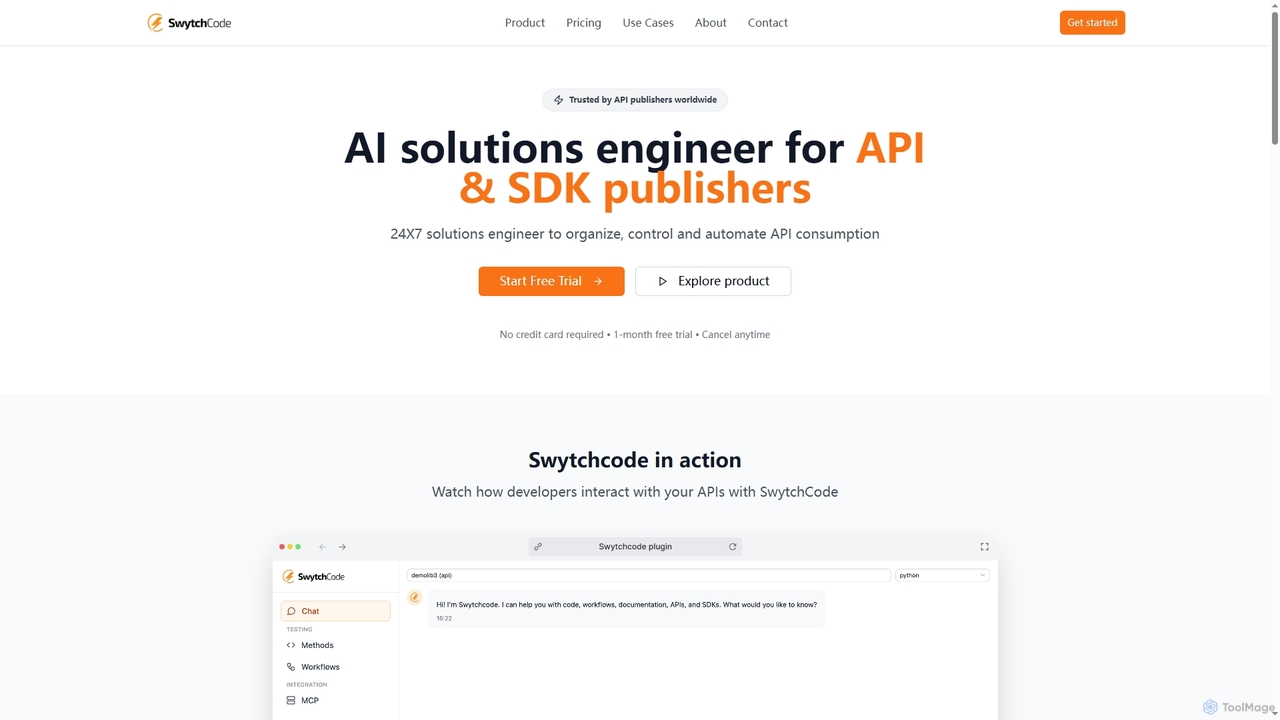
Swytchcode is an AI solutions engineer designed for API and SDK publishers to streamline API consumption. It automates …

2.2K

About Sdk Generation

SDK Generation tools are AI-powered platforms designed to automate the creation of Software Development Kits (SDKs) from API specifications. These advanced developer tools leverage artificial intelligence to parse API definitions, such as OpenAPI or Swagger, and automatically generate client libraries, code samples, and documentation in various programming languages. Their primary value lies in significantly accelerating API integration, reducing manual coding effort, and ensuring consistency across different development environments, thereby empowering developers to build applications faster and more reliably.

Core Features

  • Automated Code Generation: Automatically produces client libraries and code snippets for multiple programming languages based on API definitions.
  • Multi-Language Support: Generates SDKs compatible with a wide array of popular languages like Python, Java, JavaScript, Go, and C.
  • API Specification Integration: Directly imports and interprets standard API formats such as OpenAPI, Swagger, and GraphQL to ensure accuracy.
  • Documentation Generation: Creates comprehensive, up-to-date API documentation alongside the generated code, including usage examples.
  • Customization and Extensibility: Offers options to customize generated code, add custom logic, and integrate with existing development workflows.

Applicable Scenarios

Software development teams, API providers, and platform engineers extensively use SDK Generation tools. They are crucial for companies launching new APIs, needing to provide client libraries for various programming languages to their developer community. These tools also benefit internal development teams by standardizing API access and accelerating the integration of microservices within complex architectures, ensuring consistent and error-free communication between different system components.

How to Choose

When selecting an SDK Generation tool, consider its compatibility with your existing API specifications (e.g., OpenAPI version), the range of programming languages it supports, and the quality and readability of the generated code. Evaluate its customization options, integration capabilities with your CI/CD pipelines, and the clarity of the generated documentation. Security features, community support, and pricing models are also important factors to ensure it aligns with your team's technical requirements and budget.

Sdk GenerationUse Cases

1

Automating SDKs for Public APIs

An API provider needs to offer client libraries in multiple languages (e.g., Python, Node.js, Java) to make their public API easily consumable by a broad developer audience. By using an SDK generation tool, they can input their OpenAPI specification and automatically generate high-quality, consistent SDKs for all target languages. This saves hundreds of hours of manual coding, reduces errors, and significantly improves the developer experience for their API consumers, leading to faster adoption and integration.

2

Accelerating API Integration for Partners

An API provider needs to onboard numerous partners quickly. By using an SDK Generation tool, they can automatically create client SDKs for their RESTful APIs in Java, Python, and Node.js. This allows partner developers to integrate the API in days instead of weeks, significantly speeding up time-to-market for new collaborations.

3

Automating Client Library Creation for New APIs

For API providers launching a new service, manually developing SDKs for every popular programming language is time-consuming. SDK Generation tools allow them to input their OpenAPI specification and instantly generate robust, ready-to-use client libraries for Python, Java, Node.js, and more. This accelerates developer adoption by providing immediate, standardized access to the API, reducing the integration barrier for third-party developers and partners.

4

Streamlining Microservices Integration

In a large enterprise with a microservices architecture, different teams develop services using various programming languages. Integrating these services often requires creating client code for each interaction. An SDK generation tool allows teams to define their microservice APIs using a standard specification and then automatically generate client SDKs for other teams. This ensures consistent communication interfaces, reduces integration friction, and accelerates the development of new features that span multiple services, saving significant development time.

5

Maintaining Consistent Multi-Language SDKs

A large tech company offers a core service with APIs used by internal teams and external developers across various languages. An SDK Generation tool ensures that all client SDKs (e.g., for C, Go, Ruby) are consistently updated whenever the API changes, eliminating manual synchronization errors and reducing maintenance overhead by 70%.

6

Standardizing Internal Microservice Communication

In large enterprise environments with numerous microservices, ensuring consistent and error-free communication between services is critical. Platform engineers use SDK Generation to create standardized client libraries for internal APIs. This ensures that all internal teams consume APIs uniformly, reducing integration bugs, improving code quality, and streamlining the development of new features across the organization.

7

Accelerating Cross-Platform Development

A software company is building a new product with web, iOS, and Android clients, all interacting with the same backend API. Manually writing client code for each platform is time-consuming and prone to inconsistencies. By leveraging an SDK generation tool, the company can define their API once and generate platform-specific SDKs (e.g., JavaScript for web, Swift for iOS, Kotlin for Android). This ensures that all clients use the same API contract, speeds up development across platforms, and simplifies maintenance when API changes occur.

8

Streamlining Internal Microservice Consumption

Within a microservices architecture, different teams need to consume APIs from other services. An SDK Generation tool allows teams to automatically generate internal client libraries from service definitions. This standardizes inter-service communication, reduces boilerplate code, and improves developer productivity by 30%.

9

Accelerating Multi-Platform Application Development

Developers building applications that target multiple platforms (web, mobile, desktop) often need to interact with the same backend API. SDK Generation tools enable them to quickly generate client code for different front-end technologies (e.g., JavaScript for web, Swift/Kotlin for mobile). This significantly reduces the boilerplate code writing, allowing developers to focus on unique application logic rather than repetitive API integration tasks.

10

Modernizing Legacy API Integrations

An organization has several critical legacy systems exposed through older APIs that lack modern client libraries or clear documentation. Developers struggle with manual integration, leading to errors and slow development. By using an SDK generation tool, the organization can create OpenAPI specifications for these legacy APIs and then generate modern, well-documented SDKs in current programming languages. This revitalizes the integration process, making it easier for new applications to connect with existing systems without rewriting the backend.

11

Rapid Prototyping and Development

A startup is developing a new platform with several APIs and needs to quickly build client applications for testing and demonstration. Using an SDK Generation tool, they can instantly generate functional client SDKs for their frontend and mobile teams, enabling rapid prototyping and iterative development cycles.

12

Enhancing API Documentation with Live Code Examples

Good API documentation is crucial for developer experience. SDK Generation tools can not only generate client libraries but also produce comprehensive documentation that includes live, executable code examples derived directly from the generated SDKs. This provides developers with practical, accurate usage instructions, making it easier to understand and implement the API correctly, thus improving overall developer satisfaction.

13

Facilitating Internal Tooling Development

A development team frequently builds internal tools and dashboards that interact with various internal services. Manually creating client code for each service in every tool is repetitive and inefficient. By adopting an SDK generation workflow, the team can maintain a central repository of API specifications for all internal services. When a new internal tool is needed, they can quickly generate a client SDK, allowing developers to focus on the tool's unique logic rather than boilerplate API integration, significantly accelerating internal development.

14

Enhancing Developer Experience for SaaS Products

A SaaS company wants to make its platform more extensible and developer-friendly. By providing high-quality, automatically generated SDKs for popular languages, they significantly improve the developer experience, leading to higher adoption rates of their API and fostering a stronger developer community around their product.

15

Facilitating Rapid Prototyping and API Testing

During the early stages of API development or when integrating with unfamiliar APIs, developers need to quickly test endpoints and data models. SDK Generation tools can rapidly create basic client code, allowing developers to make API calls and experiment with different parameters without extensive manual setup. This accelerates the prototyping phase and helps identify potential API design issues early in the development cycle.

16

Consuming Third-Party APIs with Custom Clients

A developer needs to integrate with a third-party API that either doesn't offer an official SDK for their preferred language or whose existing SDK is outdated/incomplete. Instead of manually writing all API calls and data models, the developer can use an SDK generation tool with the third-party API's OpenAPI specification. This allows them to quickly generate a custom, up-to-date client library tailored to their specific needs, ensuring robust and efficient interaction with the external service while maintaining control over the client-side implementation.

17

Automating API Documentation and Examples

Beyond just code, an SDK Generation tool can automatically produce comprehensive API documentation, complete with usage examples and code snippets, directly from the API specification. This ensures that documentation is always up-to-date with the latest API version, saving technical writers countless hours and improving clarity for developers.

18

Maintaining Up-to-Date SDKs with Evolving APIs

APIs frequently evolve, requiring corresponding updates to their SDKs. Manually updating multiple SDKs can be a tedious and error-prone process. SDK Generation tools can automatically regenerate SDKs whenever the underlying API specification changes. This ensures that client libraries are always synchronized with the latest API version, minimizing compatibility issues and reducing maintenance overhead for API providers and consumers alike.

Sdk GenerationFrequently Asked Questions