Developer Tools Best in category 3 results Simulation AI Tool

Popular AI tools in the Simulation field of Developer Tools include Duckietown、Curl Calculator、PersonifAI, etc., helping you quickly improve efficiency.

PersonifAI

PersonifAI

PersonifAI is a powerful platform for designing custom AI personas, creating intricate interaction flows, and running dynamic simulations. …

4.2K
Duckietown

Duckietown

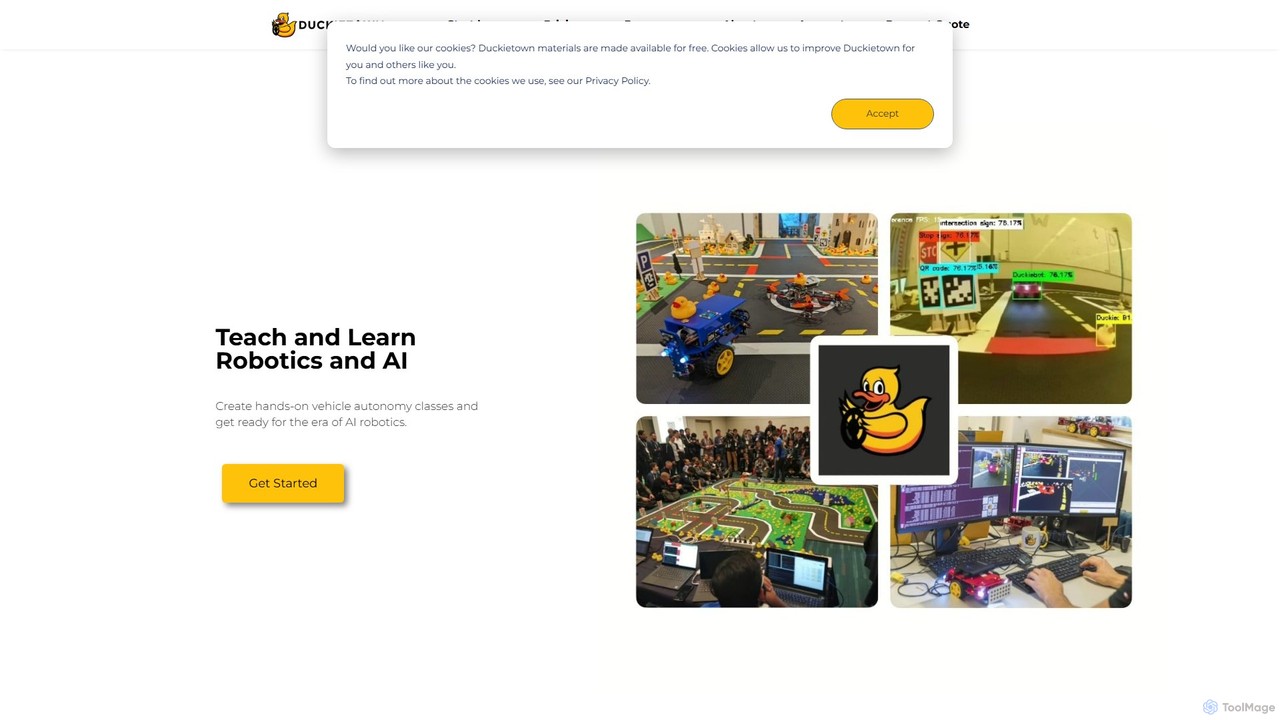
Duckietown is a hands-on educational platform for learning and teaching robotics and AI, originating from MIT. It provides …

28.4K
Free
Curl Calculator

Curl Calculator

A free online tool for students and professionals to efficiently calculate the curl of vector fields. It provides …

4.5K

About Simulation

AI Simulation tools are a class of developer software used to create dynamic, virtual models of real-world systems, environments, or processes. They leverage advanced algorithms like reinforcement learning and physics-based rendering to allow AI agents to learn and interact within a controlled, digital space. This enables developers and researchers to train, test, and validate complex systems—such as robots or autonomous vehicles—safely and efficiently before real-world deployment. These tools are essential for accelerating development cycles and exploring scenarios that are too costly, dangerous, or time-consuming to replicate physically.

Core Features

  • Physics Engine Integration: Provides realistic simulation of physical forces like gravity, friction, and collisions.
  • Reinforcement Learning Environments: Offers standardized environments for training AI agents through trial and error.
  • Scenario Generation: Allows for the programmatic creation of diverse and complex test conditions and edge cases.
  • Sensor Simulation: Accurately models data from various sensors, such as LiDAR, cameras, and IMUs.
  • Synthetic Data Generation: Creates large volumes of labeled data from the simulation to train other machine learning models.

Use Cases

AI Simulation tools are widely used in industries like robotics for training manipulation and navigation tasks, in the automotive sector for validating self-driving algorithms, and in game development for creating intelligent NPC behaviors. They are also applied in scientific research for modeling complex phenomena and in urban planning to optimize traffic flow and public infrastructure.

How to Choose

When selecting an AI Simulation tool, consider the fidelity of its physics engine and sensor models. Evaluate its integration capabilities with major machine learning frameworks like PyTorch and TensorFlow. Assess its scalability for running large-scale, parallel simulations, and check for support of relevant industry standards and asset formats (e.g., URDF for robotics).

SimulationUse Cases

1

Training a Warehouse Robot Arm

A robotics engineer is tasked with developing a robot arm that can identify and sort packages in a busy warehouse. Instead of building and potentially damaging expensive physical prototypes, the engineer uses an AI simulation tool to create a digital twin of the warehouse. Within this virtual environment, they use reinforcement learning to train the robot's control algorithm. The simulation allows for millions of pick-and-place cycles to run overnight, rapidly teaching the arm to handle various package sizes and weights under different lighting conditions, a process that would take months in the real world.

2

Validating Self-Driving Car Algorithms

An automotive company needs to test its autonomous driving software against millions of potential road scenarios, including rare and dangerous edge cases. Using an AI simulation platform, their developers can generate a vast range of virtual environments, from sunny highways to snowy city streets. They simulate thousands of scenarios concurrently, testing the vehicle's perception, prediction, and decision-making systems against unexpected events like a pedestrian suddenly crossing the road. This allows for comprehensive safety validation at a scale and speed impossible to achieve with physical test vehicles alone.

3

Developing Realistic NPC Behavior in Games

A game development studio wants to create a highly immersive open-world game where non-player characters (NPCs) behave realistically. A game AI developer uses a simulation tool to model a virtual city. They train groups of NPCs to perform complex social behaviors, such as forming crowds, navigating busy sidewalks, and reacting dynamically to the player's actions. By simulating these interactions, the developer can foster emergent behaviors that make the game world feel alive and unpredictable, enhancing the player's experience far beyond what could be achieved with simple scripting.

4

Modeling Climate Change Impacts

A team of environmental scientists needs to predict the long-term effects of various carbon emission policies. They use a large-scale AI simulation tool to model the Earth's climate system. The simulation incorporates vast datasets on weather patterns, ocean currents, and greenhouse gas concentrations. By running simulations of different policy scenarios over a simulated century, they can forecast potential outcomes, such as rising sea levels and changes in agricultural yields. These data-driven visualizations provide powerful insights for policymakers to make informed decisions on climate strategy.

5

Optimizing City Traffic Flow

An urban planner is tasked with reducing traffic congestion in a major city. They use an AI simulation tool to create a detailed digital twin of the city's road network. The simulation is populated with AI agents that mimic real driver behavior, including rush hour patterns and responses to incidents. The planner can then test various interventions, such as changing traffic light timings, adding a new bus lane, or altering one-way streets, and observe the impact on traffic flow in real-time. This allows them to identify the most effective solutions before committing to expensive and disruptive physical infrastructure changes.

6

Simulating Supply Chain Logistics

An operations manager for a global retail company wants to improve the resilience of their supply chain. Using an AI simulation platform, they model the entire network, from manufacturing plants to distribution centers and final stores. The manager can simulate various disruption scenarios, such as a port closure, a supplier failure, or a sudden spike in demand. The AI helps identify potential bottlenecks and tests different mitigation strategies, like rerouting shipments or increasing safety stock at certain locations. This proactive approach helps the company build a more robust and efficient supply chain, minimizing risks and costs.

SimulationFrequently Asked Questions