Developer Tools Best in category 1 results Software Engineering AI Tool

Popular AI tools in the Software Engineering field of Developer Tools include Cosine, etc., helping you quickly improve efficiency.

Cosine

Cosine

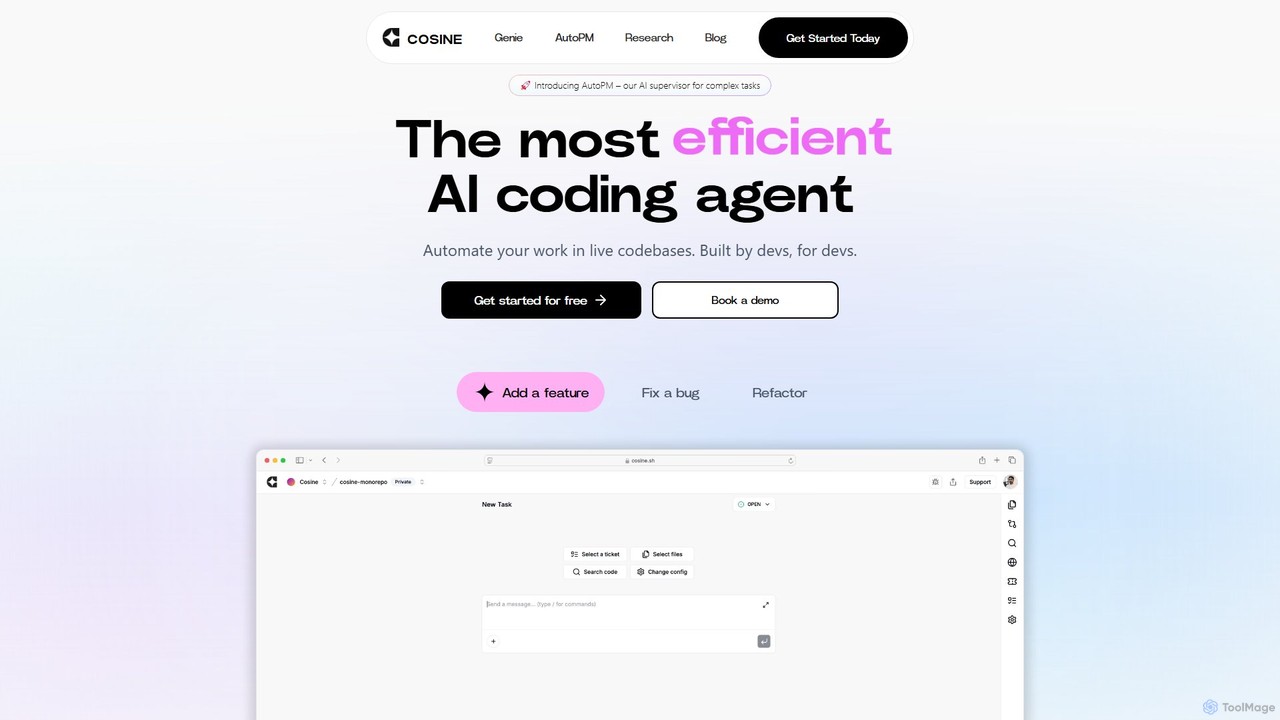
Cosine is an agentic AI software engineer designed to automate complex coding tasks. It operates directly within live …

33.5K

About Software Engineering

Software Engineering tools are AI-powered solutions designed to enhance and automate various stages of the software development lifecycle. These tools leverage machine learning, natural language processing, and advanced algorithms to assist developers, from initial design to deployment and maintenance. They aim to improve code quality, accelerate development, and reduce manual effort, making the engineering process more efficient and reliable.

Core Features

  • AI Code Generation: Automatically generates code snippets, functions, or even entire modules based on natural language prompts or existing code context.
  • Intelligent Bug Detection: Identifies potential bugs, vulnerabilities, and code smells in real-time or during static analysis, often suggesting fixes.
  • Automated Testing & Optimization: Creates test cases, executes tests, and suggests performance improvements or refactoring opportunities.
  • Smart Documentation: Generates or updates technical documentation from code, comments, and project specifications.
  • Predictive Analytics for SDLC: Forecasts project timelines, identifies potential bottlenecks, and optimizes resource allocation based on historical data.

Applicable Scenarios

Software engineering AI tools are invaluable for development teams, individual developers, and large enterprises. They are used in agile development environments to accelerate sprint cycles, in open-source projects for code quality assurance, and in large-scale system development for managing complexity and ensuring security. These tools support tasks ranging from rapid prototyping to maintaining legacy systems.

How to Choose

When selecting software engineering AI tools, consider their integration capabilities with your existing IDEs and version control systems. Evaluate the accuracy and relevance of their AI suggestions, the scope of their automation (e.g., code generation vs. testing), and their support for your preferred programming languages. Also, assess the learning curve, community support, and pricing model to ensure it aligns with your team's needs and budget.

Software EngineeringUse Cases

1

Automating Boilerplate Code Generation

A junior developer needs to set up a new API endpoint with standard CRUD operations. Instead of manually writing repetitive code for models, controllers, and routes, they use an AI code generation tool. By providing a simple schema or natural language prompt, the tool generates the necessary boilerplate, significantly reducing setup time and ensuring consistency across the project.

2

Real-time Bug and Vulnerability Detection

During active coding, a senior developer integrates an AI-powered static analysis tool into their IDE. As they write, the tool continuously scans their code, instantly highlighting potential bugs, security vulnerabilities (like SQL injection risks), and performance bottlenecks. This proactive feedback loop allows for immediate corrections, preventing costly issues from reaching later stages of development.

3

Generating Comprehensive Unit Tests

A QA engineer is tasked with ensuring high test coverage for a complex module. Using an AI test generation tool, they input the function or class to be tested. The AI analyzes the code's logic and potential edge cases, automatically generating a suite of robust unit tests, including various input scenarios and expected outputs, which drastically speeds up test creation and improves test quality.

4

Refactoring Legacy Code for Optimization

An architect is overseeing the modernization of an older application. They employ an AI refactoring tool to analyze the legacy codebase. The tool identifies redundant code, suggests clearer variable names, proposes structural improvements, and even recommends design patterns to enhance maintainability and performance, providing actionable insights for a smoother migration.

5

Automating Technical Documentation Updates

A technical writer struggles to keep documentation synchronized with rapid code changes. An AI documentation tool is integrated into the CI/CD pipeline. Upon every code commit, the AI automatically scans new functions, updated parameters, and code comments to generate or update API documentation, user guides, and internal wikis, ensuring documentation is always current and accurate.

6

Predicting Project Delays and Resource Needs

A project manager uses an AI project management assistant that integrates with their version control and task tracking systems. The AI analyzes historical data from past sprints, developer velocity, and current task dependencies to predict potential project delays, identify overloaded team members, and suggest optimal resource reallocation, enabling proactive risk management.

Software EngineeringFrequently Asked Questions