ToolMage
Sign in

Best 1 Startup Tools for Developer Tools

Popular Startup Tools in Developer Tools include Sid, helping you work more efficiently.

Paid

Sid

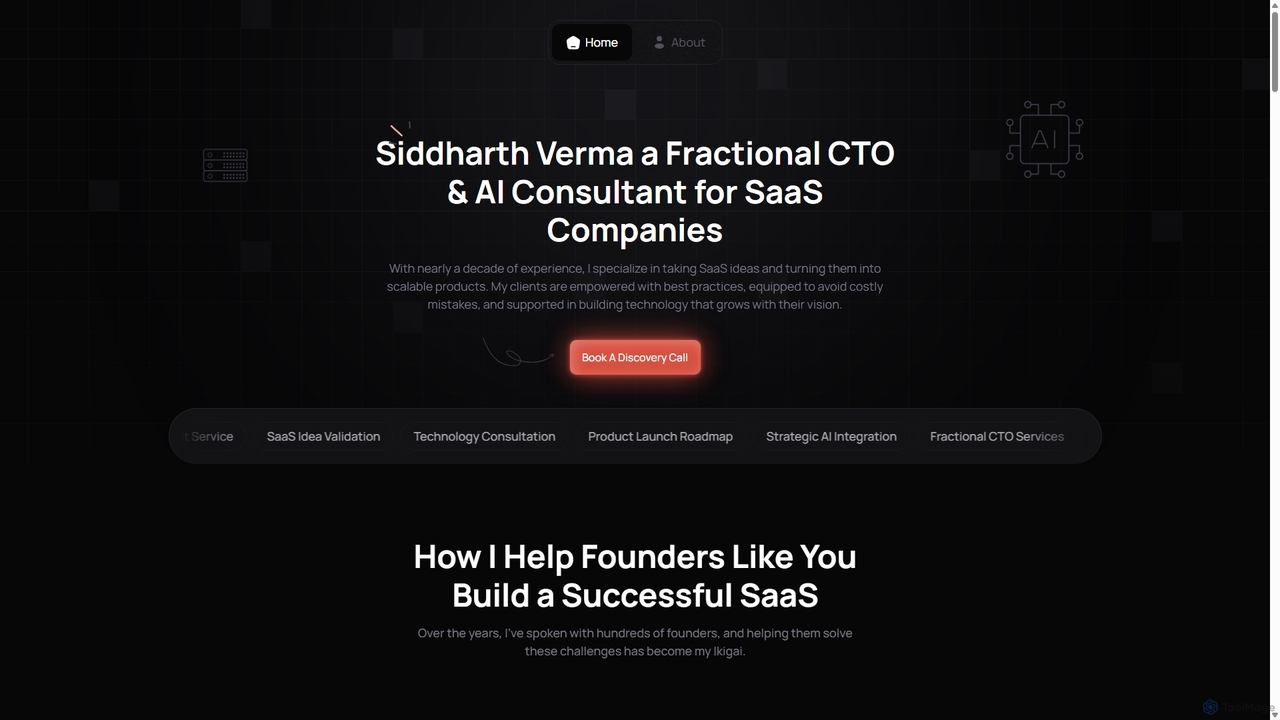
Sid (Siddharth Verma) is a Fractional CTO and AI Consultant specializing in helping SaaS companies transform ideas into scalable products. With nearly a decade of experience, he offers services like SaaS idea validation, strategic AI integration, product roadmap development, and technical leadership. Sid empowers founders to avoid costly mistakes, build robust technology, and accelerate their growth with expert guidance and firsthand entrepreneurial experience.

Artificial Intelligence
Visits 3.6KFavorites 118Likes 137

About Startup Tools

AI Startup Tools are a specialized suite of applications designed to accelerate the launch and growth of new ventures. Leveraging artificial intelligence, these tools automate and streamline critical early-stage tasks, from idea validation to initial market entry. They provide resource-constrained teams with powerful capabilities in areas like business planning, product development, and marketing, often bundling multiple functions into a single, cost-effective platform. This focus on speed and efficiency makes them a distinct subset of the broader Developer Tools category, empowering both technical and non-technical founders.

Core Features

  • Business Idea Validation: Analyzes market data, competitor landscapes, and potential user needs to assess the viability of a new concept.
  • Automated Pitch Deck & Business Plan Generation: Creates structured presentations and documents by processing core business information.
  • MVP & Prototype Development: Facilitates the rapid creation of functional prototypes and minimum viable products using low-code or no-code interfaces.
  • Brand Identity Creation: Generates company names, logos, and brand guidelines based on user-defined parameters.
  • Go-to-Market Content Automation: Produces landing page copy, social media posts, and initial ad campaign content to speed up market launch.

Use Cases

These tools are primarily used by early-stage startup founders, solo entrepreneurs, and small teams. They are invaluable during the pre-seed and seed stages for quickly testing hypotheses, building initial assets, and reaching the first customers without significant capital investment or a large workforce. Corporate innovation labs also use them for rapid prototyping of new internal ventures.

How to Choose

When selecting an AI Startup Tool, consider the stage of your venture. For ideation, prioritize tools with strong market analysis features. For MVP development, evaluate the platform's technical flexibility and scalability. Also, assess the breadth of integration with other essential tools (like CRM or analytics), the pricing model's alignment with a startup budget (e.g., freemium or pay-as-you-grow), and the ease of use for non-technical team members.

Featured tool rankings

Startup Tools use cases

1

Validating a New Business Idea

An aspiring entrepreneur has an idea for a new SaaS product but lacks the resources for extensive market research. They use an AI startup tool to analyze market trends, identify key competitors, and survey potential customer segments by generating targeted questionnaires. The tool processes this data to produce a viability report, highlighting potential market share and suggesting initial pricing strategies. This allows the founder to make a data-driven decision to proceed or pivot, saving months of manual research and significant upfront costs.

2

Generating an Investor Pitch Deck

A small founding team needs to create a professional pitch deck to secure seed funding. Instead of starting from scratch, they input their core business model, target market, and financial projections into an AI startup tool. The AI generates a complete, well-structured 12-slide presentation, including an executive summary, problem statement, solution, market size, and competitive analysis. It also suggests compelling visuals and talking points for each slide, enabling the team to produce a polished, investor-ready deck in hours instead of weeks.

3

Building a No-Code MVP

A non-technical founder wants to build a Minimum Viable Product (MVP) for a web application to test with early users. Using an AI-powered no-code platform, they describe the desired features and user flow in natural language. The AI translates these requirements into a functional application, creating the database structure, user interface, and core logic automatically. This enables the founder to launch a working prototype in a weekend, gather real user feedback, and iterate on the product without writing a single line of code or hiring a developer.

4

Automating Initial Marketing Content

A bootstrapped startup with no dedicated marketing team needs to launch its online presence. The founder uses an AI tool to generate a complete set of launch content. By providing a brief product description, the tool creates compelling copy for the website's landing page, a series of engaging social media posts for the first month, and a draft for their first email newsletter. This automated process provides a professional and consistent brand voice across all channels from day one, allowing the founder to focus on product development rather than content creation.

5

Creating a Basic Brand Identity

A new venture needs a professional brand identity but has a limited budget for a design agency. The founders use an AI startup tool to generate branding assets. They input keywords related to their industry and brand values (e.g., 'secure', 'finance', 'modern'). The AI suggests several company names, generates dozens of logo concepts in various styles, and creates a corresponding color palette and font pairing. Within an hour, the team can select and refine a complete brand kit, giving their startup a cohesive and professional look from the outset.

6

Automating Early-Stage Customer Support

A solo founder launches a product and quickly becomes overwhelmed with repetitive customer inquiries. To manage the workload without hiring support staff, they deploy an AI chatbot trained on their product documentation and FAQ page. The chatbot instantly answers common questions about features, pricing, and troubleshooting 24/7. It escalates complex issues to the founder's email, complete with a summary of the conversation. This frees up over 80% of the founder's time previously spent on support, allowing them to focus on strategic growth activities.

Startup Tools FAQ

What are AI Startup Tools?

AI Startup Tools are a specialized category of software that uses artificial intelligence to automate and accelerate tasks crucial for new businesses. Unlike general business software, they are specifically designed for the lean, fast-paced environment of a startup, focusing on functions like idea validation, MVP creation, automated marketing, and business planning. They empower founders, especially those with limited resources, to build, launch, and grow more efficiently.

How do AI Startup Tools differ from general business software?

The key difference lies in their focus and scope. General business software (like a full-scale CRM or ERP) is often broad, complex, and built for established processes. AI Startup Tools are typically:

  • All-in-One: They often bundle multiple early-stage functions (e.g., name generation, landing page creation, market analysis) into one platform.
  • Speed-Oriented: Their primary goal is to reduce time-to-market and time-to-feedback.
  • Cost-Effective: They usually offer flexible, startup-friendly pricing models like freemium or low-cost subscriptions.
  • Low-Barrier: They are designed for non-specialists, enabling founders to perform tasks that would otherwise require hiring experts.

Who should use AI Startup Tools?

AI Startup Tools are ideal for a range of users in the early stages of building a business. This includes:

  • Solo Entrepreneurs: Individuals who need to wear multiple hats and automate as many tasks as possible.
  • Early-Stage Founding Teams: Small teams with limited budgets who need to move quickly and validate their ideas without large upfront investments.
  • Non-Technical Founders: Individuals who want to build prototypes, create marketing materials, or analyze data without deep technical expertise.
  • Corporate Innovators: Teams within larger organizations tasked with rapidly developing and testing new business concepts.

What are the key features to look for in an AI Startup Tool?

When choosing a tool, prioritize features that align with your current needs. Key aspects to consider include:

  • Comprehensiveness: Does the tool cover multiple stages of the startup journey, from ideation to launch?
  • Ease of Use: Is the interface intuitive for non-technical users? How steep is the learning curve?
  • Quality of Output: Evaluate the quality of the generated content, designs, or code. Does it provide a professional starting point?
  • Integration Capabilities: Can it connect with other tools you use, such as project management software or analytics platforms?
  • Scalability: Will the tool still be useful as your company grows, or is it only for the very beginning?

Can AI Startup Tools replace developers or marketers?

No, AI Startup Tools are designed to augment, not replace, human experts. They act as powerful assistants that handle initial drafts, repetitive tasks, and data analysis at scale. A developer is still needed for complex coding, architecture, and maintenance. A marketer is essential for strategy, brand building, and nuanced campaign management. These tools empower founders to get started and operate leanly, but human expertise becomes increasingly critical as a business scales and faces more complex challenges.