Developer Tools Best in category 1 results Video Generation AI Tool

Popular AI tools in the Video Generation field of Developer Tools include Revideo, etc., helping you quickly improve efficiency.

Free
Revideo

Revideo

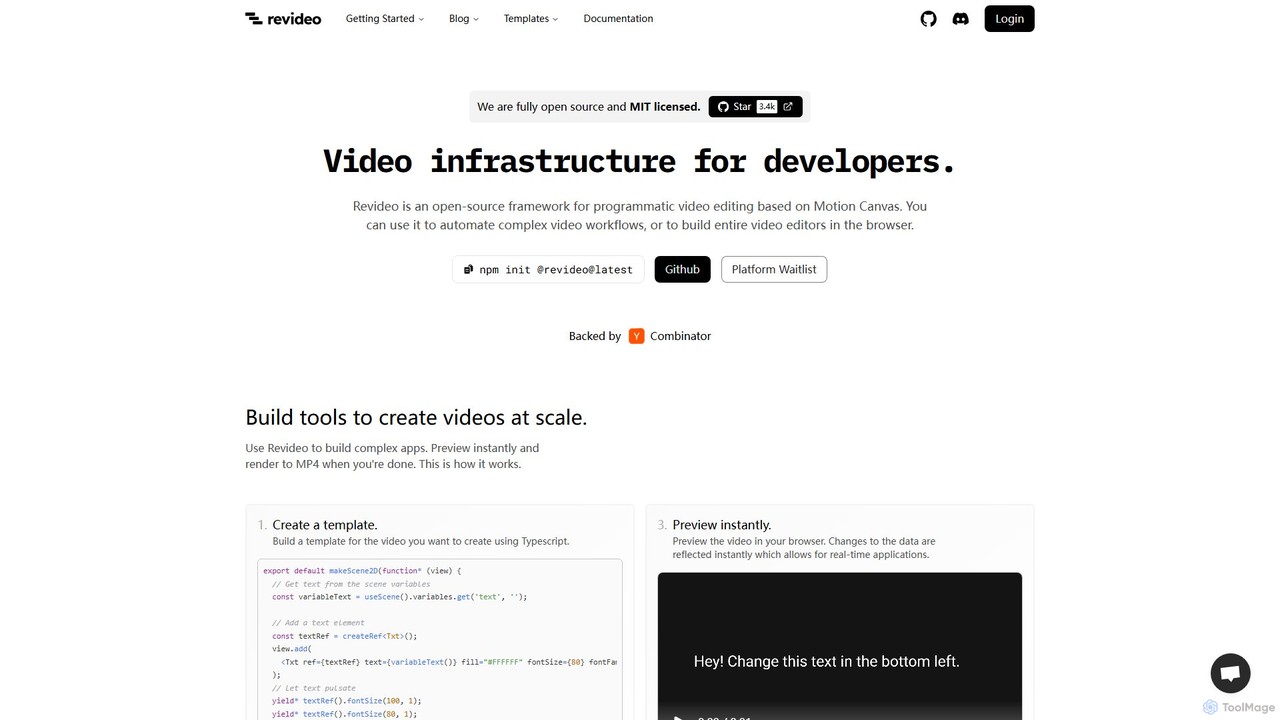
Revideo is an open-source framework for developers to create and automate videos programmatically. Using TypeScript and based on …

5.8K

About Video Generation

Video Generation tools are APIs and SDKs that enable developers to programmatically create or modify video content using artificial intelligence. These tools leverage advanced models like text-to-video, image-to-video, and generative adversarial networks (GANs) to synthesize new video sequences from various inputs. Their primary value lies in automating large-scale video production, enabling personalized content creation, and integrating dynamic video capabilities directly into applications. This allows for the creation of engaging visual content without manual editing workflows.

Core Features

  • API-Driven Generation: Programmatically create videos via REST or GraphQL APIs, enabling integration into automated workflows.
  • Text-to-Video Synthesis: Convert text prompts, scripts, or articles into corresponding video clips with visuals and narration.
  • Image-to-Video Animation: Animate static images or a sequence of images to create dynamic video content.
  • Programmatic Editing & Overlays: Automate tasks like trimming, concatenating clips, and adding dynamic text, logos, or data overlays.
  • Personalization at Scale: Use data inputs to generate thousands of unique, personalized video variations from a single template.

Use Cases

These tools are primarily used by developers in marketing technology (MarTech), e-commerce, media, and SaaS industries. For example, a developer can build a system to automatically generate product showcase videos for an e-commerce site, create personalized video ads for a marketing campaign, or integrate a feature that turns blog posts into short social media videos.

How to Choose

When selecting a Video Generation tool, developers should evaluate several key factors. Assess the API's quality, documentation clarity, and available SDKs. Consider the model's performance in terms of video realism, coherence, and resolution. Analyze the rendering speed and scalability for your expected workload. Finally, compare pricing models, which are often based on API calls, video duration, or rendering resolution.

Video GenerationUse Cases

1

Automated E-commerce Product Videos

An e-commerce platform developer is tasked with creating engaging video content for thousands of products. Instead of manual production, they integrate a Video Generation API. The system programmatically pulls product images, descriptions, and pricing data. It then uses a predefined template to generate a short, dynamic video for each item, complete with animated text overlays and a background music track. This automates a previously time-consuming process, enhances product listings, and can increase customer engagement and conversion rates.

2

Personalized Video Marketing at Scale

A marketing technology (MarTech) company wants to offer hyper-personalized video ads. A developer uses a Video Generation API to build this feature. When a campaign runs, the system takes customer data (like name, location, or past purchases) and dynamically inserts it into a video template. It can generate thousands of unique videos, each tailored to an individual recipient. This level of personalization, executed programmatically, can significantly improve ad relevance and campaign ROI compared to generic video ads.

3

Automated News and Data Visualization Videos

A digital media company needs to quickly produce video summaries of news articles and financial reports. A developer implements a workflow using a text-to-video generation tool. The system ingests an article's text, identifies key points, and generates a corresponding video with stock footage, animated charts based on data, and a synthesized voice-over. This allows the media outlet to expand its video content output tenfold without increasing its video production staff, reaching audiences who prefer video consumption.

4

Building In-App Video Creation Features

A developer at a SaaS company that offers a presentation tool wants to add a new feature: 'Animate Your Slides'. They integrate a video generation SDK. This allows their users to select their slides, add narration text, and click a button to automatically convert the static presentation into an animated explainer video. By embedding this capability, the company adds significant value to its product, differentiates from competitors, and empowers non-technical users to create professional-looking videos without leaving the application.

5

Dynamic Social Media Content Generation

A content creation platform wants to help its users produce short-form videos for platforms like TikTok and Instagram Reels more efficiently. A developer integrates a text-to-video API. Users can now input a short script or a key message, and the AI generates a visually engaging video with relevant stock clips, animated text, and trending audio suggestions. This empowers creators to maintain a high-volume posting schedule and experiment with different content ideas programmatically, saving hours of manual video editing.

6

Scalable Real Estate Virtual Tours

A property technology (PropTech) company manages thousands of listings. To enhance each listing, a developer uses a video generation API to create virtual tours. The system takes property photos, floor plans, and listing details (e.g., square footage, number of bedrooms) as input. It then programmatically stitches these assets into a smooth video walkthrough, complete with panning effects on photos and text callouts highlighting key features. This provides a scalable solution to create a consistent and professional video for every property, improving the experience for potential buyers.

Video GenerationFrequently Asked Questions