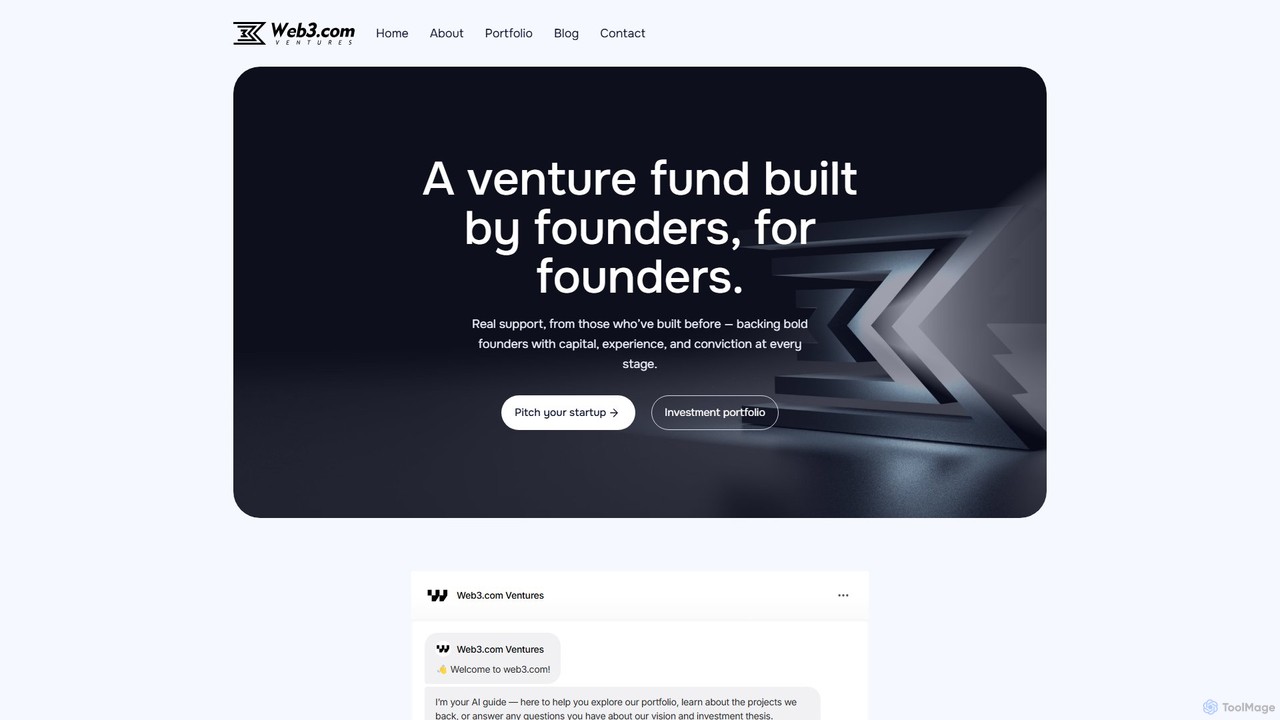
Web3.com Ventures
Web3.com Ventures is a founder-led venture capital firm that provides capital, experience, and strategic support to early-stage startups. …
Web3.com Ventures is a founder-led venture capital firm that provides capital, experience, and strategic support to early-stage startups. They focus on investing in foundational technologies across AI, decentralized infrastructure, and Zero-Knowledge (ZK) systems, aiming to back the next generation of internet builders.
About Web3 Infrastructure
Web3 Infrastructure tools are a category of services and platforms that provide the foundational building blocks for creating and deploying decentralized applications (dApps). These tools offer access to blockchain networks through APIs, abstracting away the complexity of running and maintaining individual nodes. This allows developers to focus on application logic and user experience rather than managing complex backend infrastructure. By providing reliable, scalable, and high-performance connections to blockchains, these tools accelerate the development lifecycle of Web3 projects.
Core Features
- Node as a Service (NaaS): Provides remote API access to blockchain nodes, eliminating the need for developers to run their own hardware.
- Smart Contract Development Kits (SDKs): Offers libraries and frameworks to simplify writing, testing, and deploying smart contracts.
- Data Indexing & Querying: Services that process and index blockchain data, making it fast and easy to query through APIs.
- Decentralized Storage APIs: Facilitates interaction with decentralized storage networks like IPFS or Arweave for storing off-chain data.
- Transaction Relay Services: Manages transaction broadcasting, handling complexities like gas fee estimation and nonce management for improved reliability.
Use Cases
These tools are essential for developers and teams building any type of on-chain application. This includes DeFi protocol developers requiring stable node connections for financial transactions, NFT marketplace creators needing to query token metadata and ownership, and DAO builders developing governance and voting systems based on smart contracts.
How to Choose
When selecting a Web3 Infrastructure tool, consider the specific blockchains it supports and its performance metrics like latency and uptime. Evaluate the quality of developer documentation and available SDKs. Also, review the pricing model—whether it's based on request volume or a subscription—and assess the provider's security practices and community reputation to ensure reliability for your application.
Web3 InfrastructureUse Cases
Building a DeFi Protocol
A development team creating a decentralized exchange (DEX) uses a Web3 infrastructure provider for reliable, low-latency API access to the Ethereum blockchain. This ensures that user transactions, such as swaps and liquidity provisions, are broadcasted to the network promptly. They also integrate oracle services via the infrastructure to fetch real-time price feeds for various crypto assets, which is critical for accurate trade execution and preventing arbitrage exploits. This setup allows the team to avoid the operational overhead of maintaining a synchronized, high-availability node cluster.
Launching an NFT Marketplace
An artist collective wants to launch an NFT marketplace. They use a Web3 infrastructure service that provides an NFT API. This allows their application to easily fetch metadata for all tokens in a collection, retrieve ownership data, and display transaction history without directly parsing complex blockchain data. When a user mints a new NFT, the application uses the provider's transaction relay service to ensure the transaction is processed reliably, even during periods of network congestion. This simplifies development and improves the end-user experience.
Developing a Decentralized Social Media App
A startup is building a decentralized social media platform where users control their data. They use infrastructure tools to interact with a decentralized storage network like IPFS for storing user posts and media. For user profiles and social graphs, they use a data indexing service to query relationships and activities on-chain efficiently. This hybrid approach, powered by Web3 infrastructure, allows them to build a scalable application that upholds the principles of user ownership and censorship resistance without having to build every component from scratch.
Creating a DAO Management Platform
A team is building a platform to help users create and manage Decentralized Autonomous Organizations (DAOs). The platform relies on a Web3 infrastructure provider to interact with smart contracts for proposal creation, voting, and treasury management. They use a reliable transaction broadcasting service to ensure that votes are submitted to the blockchain correctly. Additionally, they use an indexing service to provide a real-time dashboard of DAO activities, such as proposal statuses and voting results, by querying historical and current on-chain data without stressing their application's backend.
Integrating Web3 Wallets into a Web2 Application
A traditional mobile gaming company wants to add Web3 features, like token-gated content and in-game NFTs. They use a Web3 infrastructure provider's SDK to easily implement a "Connect Wallet" feature. This SDK handles the complexities of interacting with different wallet providers (like MetaMask or WalletConnect). The company can then use the provider's API to verify token ownership to grant access to exclusive content or to query a player's NFT inventory, bridging their existing Web2 game with the world of digital ownership without a complete architectural overhaul.
Powering Blockchain Data Analytics
A data analytics firm specializes in on-chain intelligence. Instead of running and maintaining archive nodes for multiple blockchains, which is resource-intensive, they use a Web3 infrastructure provider. They leverage high-throughput APIs to pull vast amounts of historical transaction data, wallet balances, and smart contract interaction logs. This data is then fed into their proprietary models to generate insights on DeFi trends, NFT market dynamics, and user behavior. This allows the firm to focus on its core competency—data analysis—while relying on the infrastructure provider for scalable and reliable data access.