Beezi
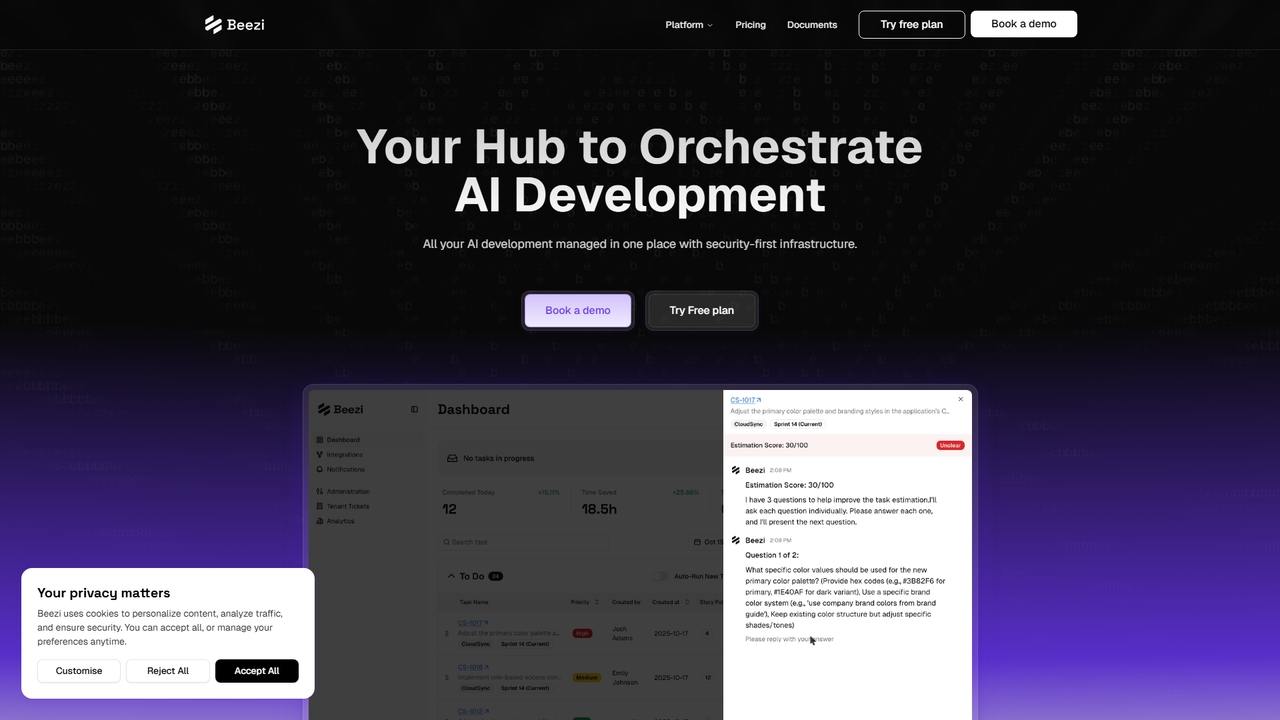
Orchestrate AI development in one place. Beezi integrates with GitHub, Jira, and Slack to plan, code, and ship …
Orchestrate AI development in one place. Beezi integrates with GitHub, Jira, and Slack to plan, code, and ship features with intelligent AI agents, smart model routing, and real-time analytics.
Gabber
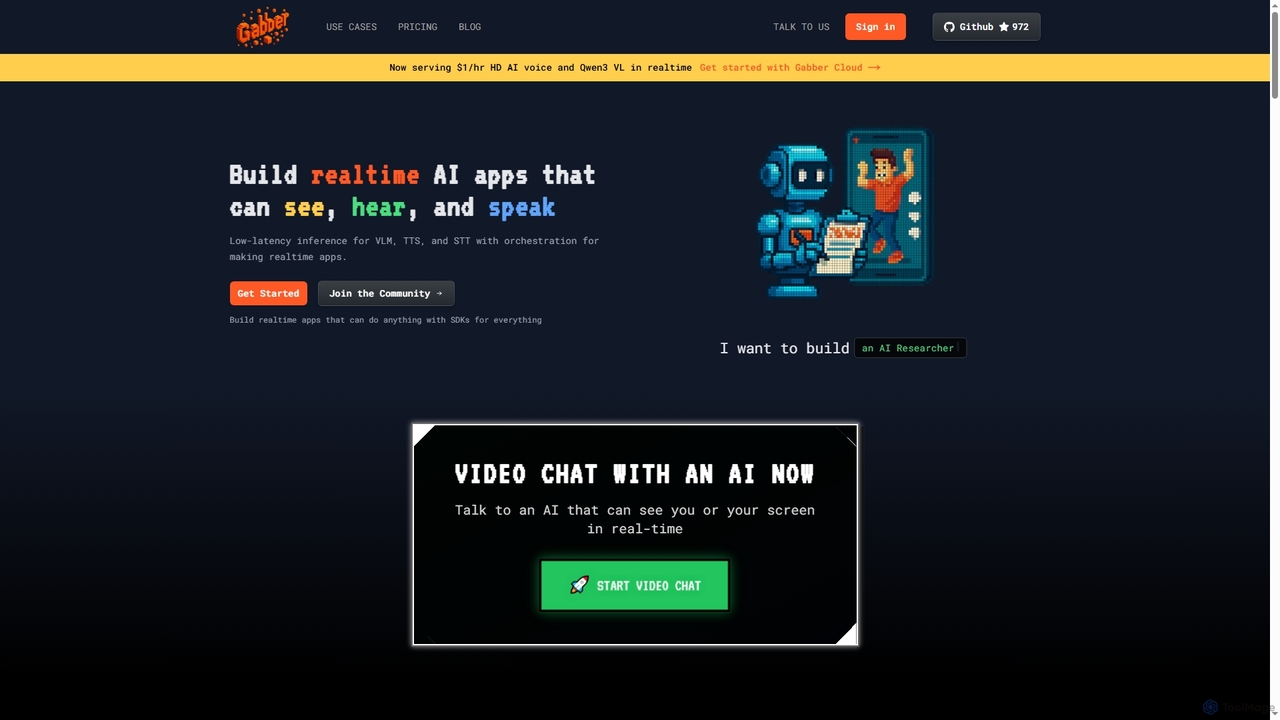
Gabber is a powerful platform for building real-time, multimodal AI applications that can see, hear, and speak. It …
Gabber is a powerful platform for building real-time, multimodal AI applications that can see, hear, and speak. It offers low-latency inference for Vision Language Models (VLM), Text-to-Speech (TTS), and Speech-to-Text (STT), coupled with a graph-based orchestration system for rapid development and deployment.
About Ai Orchestration
AI Orchestration tools are a class of development platforms designed to manage, coordinate, and automate complex AI workflows. These tools enable developers to integrate multiple AI models, services, and data pipelines into cohesive, scalable applications. By streamlining the deployment, monitoring, and interaction of diverse AI components, AI orchestration significantly enhances the efficiency and reliability of advanced AI system development. They are crucial for building sophisticated AI solutions that require seamless collaboration between various intelligent agents and data sources.
Core Features
- Workflow Automation: Automates the sequencing and execution of AI tasks, from data preprocessing to model inference and post-processing.
- Model Management: Centralizes the deployment, versioning, and lifecycle management of various AI models across different environments.
- Service Integration: Facilitates seamless connection and communication between disparate AI services, APIs, and external data sources.
- Resource Optimization: Dynamically allocates and manages computational resources for AI workloads, ensuring efficient performance and cost-effectiveness.
- Monitoring & Logging: Provides comprehensive insights into AI pipeline performance, errors, and resource utilization for proactive management.
Use Cases
AI orchestration is vital for developers and MLOps engineers building enterprise-grade AI applications. It's used in scenarios requiring the combination of multiple AI capabilities, such as a system that first uses an NLP model to extract entities, then a vision model to analyze related images, and finally a generative AI model to create a summary. This ensures consistent data flow and coordinated execution across the entire AI application lifecycle.
How to Choose
When selecting an AI orchestration tool, consider its compatibility with your existing AI models and infrastructure, the breadth of its integration capabilities with various AI services and data sources, and its scalability to handle growing workloads. Evaluate its ease of use for defining complex workflows, its monitoring and debugging features, and the level of support for MLOps practices like version control and CI/CD integration. Cost-effectiveness and community support are also important factors.

Ai OrchestrationUse Cases
Building Multi-Modal AI Applications
An AI engineer develops a customer support system that combines natural language processing (NLP) for text understanding, speech-to-text for voice input, and a knowledge graph for information retrieval. AI orchestration tools manage the sequential and parallel execution of these distinct AI models, ensuring smooth data flow from voice input to text processing, knowledge lookup, and generating a coherent response, thereby creating a unified and intelligent customer interaction experience.
Automating Complex Data Science Pipelines
A data scientist needs to automate a pipeline involving data ingestion, feature engineering using one AI model, training another predictive model, and deploying it for real-time inference. AI orchestration platforms define and execute this entire sequence, handling dependencies, error recovery, and resource allocation across different stages. This ensures consistent, reproducible, and efficient execution of complex machine learning workflows without manual intervention.
Scalable AI Model Deployment and Management
An MLOps team manages hundreds of AI models for various business units, each with different versioning, deployment, and scaling requirements. AI orchestration tools provide a centralized platform to deploy, monitor, and update these models efficiently. They automate canary deployments, A/B testing, and rollback procedures, ensuring high availability and performance while minimizing operational overhead for a large portfolio of AI services.
Real-time AI-Powered Decision Systems
A financial institution implements an AI system for real-time fraud detection that integrates transaction data analysis, anomaly detection models, and customer behavior prediction. AI orchestration ensures that data flows instantly through multiple AI components, from initial data capture to risk scoring and alert generation, all within milliseconds. This coordinated execution allows for immediate decision-making and proactive intervention against fraudulent activities.
Personalized Content Recommendation Engines
An e-commerce platform aims to provide highly personalized product recommendations by combining user browsing history, purchase patterns, and real-time inventory data. AI orchestration tools manage the complex interplay of collaborative filtering models, content-based recommendation algorithms, and dynamic pricing engines. They ensure that relevant data is fed to the correct models in sequence, generating tailored recommendations that adapt to user preferences and inventory changes.
Intelligent Automation for Business Processes
An enterprise seeks to automate a complex business process, such as invoice processing, which involves optical character recognition (OCR) for data extraction, an NLP model for classification, and a rules engine for validation. AI orchestration coordinates these distinct AI and rule-based components, guiding the invoice through each stage. This reduces manual effort, accelerates processing times, and improves accuracy by ensuring each AI component performs its task in the correct order.