Bucket
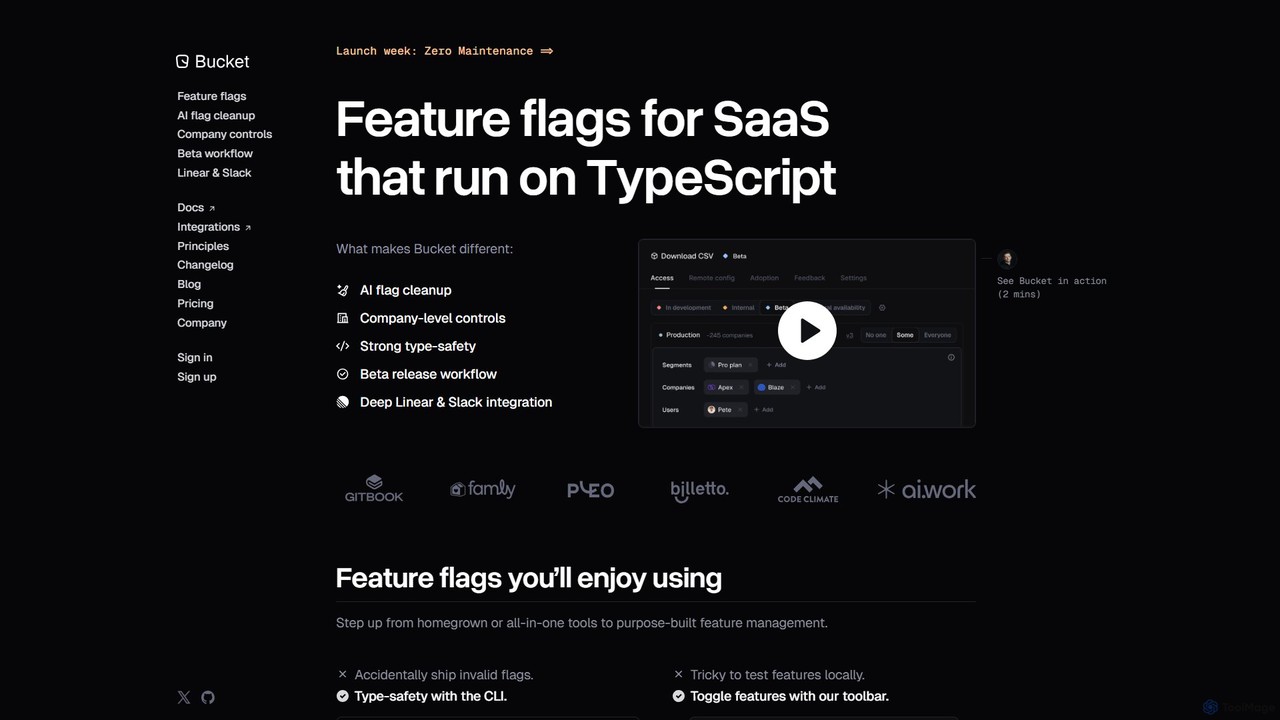
Bucket is an AI-powered feature flagging platform for SaaS companies, built on TypeScript. It streamlines feature management with …
Bucket is an AI-powered feature flagging platform for SaaS companies, built on TypeScript. It streamlines feature management with AI-driven cleanup of stale flags, company-level controls, and deep integrations with developer tools like Linear and Slack. It enables safe testing in production, manages beta releases, and gathers user feedback efficiently, enhancing the developer experience and accelerating the shipping process.
About Feature Management
Feature Management tools are a class of intelligent solutions designed to control the lifecycle and delivery of software features. These tools enable developers and product teams to decouple code deployment from feature release, allowing for dynamic control over which features are visible to specific user segments. By leveraging techniques like feature flags and remote configuration, they facilitate safe experimentation, phased rollouts, and instant kill switches, significantly reducing deployment risks and accelerating product iteration.
Core Features
- Feature Flags/Toggles: Dynamically enable or disable features for specific users or groups without redeploying code.
- A/B Testing & Experimentation: Run controlled experiments to compare different feature versions and gather data-driven insights.
- Phased Rollouts: Gradually release new features to a small percentage of users before a full launch.
- Kill Switches: Instantly turn off problematic features in production to prevent widespread issues.
- User Segmentation: Target features to specific user demographics, subscription tiers, or behavioral groups.
Applicable Scenarios
Feature Management is essential for agile development teams, product managers, and DevOps engineers aiming for continuous delivery and rapid iteration. It's used in scenarios requiring controlled feature releases, personalized user experiences, and data-driven product decisions across web, mobile, and backend applications.
How to Choose
When selecting a Feature Management tool, consider its integration capabilities with your existing CI/CD pipelines and development stack. Evaluate its support for advanced user segmentation, A/B testing, and analytics. Look for robust security features, scalability, and an intuitive interface that simplifies feature flag management and experimentation setup.

Feature ManagementUse Cases
Gradual Feature Rollout for New Functionality
A product team wants to launch a major new feature but minimize risk. Using a Feature Management tool, they deploy the code to production but initially enable the feature only for internal employees. After successful internal testing, they gradually roll it out to 5% of beta users, then 20%, and finally to all users, monitoring performance and feedback at each stage. This controlled release prevents widespread issues and allows for quick adjustments.
A/B Testing UI/UX Variations
An e-commerce company wants to optimize its checkout flow. They use Feature Management to create two different versions of the checkout button (e.g., color, text) and expose them to different user segments. The tool tracks conversion rates for each variation, allowing the product team to identify which design performs better based on real user data, leading to improved user experience and sales.
Emergency Kill Switch for Critical Bugs
During a peak traffic period, a critical bug is discovered in a newly released payment gateway integration. Instead of rushing a hotfix or rolling back the entire deployment, the operations team uses the Feature Management tool's kill switch to instantly disable the problematic payment option. This prevents further customer impact while developers work on a permanent solution, maintaining system stability.
Personalizing User Experiences by Subscription Tier
A SaaS platform offers different features based on subscription plans (Free, Pro, Enterprise). With Feature Management, the platform can dynamically enable or disable specific functionalities for users based on their current subscription tier. This ensures that users only see and access features relevant to their plan, simplifying the user interface and facilitating upsell opportunities without code changes for each tier.
Decoupling Deployment from Release in CI/CD
A DevOps team practices continuous integration and continuous delivery (CI/CD). They use Feature Management to deploy new code to production multiple times a day, even if features are not yet ready for release. Feature flags keep these features hidden until product managers decide to activate them. This allows developers to merge code frequently, reducing integration issues and enabling faster, more flexible release cycles.
Targeted Beta Testing for Specific User Segments
A mobile app developer wants to gather feedback on an experimental feature from a specific group of power users or users in a particular region. Feature Management tools allow them to target this new feature only to those predefined user segments. This ensures that feedback is collected from the most relevant audience, enabling focused iteration and preventing the feature from impacting the general user base prematurely.