Development Best in category 1 results Frameworks & Libraries AI Tool

Popular AI tools in the Frameworks & Libraries field of Development include React, etc., helping you quickly improve efficiency.

Free
React

React

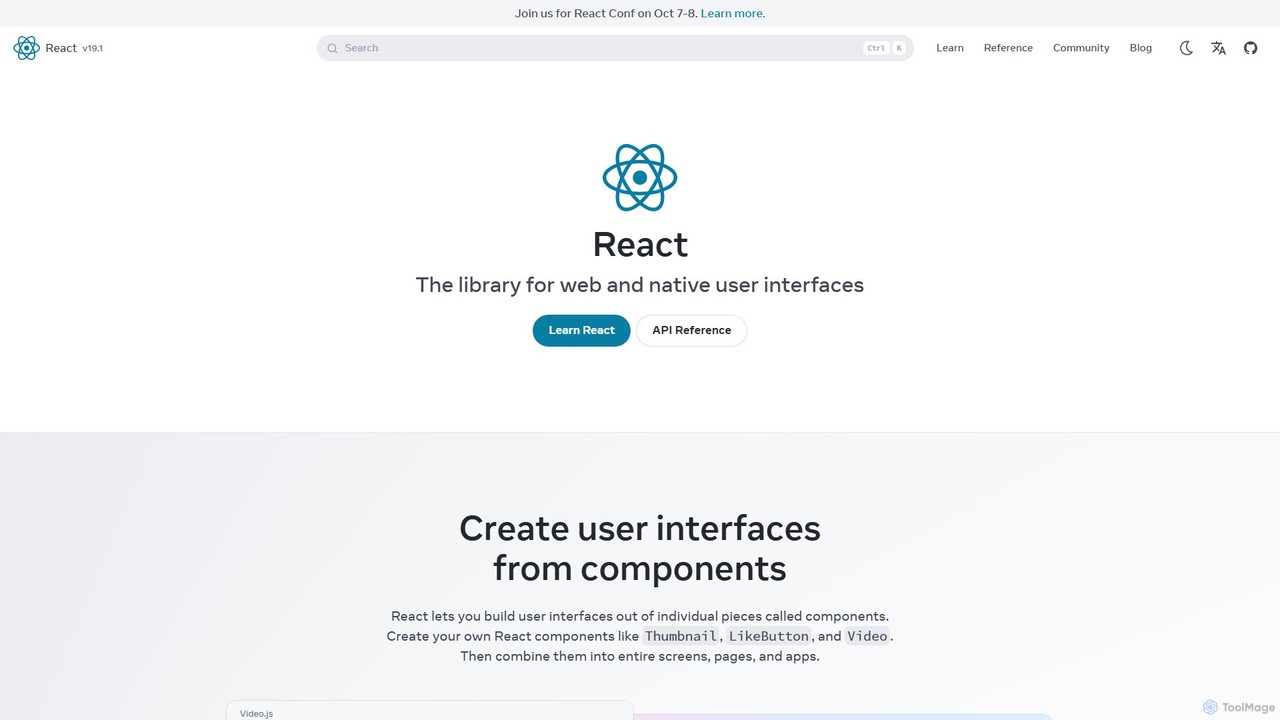
React is a free and open-source JavaScript library for building user interfaces based on components. Developed by Meta, …

2.0M

About Frameworks & Libraries

AI Frameworks & Libraries are foundational collections of pre-written code that provide developers with the essential building blocks to create, train, and deploy artificial intelligence models. They operate by offering high-level APIs and optimized modules that abstract away complex mathematical computations and hardware interactions. This enables developers to build sophisticated AI applications, such as natural language processing systems or computer vision models, with significantly less effort and code. These tools are crucial for accelerating the AI development lifecycle, from rapid prototyping to production-scale deployment.

Core Features

  • Pre-built Models & Algorithms: Provides access to state-of-the-art neural network architectures and machine learning algorithms that can be readily used or fine-tuned.
  • High-Level APIs: Offers simplified interfaces for complex tasks like model definition, training loops, and data processing, making AI development more accessible.
  • Automatic Differentiation: Automatically calculates gradients for model parameters, a critical function for training deep learning models via backpropagation.
  • Hardware Acceleration Support: Includes built-in optimizations for running computations on GPUs and TPUs, drastically reducing training and inference times.
  • Extensible Architecture: Allows developers to create custom layers, models, and functions, offering the flexibility needed for research and specialized applications.

Use Cases

AI Frameworks & Libraries are primarily used by software developers, machine learning engineers, data scientists, and academic researchers. They are essential in technology companies for building AI-powered product features, in research labs for experimenting with new model architectures, and in startups for rapidly developing AI-driven minimum viable products (MVPs). Common applications include creating custom chatbots, developing object detection systems for autonomous vehicles, and building personalized recommendation engines.

How to Choose

When selecting an AI framework or library, consider several key factors. Evaluate the ecosystem and community support, as a larger community means more tutorials and third-party tools. Assess its primary use case; some are better for production (e.g., TensorFlow), while others excel in research and flexibility (e.g., PyTorch). Consider the programming language, with Python being the most common. Finally, analyze the quality of documentation and the learning curve, especially for teams new to AI development.

Frameworks & LibrariesUse Cases

1

Build a Custom LLM Application for Internal Q&A

A software development team at a large enterprise needs to create a chatbot that can accurately answer employee questions based on internal documentation, such as HR policies and technical guides. Instead of building from scratch, they use a framework like LangChain. The framework provides tools to connect a powerful large language model (LLM) to their private document repository. Developers use its modules to handle document loading, text splitting, embedding creation, and vector storage. The result is a secure, context-aware chatbot that significantly reduces the time HR and IT support spend on repetitive inquiries.

2

Develop a Computer Vision Model for Quality Control

A manufacturing company wants to automate defect detection on its production line. A machine learning engineer uses a deep learning library like PyTorch or TensorFlow to build a custom image classification model. They leverage the library's tools for data augmentation to expand their limited dataset of defect images. They then define a convolutional neural network (CNN) architecture using the library's pre-built layers and train the model on company servers equipped with GPUs. The trained model is then deployed to a camera system on the assembly line, identifying defective products in real-time with high accuracy.

3

Create a Personalized Recommendation Engine

An e-commerce platform aims to increase user engagement and sales by providing personalized product recommendations. A data scientist on the team uses a library like Scikit-learn, which offers a wide range of classical machine learning algorithms. They use it to preprocess user behavior data, such as clicks and purchases. Then, they implement a collaborative filtering algorithm available in the library to find similar users and recommend products. The library's straightforward API allows for rapid experimentation with different algorithms and parameters, leading to an effective recommendation model that is integrated into the website's homepage.

4

Rapid Prototyping of a New AI Feature

A startup wants to quickly test the viability of a new text summarization feature in their productivity app. A developer uses a high-level library like Hugging Face Transformers. This library provides direct access to thousands of pre-trained models with just a few lines of code. The developer can implement a functional prototype in a single afternoon by loading a pre-trained summarization model and integrating it into their application's backend. This allows the team to gather user feedback and validate the feature's value without investing months in training a model from scratch.

5

Academic Research and Experimentation with Neural Networks

A university researcher is developing a novel neural network architecture for climate modeling. They choose a flexible framework like JAX, known for its high-performance capabilities and functional programming paradigm. The framework's features, such as automatic vectorization and just-in-time (JIT) compilation, allow the researcher to write clean, Pythonic code that runs efficiently on TPUs. They can easily implement custom mathematical operations and experiment with complex model structures, accelerating the research cycle and enabling them to publish their findings on a new, more efficient modeling approach.

6

Deploying Scalable AI Services as APIs

An MLOps engineer is tasked with deploying a newly trained fraud detection model into production. The model needs to handle thousands of requests per second with low latency. The engineer uses a tool like TensorFlow Serving, which is designed specifically for this purpose. They package the trained model into a deployable format and configure the serving system to run on a cluster of servers. TensorFlow Serving automatically handles request batching to optimize GPU usage and provides a standardized API endpoint (like REST or gRPC). This allows other microservices within the company to easily integrate the fraud detection capability without needing to understand the model's internal complexity.

Frameworks & LibrariesFrequently Asked Questions