Development Best in category 1 results Infrastructure AI Tool

Popular AI tools in the Infrastructure field of Development include Myple, etc., helping you quickly improve efficiency.

Myple

Myple

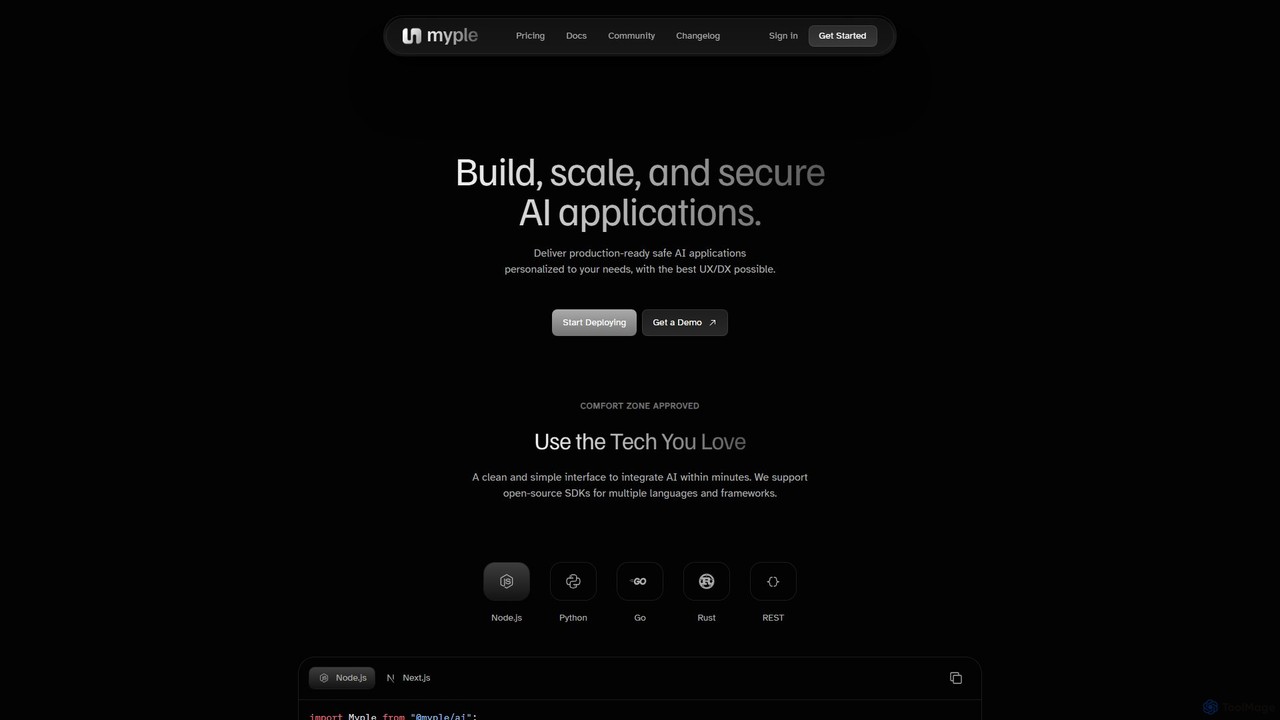
Myple is a comprehensive platform for developers to build, scale, and secure production-ready AI applications. It offers a …

2.3K

About Infrastructure

AI Infrastructure tools provide the foundational hardware and software platforms for building, deploying, and managing machine learning models at scale. They offer access to specialized computing resources like GPUs, along with MLOps frameworks for streamlining the entire AI lifecycle. These platforms are essential for developers and businesses looking to move beyond pre-built APIs and create custom, high-performance AI applications. They enable efficient model training, reliable inference serving, and robust operational management.

Core Features

  • Scalable Model Deployment: Deploy models as secure, auto-scaling API endpoints for production use.
  • GPU Resource Management: Access and manage on-demand specialized hardware for intensive training and inference tasks.
  • MLOps & Lifecycle Management: Automate workflows including experiment tracking, model versioning, and continuous integration/deployment (CI/CD).
  • Vector Database Integration: Support or integrate with vector databases for building advanced semantic search and RAG applications.

Use Cases

AI Infrastructure is critical for tech companies, research labs, and enterprises building custom AI solutions. It's used to deploy proprietary fraud detection models, host large language models for internal knowledge bases, and power real-time recommendation engines on e-commerce platforms.

How to Choose

When selecting an AI Infrastructure tool, evaluate its scalability and performance for your expected workload. Consider the supported frameworks (e.g., PyTorch, TensorFlow), the comprehensiveness of its MLOps features, and the pricing model (pay-as-you-go vs. subscription). Also, assess the level of control versus ease of use to match your team's technical expertise.

InfrastructureUse Cases

1

Deploying a Custom LLM for Enterprise Search

A data science team uses an AI infrastructure platform to deploy a fine-tuned open-source LLM. They containerize the model, configure an auto-scaling GPU cluster, and expose it as a private API. This allows the company's internal knowledge base to offer powerful semantic search capabilities, enabling employees to find precise information in vast document repositories, improving productivity and reducing information retrieval time.

2

Scaling a Generative AI SaaS Application

A startup building an AI-powered video generation tool relies on an infrastructure provider to manage inference workloads. As user demand fluctuates, the platform automatically scales the number of active GPUs up or down. This ensures a responsive user experience during peak hours and minimizes costs during quiet periods, providing a cost-effective and reliable backend for their core product.

3

Managing the Machine Learning Lifecycle (MLOps)

An ML engineering team implements an MLOps platform to bring rigor to their model development process. They use it to track every experiment, version datasets and models, and automate the retraining and deployment pipeline. This creates a reproducible and auditable workflow, accelerating the time from model prototype to production-ready system while ensuring quality and governance.

4

Building a Real-Time Recommendation Engine

An e-commerce company uses a managed infrastructure service to host its recommendation model. The service provides low-latency inference, ensuring that personalized product suggestions are delivered to users instantly as they browse the site. The platform handles the complexities of server management and scaling, allowing the development team to focus solely on improving the recommendation algorithm.

5

Fine-Tuning Models on Sensitive Data

A healthcare organization needs to fine-tune a language model on private patient data. They choose a secure AI infrastructure provider that offers virtual private cloud (VPC) deployments and compliance with regulations like HIPAA. This allows them to leverage powerful AI capabilities for tasks like clinical note summarization while maintaining strict data privacy and security.

6

Powering a Vector Search System for a Q&A Bot

A developer is building an advanced Q&A chatbot that uses Retrieval-Augmented Generation (RAG). They use an infrastructure platform that includes a managed vector database. The platform handles the ingestion, indexing, and efficient querying of millions of text embeddings, providing the fast and accurate retrieval component needed for the RAG pipeline to generate relevant, context-aware answers.

InfrastructureFrequently Asked Questions