
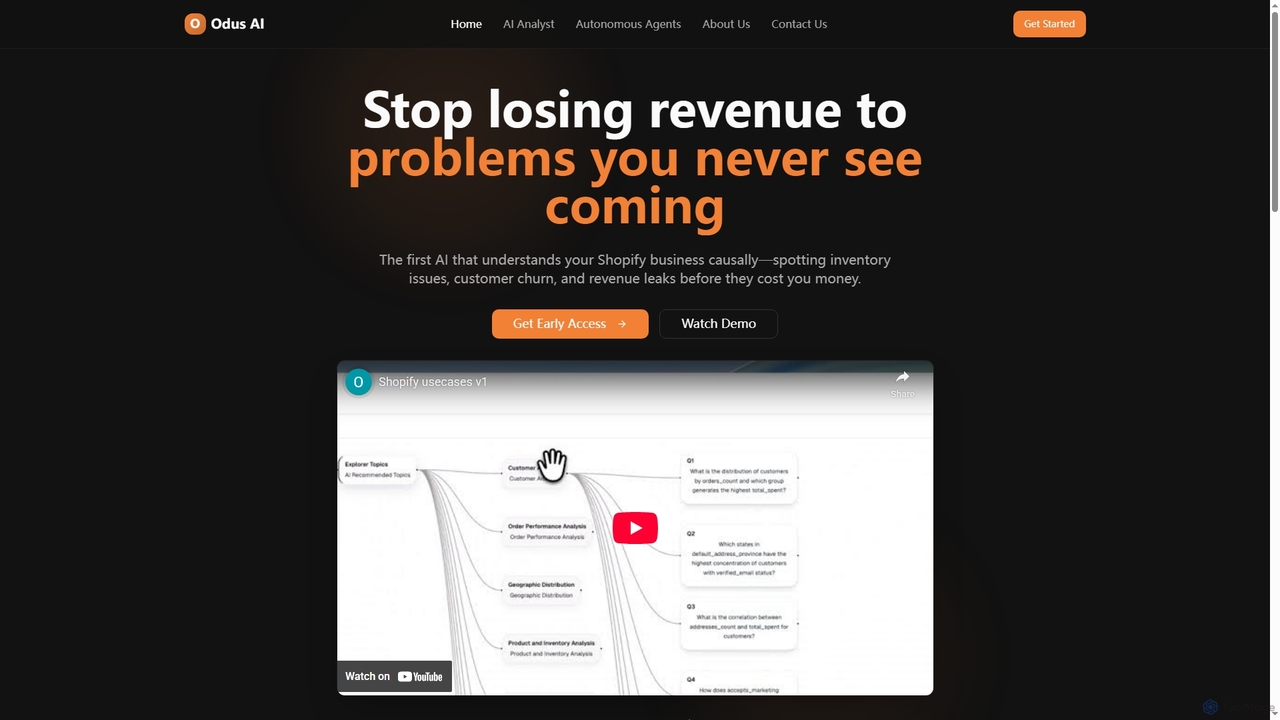
Best 3 Analytics AI tools for E Commerce
Popular Analytics AI tools in E Commerce include 42signals, Odus, and Heyario, helping you work more efficiently.

Paid
Heyario
Heyario is an API that enables businesses to access customers' consented, item-level purchase history from any website. It provides deep insights into real buying behavior to power hyper-personalized marketing, reduce returns, and increase customer lifetime value.
Customer Data PlatformVisits 4.9KFavorites 103Likes 109
Paid
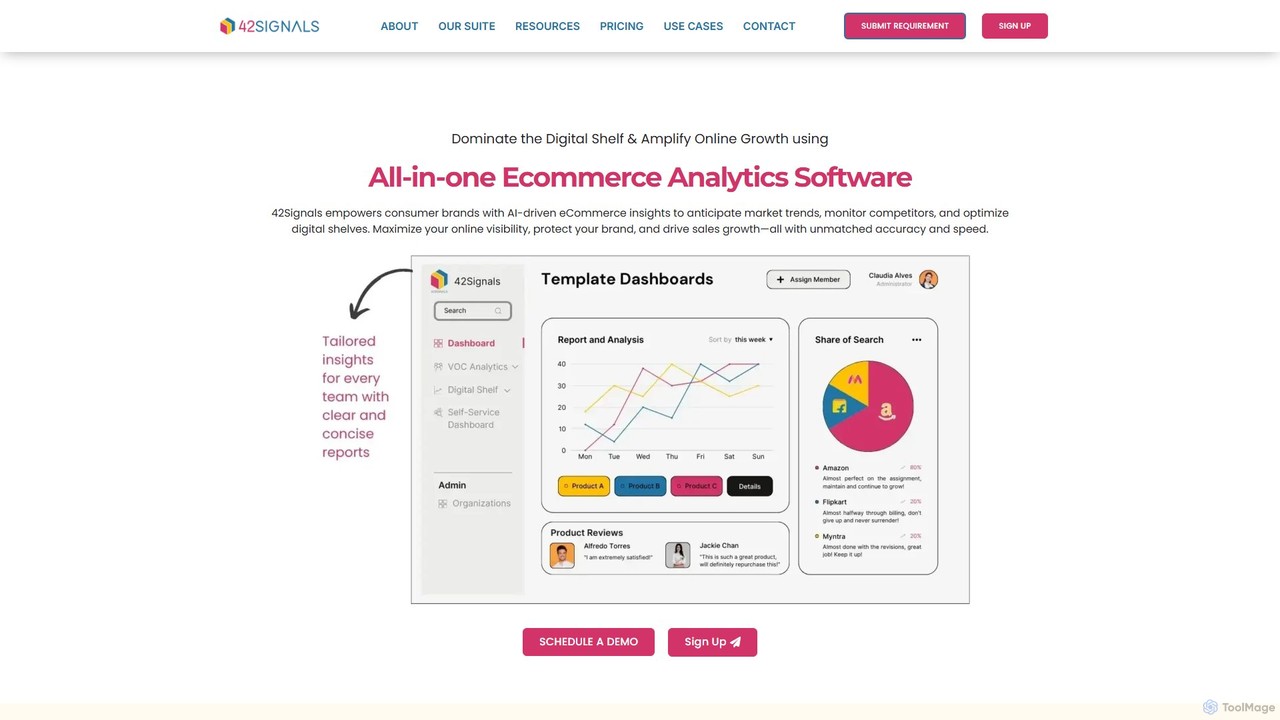
42signals
42signals is an AI-powered, all-in-one eCommerce analytics platform designed for consumer brands. It provides real-time insights into digital shelf performance, competitor strategies, customer sentiment, and pricing. The tool helps businesses optimize online visibility, protect brand integrity, and accelerate sales growth through data-driven intelligence.
Business IntelligenceVisits 29.3KFavorites 107Likes 99
About Analytics
AI Analytics tools for e-commerce leverage machine learning and artificial intelligence to process vast datasets, providing actionable insights for online businesses. These tools analyze customer behavior, sales trends, inventory, and marketing performance to optimize operations and drive growth. They enable businesses to move beyond descriptive reporting to predictive forecasting and prescriptive recommendations, enhancing decision-making across the entire e-commerce value chain.
Core Features
- Predictive Modeling: Forecasts future sales, demand, and customer behavior with high accuracy.
- Customer Segmentation: Automatically groups customers based on purchasing patterns and demographics for targeted marketing.
- Fraud Detection: Identifies and flags suspicious transactions or activities in real-time to prevent losses.
- Inventory Optimization: Recommends optimal stock levels and reorder points to minimize carrying costs and prevent stockouts.
- Personalized Recommendations: Delivers tailored product suggestions to individual customers, improving conversion rates.
Use Cases
E-commerce businesses utilize AI Analytics to gain a competitive edge. Retailers employ these tools for dynamic pricing adjustments based on market conditions, while marketing teams use them to optimize ad spend by attributing sales to specific campaigns. Operations managers leverage AI for precise demand forecasting, ensuring efficient supply chain management and reducing waste.
How to Choose
When selecting an AI Analytics tool for e-commerce, consider its data integration capabilities with existing platforms (CRM, ERP), the accuracy and explainability of its predictive models, and its real-time processing abilities. Evaluate the level of customization offered, scalability to handle growing data volumes, and the clarity of its reporting dashboards. Finally, assess the vendor's support and the tool's compliance with data privacy regulations.
Analytics use cases
1
Personalized Product Recommendations
An e-commerce platform uses AI analytics to analyze a customer's browsing history, past purchases, and interactions. The system then generates highly personalized product recommendations, displaying them on the homepage, product pages, or in email campaigns. This leads to increased engagement, higher average order values, and improved conversion rates by showing customers exactly what they are most likely to buy.
2
Dynamic Pricing Optimization
E-commerce retailers employ AI analytics to continuously monitor market demand, competitor pricing, inventory levels, and customer behavior. The AI model then dynamically adjusts product prices in real-time to maximize revenue and profit margins. This allows businesses to respond quickly to market fluctuations, clear excess stock, or capitalize on high-demand periods, ensuring optimal pricing strategies without manual intervention.
3
Customer Churn Prediction and Retention
An e-commerce business uses AI analytics to identify customers at high risk of churning (stopping purchases). The AI analyzes factors like purchase frequency, last purchase date, browsing patterns, and customer service interactions. Based on these predictions, the business can proactively engage at-risk customers with targeted offers, personalized communications, or loyalty programs, significantly improving customer retention rates and lifetime value.
4
Fraud Detection in E-commerce Transactions
Online retailers face constant threats from fraudulent transactions. AI analytics tools continuously monitor and analyze vast amounts of transaction data, including payment methods, IP addresses, shipping locations, and purchase patterns. The AI identifies anomalies and suspicious behaviors that deviate from normal customer activity, flagging potential fraud in real-time. This proactive detection helps prevent financial losses, chargebacks, and protects customer trust without slowing down legitimate transactions.
5
Inventory Demand Forecasting
E-commerce businesses leverage AI analytics to accurately forecast future product demand. By analyzing historical sales data, seasonality, promotional impacts, external market trends, and even weather patterns, AI models predict which products will be in demand and when. This enables precise inventory planning, reducing overstocking costs, minimizing stockouts, and optimizing warehouse operations for greater efficiency and profitability.
6
Marketing Campaign Performance Analysis
Marketing teams in e-commerce use AI analytics to gain deep insights into the performance of their campaigns across various channels. The AI attributes sales and conversions to specific marketing touchpoints, channels, and campaigns, providing a clear understanding of ROI. This allows marketers to optimize their budget allocation, refine targeting strategies, and improve the effectiveness of future campaigns by focusing on what truly drives results.
Related categories
Analytics FAQ
What are AI Analytics tools for E-commerce?
AI Analytics tools for e-commerce are software solutions that use artificial intelligence and machine learning algorithms to collect, process, and interpret vast amounts of data from online stores. They go beyond traditional reporting by identifying patterns, predicting future trends, and offering prescriptive recommendations to optimize various aspects of an e-commerce business, from customer behavior to inventory management and marketing effectiveness.
How do AI Analytics differ from traditional analytics in E-commerce?
Traditional e-commerce analytics primarily focus on descriptive reporting, showing what happened in the past (e.g., sales figures, website traffic). AI analytics, however, leverage advanced algorithms to not only describe but also predict and prescribe. They can forecast future sales, identify customer churn risks, and recommend specific actions (e.g., dynamic pricing, personalized offers), often in real-time and at a scale impossible for manual analysis, providing deeper, more actionable insights.
What are the key benefits of using AI Analytics in E-commerce?
Implementing AI analytics in e-commerce offers several significant benefits. It leads to improved decision-making through data-driven insights, increased revenue by optimizing pricing and personalization, and reduced operational costs through efficient inventory management and fraud detection. Furthermore, it enhances the customer experience with tailored recommendations and proactive support, ultimately boosting customer loyalty and competitive advantage in a dynamic market.
What data sources do AI Analytics tools typically use in E-commerce?
AI Analytics tools for e-commerce typically integrate and analyze a wide array of data sources. These include transactional data (purchase history, order values), customer behavior data (website clicks, browsing patterns, cart abandonment), marketing campaign data (ad impressions, conversions), inventory data (stock levels, supplier information), and external data (market trends, competitor pricing, social media sentiment, weather). Combining these diverse datasets allows for a holistic and accurate view of the e-commerce ecosystem.
How to choose the best AI Analytics tool for an E-commerce business?
Choosing the best AI Analytics tool involves evaluating several factors. Prioritize tools with robust data integration capabilities that connect seamlessly with your existing e-commerce platforms (e.g., Shopify, Magento, CRM, ERP). Assess the accuracy and explainability of its predictive models, ensuring you understand how insights are generated. Consider real-time processing, scalability for future growth, and the clarity of its dashboards. Finally, compare pricing models, vendor support, and compliance with data privacy regulations relevant to your region.