Varos
Varos is an AI-powered competitive intelligence platform that provides real-time, anonymized benchmarks for e-commerce marketing. It enables businesses …
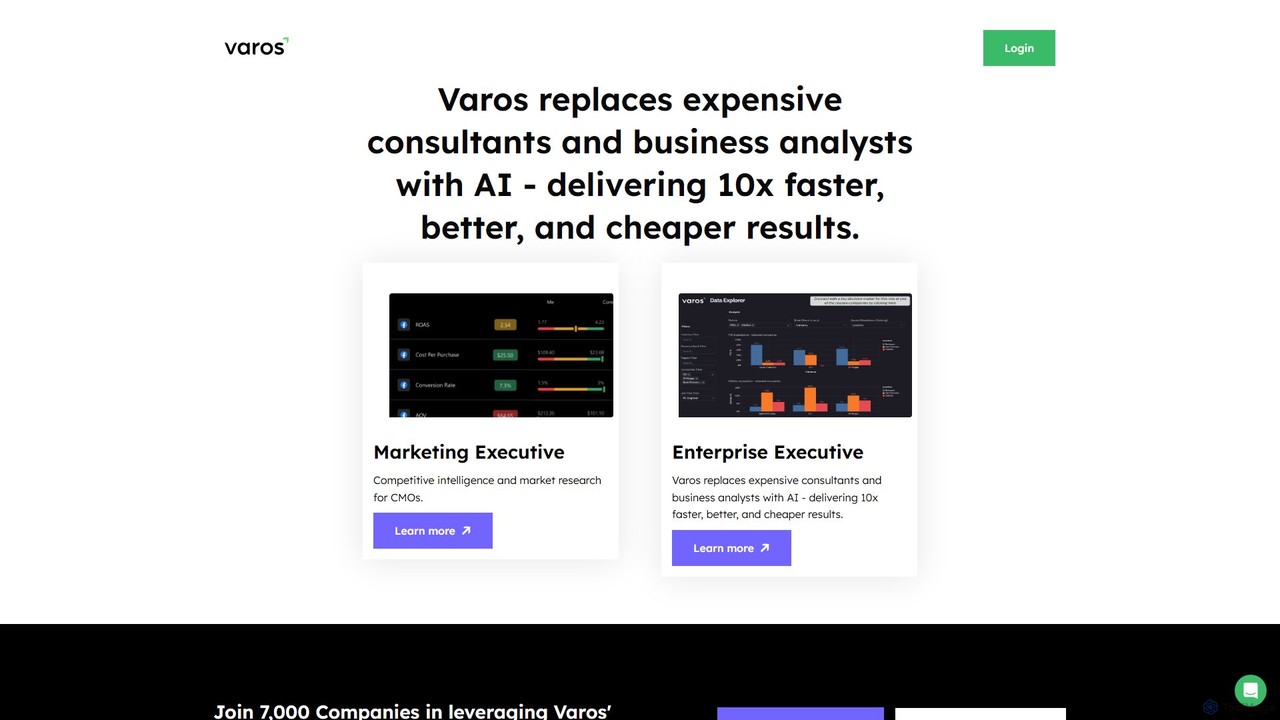
Varos is an AI-powered competitive intelligence platform that provides real-time, anonymized benchmarks for e-commerce marketing. It enables businesses to compare their performance metrics across Shopify, Meta, Google, and TikTok Ads against industry peers, replacing expensive consultants with data-driven insights.
About Benchmarking
AI Benchmarking tools for ecommerce are a specialized category of software designed to automatically collect, analyze, and compare your business performance against competitors. These tools leverage AI and machine learning to process vast amounts of public data, such as pricing, product assortments, marketing campaigns, and customer reviews. By providing actionable competitive intelligence, they empower ecommerce businesses to make data-driven decisions, identify market opportunities, and refine their strategies. This continuous analysis helps businesses maintain a competitive edge in a dynamic online marketplace.
Core Features
- Competitor Price Tracking: Automatically monitors and analyzes competitors' pricing strategies, promotions, and stock levels in real-time.
- Product Assortment Analysis: Compares your product catalog against rivals to identify gaps, overlaps, and trending products.
- Marketing Campaign Monitoring: Tracks competitors' advertising, social media presence, and promotional activities to uncover their marketing tactics.
- Performance Indexing: Creates composite scores or indexes to benchmark your brand's overall performance against a set of competitors on various metrics.
- Customer Sentiment Analysis: Aggregates and analyzes customer reviews from competitor sites to gauge public perception and identify service weaknesses.
Use Cases
These tools are essential for ecommerce managers, pricing analysts, marketing strategists, and product managers. They are used to formulate dynamic pricing strategies, discover new product opportunities by analyzing market gaps, and gain insights into successful competitor marketing campaigns to inform their own promotional calendar. For instance, a brand can track a competitor's new product launch and subsequent customer feedback to decide whether to enter that market segment.
How to Choose
When selecting an AI Benchmarking tool, consider the scope and accuracy of the data sources. Evaluate its ability to track the specific competitors and regions relevant to your business. Assess the granularity of the analytics and the customizability of reports. Also, consider its integration capabilities with your existing ecommerce platforms (like Shopify or Magento) and the level of customer support provided.

BenchmarkingUse Cases
Optimize Dynamic Pricing Strategies
An ecommerce pricing analyst uses an AI benchmarking tool to continuously monitor the prices of top 5 competitors for their 100 best-selling products. The tool's AI algorithm identifies pricing patterns and recommends optimal price adjustments in real-time. This allows the company to maintain competitive pricing, maximize profit margins on less price-sensitive items, and increase sales volume by up to 15% without manually tracking competitor websites.
Identify Product Assortment Gaps
A product manager for an online fashion retailer uses a benchmarking tool to analyze the product catalogs of three key competitors. The tool identifies that competitors are successfully selling a line of sustainable activewear, a category missing from their own store. Based on this data-backed insight, the manager launches a new activewear collection, which becomes a top-performing category within six months, capturing a new customer segment.
Analyze Competitor Marketing Campaigns
A marketing team for a consumer electronics brand uses a benchmarking tool to track the social media ad campaigns and promotional offers of their main rival. The tool reveals that the rival's 'free shipping on all orders' promotion generated a 30% higher engagement rate than their own '10% off' campaign. This insight prompts the team to A/B test shipping-based offers, leading to a more effective promotional strategy and a 20% increase in conversion rates during the next sales event.
Benchmark Website User Experience
A UX designer for an online furniture store wants to improve their checkout process. They use a benchmarking tool to analyze the checkout flows of leading competitors, tracking metrics like the number of steps, required form fields, and available payment options. The analysis highlights that their checkout requires three more steps than the industry average. By simplifying their process based on these findings, they reduce cart abandonment by 18%.
Monitor Share of Voice in the Market
A brand manager wants to understand their brand's visibility compared to competitors. They use an AI benchmarking tool that tracks brand mentions across social media, news sites, and forums. The dashboard shows their 'share of voice' is 15%, while a key competitor holds 35%. The tool also identifies that the competitor is frequently mentioned in popular tech blogs. This insight guides the PR team to focus their outreach on tech publications, successfully increasing their share of voice by 10% in the next quarter.
Analyze Customer Reviews and Sentiment
An ecommerce operations manager uses a benchmarking tool to aggregate and analyze customer reviews for their products and those of a direct competitor. The AI-powered sentiment analysis reveals that while their product quality is rated higher, customers frequently complain about slow shipping. In contrast, the competitor receives praise for next-day delivery. This leads to a strategic review of their logistics partners, resulting in a new partnership that reduces average delivery time by 48 hours and boosts customer satisfaction scores.