tak.chat
tak.chat is an AI-powered chatbot designed for e-commerce businesses to automate customer support. By integrating with your store's …
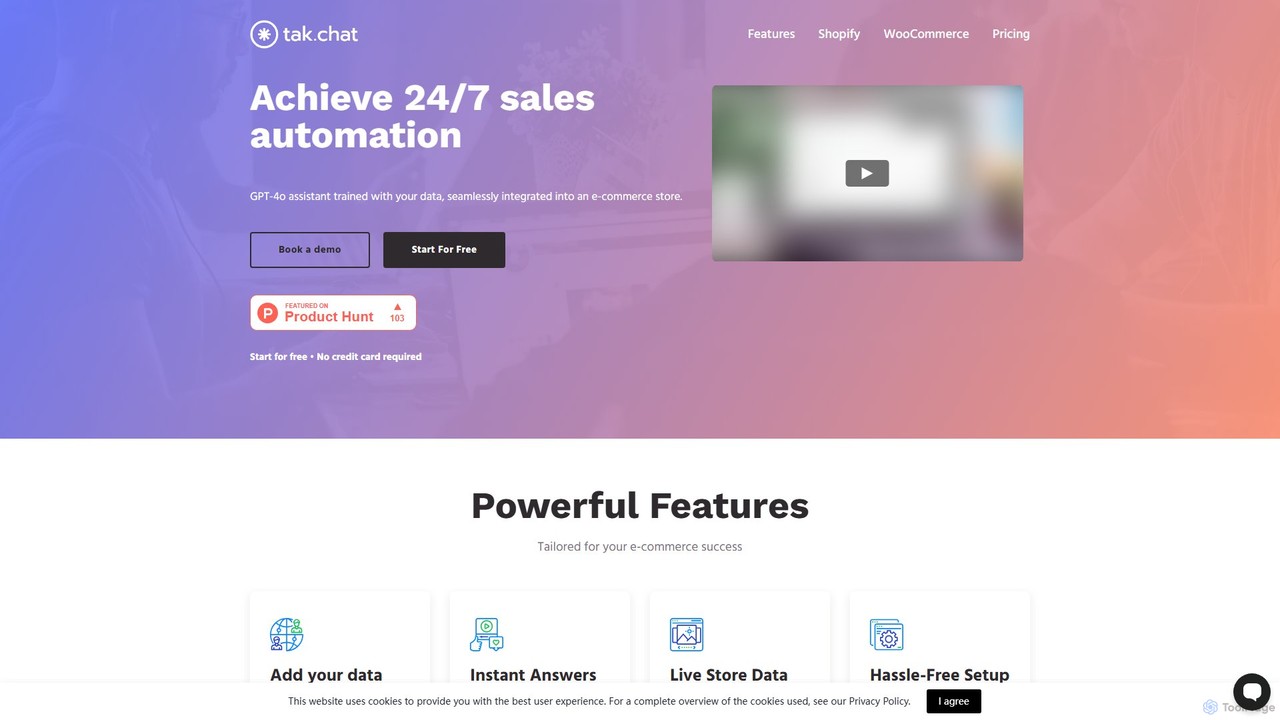
tak.chat is an AI-powered chatbot designed for e-commerce businesses to automate customer support. By integrating with your store's live data, it provides instant answers to queries about products, orders, and policies. This helps resolve up to 70% of support questions, reducing workload and enhancing the customer experience. The platform offers a hassle-free setup, custom branding, and flexible plans, including a free starter option, making it accessible for stores of all sizes.
About Store Assistant
Store Assistant tools are specialized AI applications designed to automate and personalize the customer experience within an e-commerce environment. Leveraging Natural Language Processing (NLP) and machine learning, these assistants simulate human-like conversations to guide users, answer product questions, and facilitate purchases. They act as virtual sales associates, available 24/7 to increase engagement, boost conversion rates, and provide instant support. Unlike general chatbots, they are deeply integrated with product catalogs and customer data to offer highly relevant interactions.
Core Features
- Personalized Product Recommendations: Analyzes user behavior and preferences to suggest relevant products, increasing upsell and cross-sell opportunities.
- 24/7 Automated Customer Support: Instantly answers common questions about shipping, returns, product details, and order status, reducing the load on human agents.
- Shopping Cart Assistance: Proactively engages users to prevent cart abandonment by offering help, clarifying doubts, or providing discount codes.
- Guided Selling & Navigation: Asks qualifying questions to help customers find the right products, simplifying the discovery process in large catalogs.
- Order Tracking & Management: Allows customers to check their order status or initiate returns directly within the chat interface.
Applicable Scenarios
These tools are primarily used by online retailers, from small Shopify stores to large enterprise e-commerce platforms. E-commerce managers and customer support teams deploy them to handle high volumes of customer inquiries efficiently. They are particularly effective in industries like fashion, electronics, and cosmetics, where customers often require guidance and personalized recommendations to make a purchasing decision.
Selection Criteria
When choosing a Store Assistant, consider its integration capabilities with your e-commerce platform (e.g., Shopify, WooCommerce, Magento). Evaluate the level of customization for conversation flows and branding. Assess the sophistication of its AI, particularly its ability to understand user intent and provide accurate recommendations. Also, review the analytics dashboard for insights into customer interactions and conversion performance.

Store AssistantUse Cases
Automating Responses to Common Customer Queries
An online fashion retailer's support team is overwhelmed with repetitive questions about sizing, shipping policies, and return procedures. By implementing an AI Store Assistant, they automate responses to these FAQs 24/7. The assistant accesses a knowledge base to provide instant, accurate answers. This frees up human agents to focus on complex issues like custom orders or escalated complaints, reducing response times by over 80% and improving overall customer satisfaction.
Guiding Shoppers to the Right Product
A large electronics store offers hundreds of similar products, causing choice paralysis for customers. Their AI Store Assistant acts as a virtual sales expert. It asks customers a series of questions like 'What is your budget?', 'Are you a gamer?', or 'Do you need a lightweight laptop for travel?'. Based on the answers, it filters the extensive catalog and presents a curated list of 2-3 top recommendations. This guided selling process simplifies decision-making, increases conversion rates, and enhances the user experience.
Reducing Shopping Cart Abandonment
An online cosmetics store notices a high cart abandonment rate. They configure their AI Store Assistant to trigger when a user shows exit intent (e.g., moving the cursor towards the close button) with items in their cart. The assistant proactively pops up with a message like, 'Hi! Did you have any questions about your items? I can offer you free shipping on this order.' This timely intervention helps address last-minute hesitations, clarifies shipping costs, and provides an incentive to complete the purchase, successfully recovering a significant percentage of potentially lost sales.
Providing Post-Purchase Order Tracking
After making a purchase, customers frequently contact support to ask, 'Where is my order?'. An e-commerce business integrates its Store Assistant with its shipping and logistics system. Now, customers can simply open the chat widget, enter their order number, and receive real-time tracking information, including current location and estimated delivery date. This self-service option significantly reduces the number of support tickets related to order status, improves the post-purchase experience, and builds customer trust.
Upselling and Cross-selling with Personalized Recommendations
A customer adds a high-end digital camera to their cart. The AI Store Assistant, integrated with the product catalog, immediately suggests relevant accessories. It displays a message like, 'Great choice! Photographers who bought this camera also recommend this memory card for high-speed shooting and this protective case.' By analyzing purchasing patterns and product relationships, the assistant effectively cross-sells complementary items, increasing the average order value without being intrusive.
Collecting Customer Feedback and Reviews
An online retailer wants to increase the number of product reviews on their site. They program their Store Assistant to contact customers via email or chat a week after their order has been delivered. The assistant initiates the conversation by asking about their experience with the product and then provides a simple, direct link to leave a review. This automated and personalized approach to feedback collection feels less intrusive than generic email blasts and significantly boosts the volume of user-generated content, which in turn helps future shoppers make informed decisions.