
ToolMage
Sign in

Best 1 Continuing Education AI tools for Education

Popular Continuing Education AI tools in Education include OpenEvidence, helping you work more efficiently.

OpenEvidence
Free

OpenEvidence

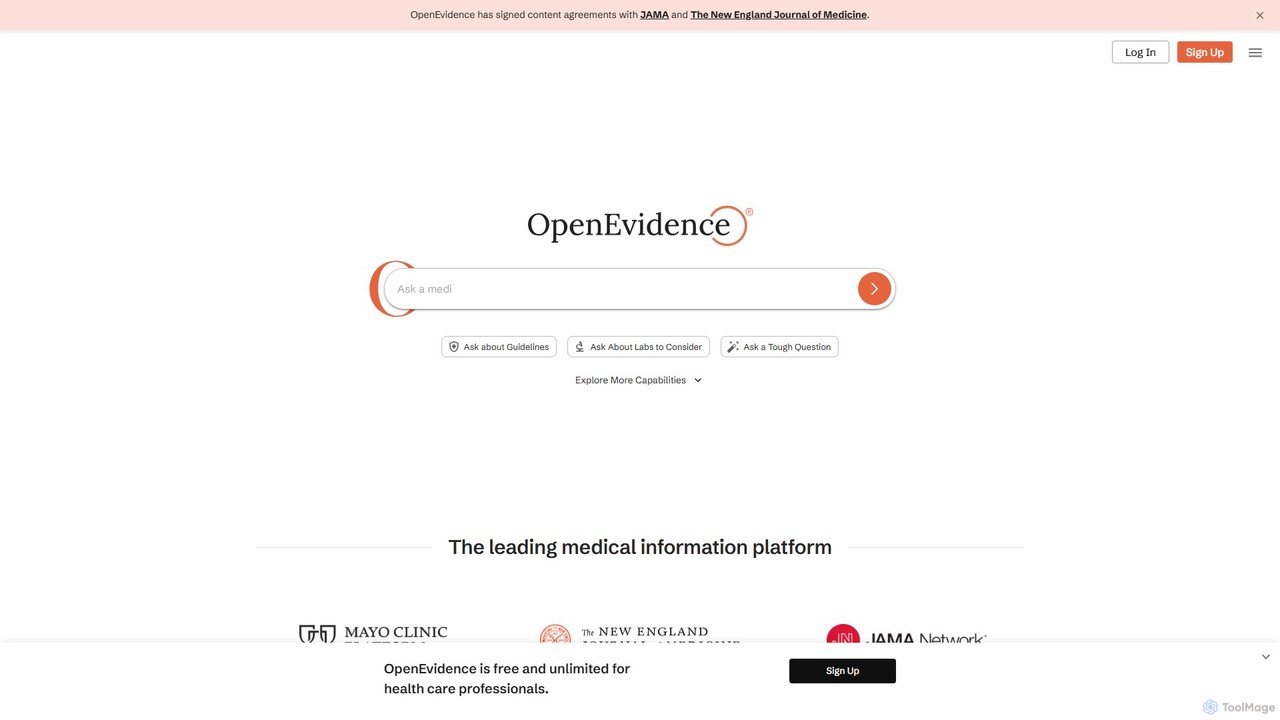
OpenEvidence is a leading AI-powered medical information platform designed for healthcare professionals. It synthesizes vast medical literature from top-tier sources like NEJM and JAMA to provide instant, evidence-based answers for clinical decision-making. The platform is HIPAA compliant, offers CME credits, and is free for verified U.S. healthcare providers.

Continuing Education
Visits 11.4MFavorites 121Likes 126

About Continuing Education

Continuing Education AI tools are platforms that leverage artificial intelligence to personalize and enhance lifelong learning experiences for adults. These tools utilize adaptive learning algorithms, content recommendation engines, and intelligent tutoring systems to cater to individual learning paces and styles. They empower professionals and individuals to acquire new skills, update knowledge, and achieve career growth efficiently, serving as a dynamic extension of the broader education sector.

Core Features

  • Adaptive Learning Paths: AI analyzes learner performance and preferences to dynamically adjust course content and difficulty, ensuring optimal engagement and retention.
  • AI-Powered Content Curation: Automatically recommends relevant courses, articles, videos, and resources based on a learner's goals, progress, and industry trends.
  • Intelligent Tutoring Systems: Provides personalized feedback, answers questions, and offers explanations in real-time, simulating a human tutor to guide learners.
  • Skill Gap Analysis: Identifies specific knowledge or skill deficiencies and suggests targeted learning modules to address them, facilitating focused development.
  • Progress Tracking & Analytics: Offers detailed insights into learning progress, completion rates, and areas needing improvement for both individuals and organizations.

Use Cases

These tools are invaluable for professionals seeking to upskill or reskill, organizations aiming to enhance employee capabilities, and individuals pursuing personal development. They support continuous professional development (CPD) across various industries, from tech and healthcare to finance and creative arts, by providing flexible and effective learning solutions.

How to Choose

When selecting a Continuing Education AI tool, consider the breadth and quality of its content library, the sophistication of its personalization engine, and its integration capabilities with existing learning management systems. Evaluate the user interface for ease of navigation, the types of certifications offered, and the pricing model to ensure it aligns with your learning objectives and budget.

Continuing Education use cases

1

Personalized Skill Development for Career Advancement

A marketing professional aiming for a senior role uses an AI continuing education platform to identify specific skill gaps in advanced digital analytics and leadership. The platform then curates a tailored curriculum of micro-courses, case studies, and interactive simulations, allowing the professional to acquire necessary competencies efficiently and demonstrate readiness for promotion.

2

Corporate Upskilling and Compliance Training

A large enterprise implements an AI continuing education solution to provide its workforce with ongoing training in cybersecurity best practices and new software tools. The AI system tracks individual progress, identifies areas of weakness across departments, and automatically assigns relevant modules, ensuring all employees meet compliance standards and stay updated with critical industry knowledge, reducing training costs by 30%.

3

Personal Enrichment and Hobby Learning

An individual passionate about photography uses an AI continuing education app to learn advanced editing techniques and composition theory. The AI suggests tutorials, provides feedback on uploaded photos, and recommends courses from renowned photographers, enabling the user to master new skills at their own pace and significantly improve their craft without formal classroom settings.

4

Academic Refresher and Advanced Studies

A university graduate preparing for a master's program uses an AI continuing education tool to review foundational concepts in their field, such as advanced mathematics or research methodologies. The AI identifies specific areas where knowledge is rusty and provides targeted refreshers and practice problems, ensuring the student is well-prepared for the rigor of postgraduate studies.

5

Certification and License Renewal

Healthcare professionals, such as nurses or doctors, utilize AI continuing education platforms to fulfill mandatory continuing medical education (CME) credits for license renewal. The AI tracks completed courses, suggests relevant new research and clinical updates, and provides interactive quizzes to ensure knowledge retention, streamlining the compliance process and saving administrative time.

6

Bridging Skill Gaps for Career Transition

An individual transitioning from a traditional industry to a tech-focused role uses an AI continuing education tool to quickly acquire foundational coding skills and data analysis knowledge. The AI identifies the most efficient learning path based on their existing background and target role, providing accelerated modules and practical projects that significantly reduce the time needed for a successful career pivot.

Continuing Education FAQ

What are AI Continuing Education tools?

AI Continuing Education tools are platforms that use artificial intelligence to deliver personalized and adaptive learning experiences for adults. They focus on skill development, knowledge updates, and professional growth, differing from traditional education by offering highly customized learning paths and real-time feedback. These tools leverage AI to analyze learner data, recommend relevant content, and provide intelligent tutoring, making lifelong learning more efficient and engaging.

How do AI Continuing Education tools personalize learning?

AI Continuing Education tools personalize learning by analyzing a learner's past performance, current knowledge gaps, learning style, and career goals. Based on this data, the AI dynamically adjusts the curriculum, recommends specific resources, and modifies the difficulty of exercises. This adaptive approach ensures that each learner receives content and support tailored to their individual needs, optimizing their learning journey and maximizing retention.

Who benefits most from AI Continuing Education tools?

Professionals seeking to upskill or reskill, individuals pursuing personal development, and organizations aiming to enhance employee capabilities benefit most. This includes those in rapidly evolving fields like technology, healthcare, and finance, where continuous learning is crucial. AI tools are particularly valuable for self-directed learners, busy professionals needing flexible schedules, and companies requiring scalable, personalized training solutions for their workforce.

How do AI Continuing Education tools differ from traditional online courses?

AI Continuing Education tools offer a more dynamic and personalized experience compared to traditional online courses. While traditional courses often follow a fixed curriculum, AI tools adapt content, pace, and feedback based on individual learner progress and preferences. They provide intelligent tutoring, real-time skill gap analysis, and proactive content recommendations, leading to more efficient learning outcomes and higher engagement than a one-size-fits-all approach.

What are the key benefits of using AI for continuing education?

The key benefits include highly personalized learning paths, increased engagement through adaptive content, and efficient skill gap identification. AI tools offer flexible, on-demand access to learning, making it easier for busy professionals to fit education into their schedules. They also provide real-time feedback and intelligent tutoring, leading to faster skill acquisition and improved knowledge retention, ultimately enhancing career prospects and organizational performance.