ToolMage
Sign in

Best 4 Mathematics AI tools for Education

Popular Mathematics AI tools in Education include Mathify, mathhandwrit, MathWibe, and AI MathGPT, helping you work more efficiently.

MathWibe
Freemium

MathWibe

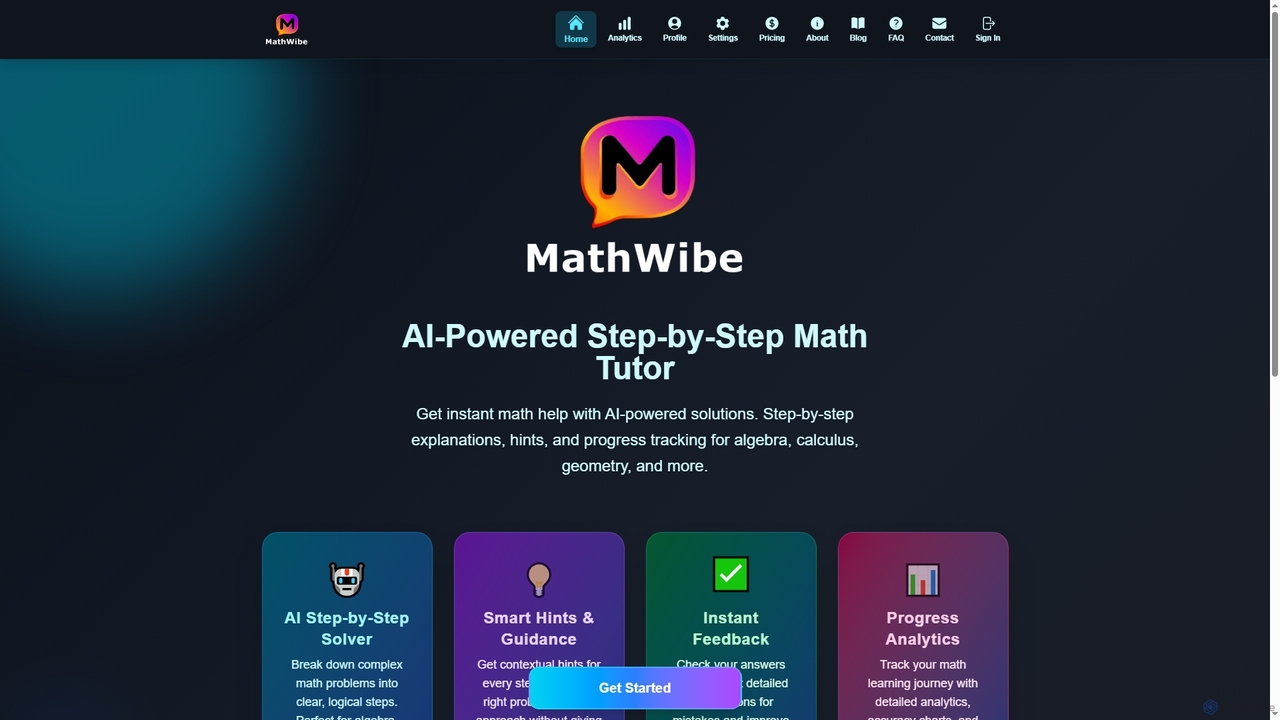
MathWibe is an AI-powered step-by-step math tutor designed to provide instant, interactive help for students. It breaks down complex problems, offers smart hints, instant feedback, and tracks progress across various math subjects, fostering genuine understanding and improved skills.

Mathematics
Visits 4.7KFavorites 101Likes 103
Mathify
Freemium

Mathify

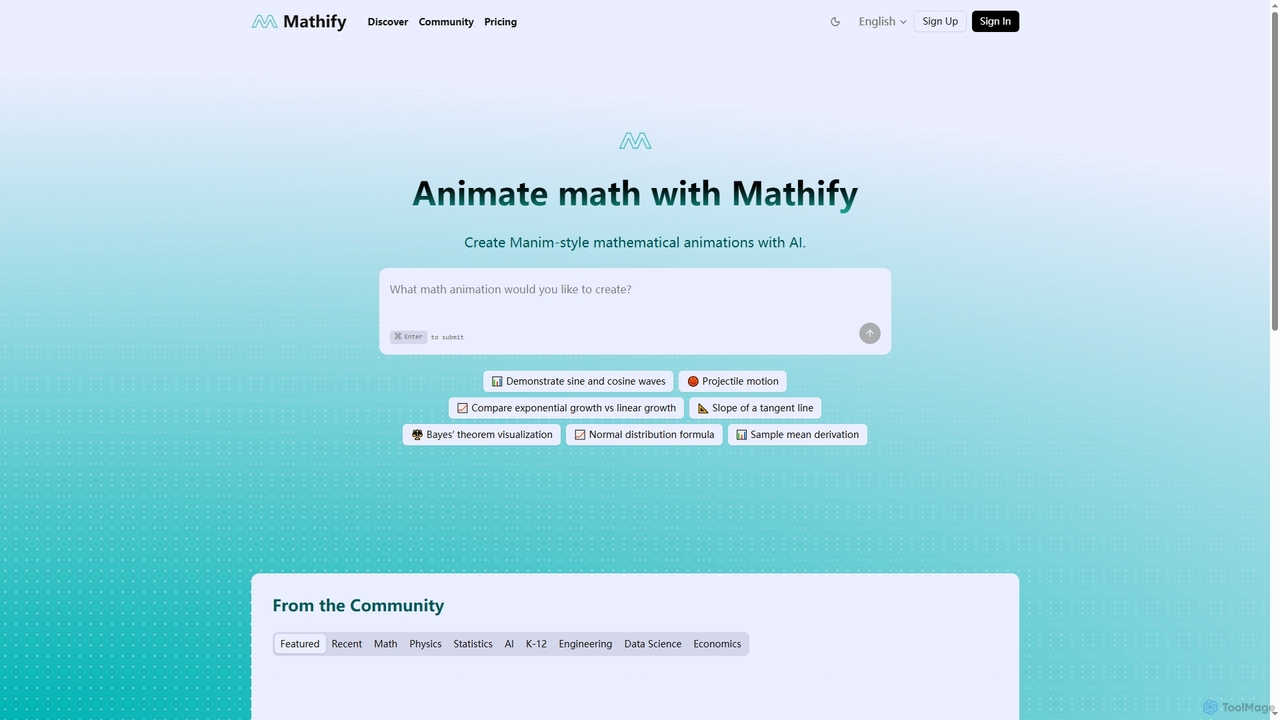
Mathify is an AI-powered tool that simplifies the creation of Manim-style mathematical animations. It enables users to visualize complex mathematical and scientific concepts, making abstract ideas more accessible for education, research, and content creation.

Ai Development Tools
Visits 6.2KFavorites 107Likes 99
AI MathGPT
Freemium

AI MathGPT

AI MathGPT is your 24/7 AI-powered math tutor. Powered by advanced models like Llama3 and OpenAI o1, it provides instant, step-by-step solutions and clear explanations for complex math problems. Designed for students and parents, it aims to transform math frustration into confidence and improve academic performance.

Homework Help
Visits 4.7KFavorites 136Likes 134
mathhandwrit
Freemium

mathhandwrit

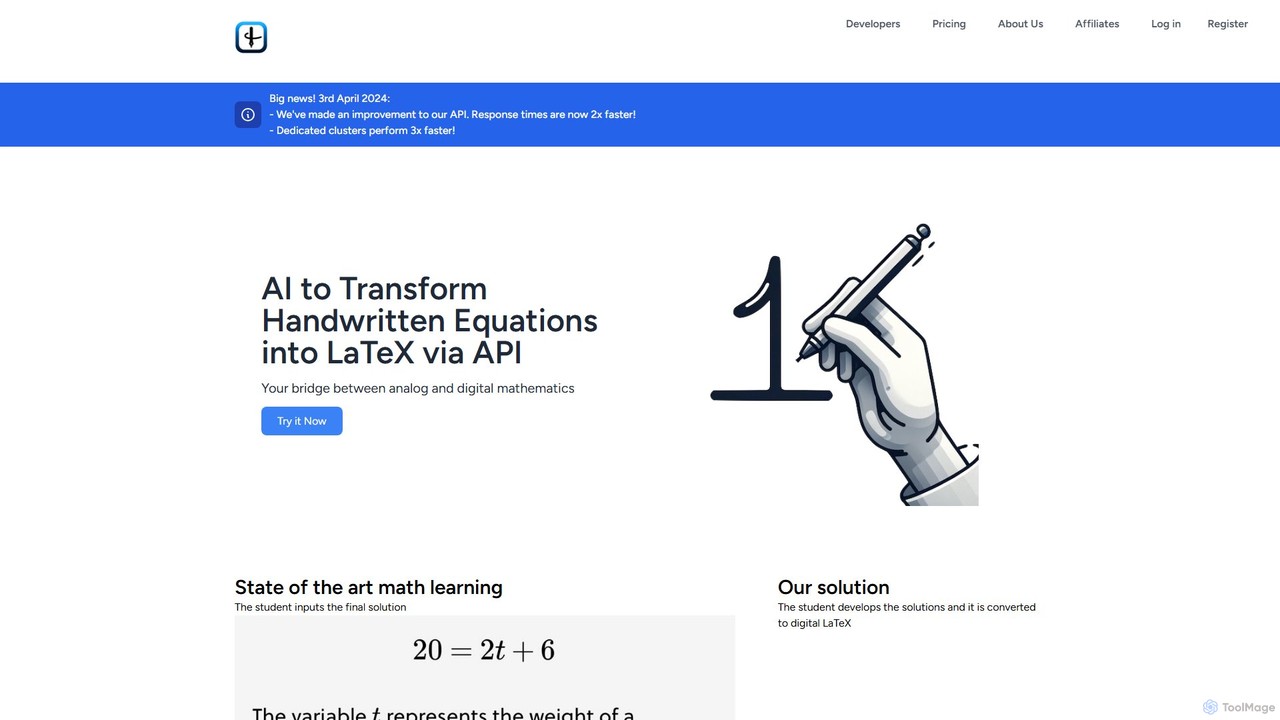
An AI-powered API that transforms handwritten mathematical equations into clean, digital LaTeX code. Designed for developers, educators, and students, it bridges the gap between analog and digital mathematics with high accuracy and speed, simplifying the process of digitizing complex formulas.

Api
Visits 5.3KFavorites 125Likes 112

About Mathematics

AI Mathematics tools are specialized applications designed to solve complex mathematical problems, visualize concepts, and provide step-by-step explanations. As a key part of modern AI-driven education, these tools leverage machine learning and computational algorithms to interpret everything from simple arithmetic to advanced calculus. They serve as powerful assistants for students, educators, and professionals, transforming abstract equations into understandable, interactive visuals and logical steps. This approach not only provides answers but also deepens conceptual understanding.

Core Features

  • Step-by-Step Problem Solving: Breaks down complex problems into sequential, easy-to-understand steps, explaining the logic behind each one.
  • Equation Recognition (OCR): Uses a device's camera to scan and interpret handwritten or printed mathematical expressions for instant solving.
  • Interactive Graphing: Generates dynamic 2D and 3D graphs of functions and data sets, allowing users to manipulate variables and explore relationships.
  • Symbolic Computation: Performs algebraic manipulations on symbolic expressions, solving equations without numerical values.
  • Personalized Learning Paths: Adapts the difficulty and type of problems based on a user's performance to target areas needing improvement.

Use Cases

These tools are widely used in academic settings from middle school to university for homework help, exam preparation, and concept exploration. In professional fields, engineers, data scientists, and researchers use them for complex modeling, data analysis, and verifying calculations, significantly speeding up their workflow. They are also valuable for self-learners who want to master mathematical concepts at their own pace.

How to Choose

When selecting an AI Mathematics tool, consider the scope of mathematical subjects it covers (e.g., algebra, calculus, statistics). Evaluate its input methods—whether it supports typing, photo scanning (OCR), or voice input. The quality and clarity of its step-by-step explanations are crucial for learning. Finally, assess its graphing and visualization capabilities, as interactive models can greatly enhance understanding.

Mathematics use cases

1

Assisting with University-Level Calculus Homework

A university student studying engineering is stuck on a complex integration problem for their calculus homework. Instead of spending hours frustrated, they use an AI Mathematics tool. They take a photo of the handwritten problem using their phone. The tool instantly recognizes the integral, solves it, and provides a detailed, step-by-step solution. The student can review each step, from applying integration by parts to simplifying the final expression, helping them understand the methodology rather than just getting the answer. This process turns a potential roadblock into a valuable learning opportunity.

2

Visualizing 3D Functions for Classroom Teaching

A high school math teacher wants to explain the concept of multivariable functions and their 3D surfaces, which is difficult to draw on a whiteboard. Using an AI Mathematics tool with interactive graphing capabilities, the teacher inputs a function like z = sin(x) * cos(y). The tool instantly renders a dynamic 3D graph on the classroom projector. The teacher can then rotate, zoom, and pan the graph in real-time to show students different perspectives, cross-sections, and how changing variables affects the surface shape. This visual and interactive approach makes an abstract topic concrete and engaging for students.

3

Verifying Engineering Calculations

An aerospace engineer is working on stress analysis for a new component, which involves complex differential equations. A manual calculation error could be costly and time-consuming. To ensure accuracy, the engineer inputs the equations into an AI Mathematics tool with a symbolic computation engine. The tool not only solves the equations but also allows the engineer to check intermediate steps and assumptions. This process serves as a reliable second check, validating the manual work in minutes instead of hours and increasing confidence in the final design specifications before moving to physical prototyping.

4

Personalized Practice for Standardized Tests

A student is preparing for the math section of a standardized test like the SAT or GRE. They are strong in algebra but struggle with geometry. Using an AI Mathematics tool with adaptive learning features, the student takes an initial diagnostic test. The AI identifies their weak areas and creates a personalized study plan. It then generates a series of geometry problems, starting with fundamental concepts and gradually increasing in difficulty as the student's performance improves. This targeted practice is more efficient than randomly solving problems, helping the student build confidence and master difficult topics before the exam.

5

Exploring Mathematical Proofs

A mathematics undergraduate is studying number theory and needs to understand the steps of a complex proof. They use an AI tool that specializes in formal verification and proof assistance. The student inputs the theorem and the initial steps of the proof. The AI tool can then validate each logical step, highlight potential fallacies, and even suggest the next logical deduction based on established axioms and theorems. This interactive exploration helps the student deconstruct the proof into manageable parts, fostering a deeper understanding of abstract logical reasoning than simply reading it from a textbook.

6

Rapid Statistical Analysis for Research

A social sciences researcher has collected survey data and needs to perform statistical analysis, such as t-tests and regressions, but is not an expert in statistical software like R or SPSS. They use an AI Mathematics tool that supports data analysis. The researcher uploads their dataset as a CSV file. Using natural language commands like "run a linear regression of income on education level," the tool performs the analysis, generates summary tables, and creates visualizations like scatter plots. This lowers the technical barrier, allowing the researcher to focus on interpreting the results and drawing conclusions rather than wrestling with complex syntax.

Mathematics FAQ

What are AI Mathematics tools?

AI Mathematics tools are software applications that use artificial intelligence to solve mathematical problems and explain the underlying concepts. Unlike basic calculators, they can interpret complex equations (including handwritten ones via OCR), provide detailed step-by-step solutions, perform symbolic algebra, and create interactive 2D/3D visualizations. They function as both powerful calculators and personal tutors, designed to assist students, educators, and professionals in understanding and applying mathematical principles.

How to choose the right AI Mathematics tool?

To choose the right tool, consider these four factors:

  • Subject Coverage: Ensure the tool supports the specific branch of mathematics you need, whether it's algebra, calculus, statistics, or linear algebra.
  • Input Method: Decide if you need a tool that can scan handwritten problems (OCR), or if typing equations using a standard or LaTeX editor is sufficient.
  • Explanation Quality: If your goal is learning, look for tools that provide clear, comprehensive, and easy-to-follow step-by-step solutions, not just the final answer.
  • Advanced Features: Determine if you require extra capabilities like interactive 2D/3D graphing, symbolic computation, or data analysis functionalities.
What's the difference between an AI Mathematics tool and a standard calculator?

The primary difference is in capability and purpose. A standard calculator performs numerical computations and provides a single answer. An AI Mathematics tool goes much further: it acts as a problem-solver and a tutor. It can understand complex algebraic expressions, solve for variables, provide detailed step-by-step explanations of the solution process, and visualize functions with interactive graphs. While a calculator gives you the 'what' (the answer), an AI tool also gives you the 'how' and 'why' (the method and concept).

Can AI Mathematics tools solve word problems?

Yes, many advanced AI Mathematics tools can solve word problems. They use Natural Language Processing (NLP) to read and interpret the text, identify the underlying mathematical question, extract relevant numbers and variables, and formulate the necessary equations. The tool then solves these equations and presents the solution, often explaining how it translated the word problem into a mathematical one. However, the capability and accuracy can vary, especially with highly complex or ambiguously worded problems.

Who are AI Mathematics tools for?

AI Mathematics tools serve a wide range of users. They are invaluable for:

  • Students (K-12 to University): For homework help, exam preparation, and understanding difficult concepts through step-by-step guidance.
  • Educators and Tutors: To create engaging lesson materials, demonstrate complex functions visually, and provide students with personalized practice.
  • Engineers and Scientists: For performing complex calculations, modeling systems, and verifying results in fields like physics, finance, and computer science.
  • Lifelong Learners: For individuals who want to study mathematics independently or brush up on their skills for professional or personal development.