Metrics Help
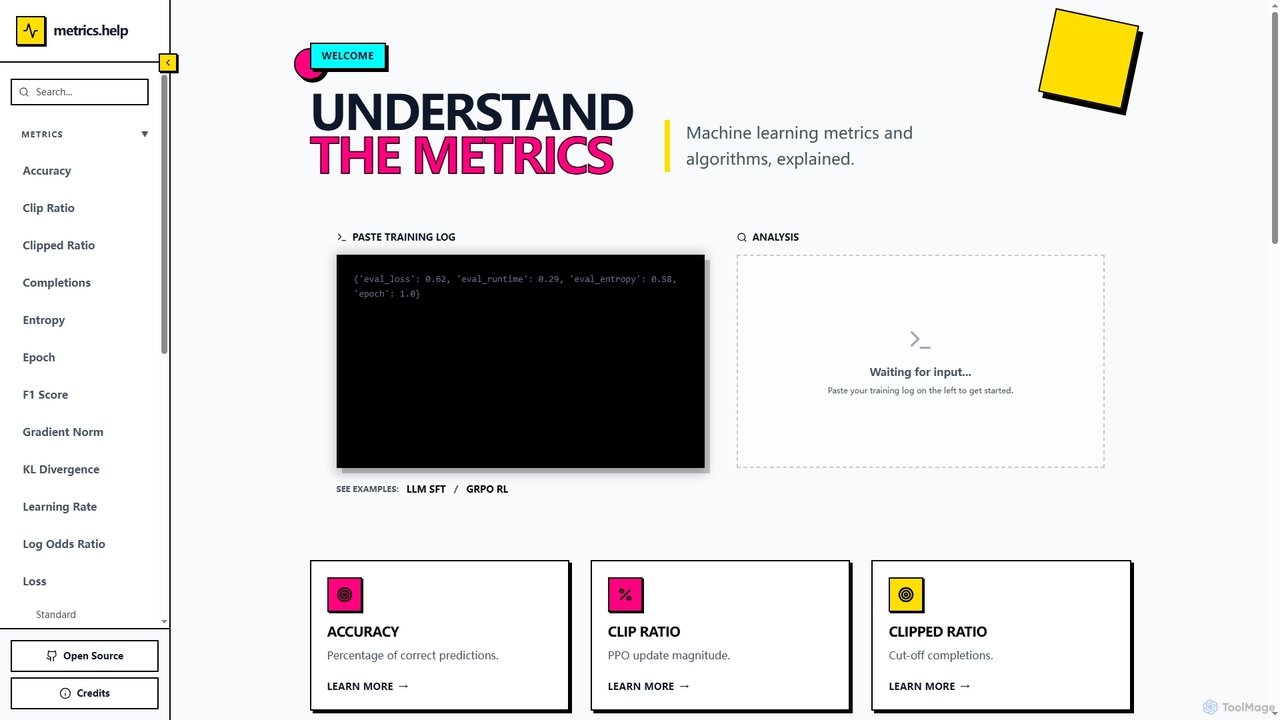
Metrics Help is an open-source web tool for machine learning practitioners. It functions as a comprehensive guide and …
Metrics Help is an open-source web tool for machine learning practitioners. It functions as a comprehensive guide and an interactive analyzer for ML training metrics. Users can paste training logs to get instant explanations for key metrics like accuracy, loss, and perplexity, aiding in model performance analysis and debugging.
Spiritualmeanings
An AI-powered spiritual guide for interpreting dreams, angel numbers, and symbols. Gain deeper insights into your life's journey …
An AI-powered spiritual guide for interpreting dreams, angel numbers, and symbols. Gain deeper insights into your life's journey and unlock the hidden meanings in your experiences. It provides instant, personalized, and comprehensive analysis based on a vast knowledge of spiritual traditions.
About Reference
AI Reference tools are specialized applications designed to assist with academic research, fact-checking, and citation management. They leverage natural language processing (NLP) and access curated databases of scholarly articles, books, and credible sources to provide accurate information. These tools streamline the research process by helping users find relevant sources, verify facts, and correctly format bibliographies. Their primary value lies in enhancing academic integrity and significantly improving the efficiency of writing and research tasks.
Core Features
- Citation Generation: Automatically creates accurate citations and bibliographies in various academic styles like APA, MLA, and Chicago.
- Fact-Checking: Cross-references claims against a database of reliable sources to verify accuracy and prevent the spread of misinformation.
- Source Discovery: Recommends relevant academic papers, articles, and studies based on a user's research topic or query.
- Information Synthesis: Summarizes key points from multiple sources to provide a concise overview of a topic.
- Semantic Search: Understands the contextual meaning of a query to deliver more precise and relevant search results than traditional keyword searches.
Use Cases
AI Reference tools are primarily used by students, academics, researchers, and writers. In an academic setting, they are essential for writing essays, research papers, and dissertations. Journalists and content creators use them for fact-checking and sourcing information for articles and reports. They are also valuable for legal and medical professionals who need to reference specific case law or clinical studies quickly.
How to Choose
When selecting an AI Reference tool, consider the breadth and quality of its source database—ensure it covers your field of study. Evaluate the range of citation styles it supports and its accuracy. Look for seamless integration with your writing software, such as Microsoft Word or Google Docs. Finally, assess the user interface for ease of use and the effectiveness of its search and synthesis capabilities.

ReferenceUse Cases
Streamlining Academic Paper Writing
A university student writing a research paper on climate change uses an AI Reference tool to accelerate their workflow. They input their thesis statement, and the tool suggests a list of highly-cited, peer-reviewed articles. As they write, they use the tool's browser extension to instantly generate APA 7th edition citations for sources they find online. Before submission, they run their draft through the fact-checking feature to ensure all statistics are accurate, saving hours of manual bibliography creation and verification.
Fact-Checking for Journalistic Content
A freelance journalist is writing an investigative piece on the economic impact of a new policy. To ensure credibility, they use an AI Reference tool to verify data points and quotes from various sources. The tool cross-references statistics with reports from governmental agencies and academic institutions. It also helps identify the original source of a quote, preventing the use of misattributed information. This process enhances the article's accuracy and trustworthiness, protecting the journalist's professional reputation.
Building a Literature Review for a Thesis
A graduate student is beginning their dissertation and needs to conduct a comprehensive literature review. They use an AI Reference tool's semantic search feature to find foundational and recent papers in their niche field. The tool's synthesis function helps them group papers by theme and summarize the key findings of each cluster. This provides a structured overview of the existing research, identifies gaps in the literature, and helps the student position their own research contribution effectively, reducing weeks of manual sorting and reading into a few days of focused work.
Preparing Accurate Lesson Plans
A high school history teacher is creating a lesson plan on the Renaissance. To ensure the material is accurate and engaging, they use an AI Reference tool to gather key facts, dates, and information about important figures. The tool provides concise summaries from encyclopedic sources and academic journals, which the teacher can adapt for their students. It also helps find primary source documents and suggests relevant multimedia resources, enriching the learning experience and ensuring the content is based on reliable information.
Corporate Research and Competitive Analysis
A market analyst at a consulting firm needs to compile a report on a competitor. They use an AI Reference tool to quickly gather and synthesize information from financial reports, industry news, and academic studies on market trends. The tool helps identify key statistics, executive statements, and strategic initiatives. By consolidating verified information from diverse, credible sources, the analyst can produce a comprehensive and accurate competitive analysis report in a fraction of the time it would take with manual research methods.
Personal Learning and Topic Exploration
An individual curious about quantum computing uses an AI Reference tool to get a structured and reliable introduction to the topic. Instead of sifting through potentially biased or inaccurate web results, the tool provides a synthesized overview based on university course materials and scientific publications. It explains core concepts, defines key terminology, and provides links to foundational papers. This allows for a self-directed, efficient, and accurate learning path, building a strong knowledge base without the risk of encountering misinformation.