
ToolMage
Sign in

Best 9 Technology AI tools for Education

Popular Technology AI tools in Education include Experiments with Google, They See Your Photos, How Normal Am I?, AIToolGo, AllThingsAI, Outlier Database, jessezhang.org, Allaitools, and Lobe, helping you work more efficiently.

Lobe
Free

Lobe

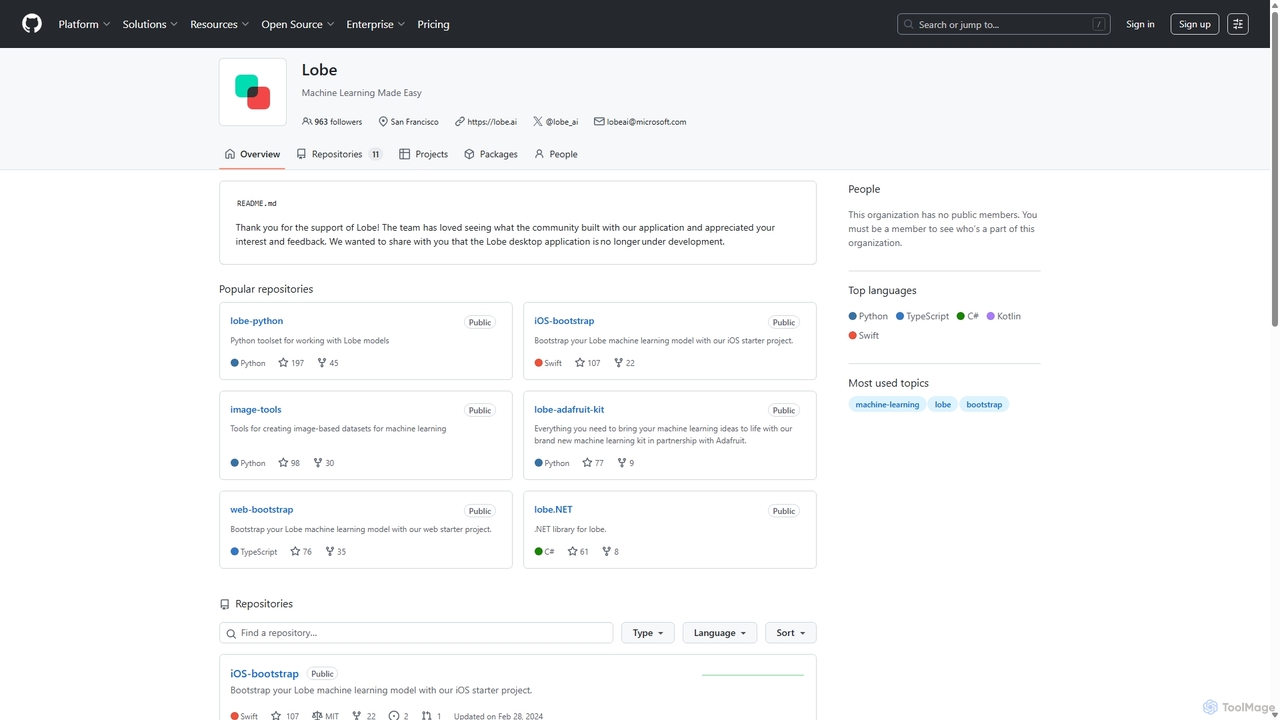
Lobe is a free, user-friendly desktop application for Mac and PC that simplifies the process of training custom machine learning models. It enables users to build, manage, and export image classification models without writing a single line of code, making AI accessible to everyone.

Machine Learning
Visits 5.7KFavorites 137Likes 143

About Technology

Technology tools are AI-powered platforms and applications designed to enhance learning experiences related to science, technology, engineering, and mathematics (STEM), as well as digital literacy. These tools leverage advanced AI, virtual reality, and coding environments to provide interactive, hands-on learning. They empower students and educators to explore complex concepts, develop practical technical skills, and prepare for future technological advancements.

Core Features

  • Interactive Coding Environments: Provide real-time feedback and automated grading for programming exercises.
  • Virtual Labs & Simulations: Offer immersive environments for conducting scientific experiments or engineering design.
  • AI-Driven Personalized Learning: Adapt technical content and pace to individual student needs and progress.
  • Data Analysis & Visualization: Enable learners to process and interpret complex datasets in STEM fields.
  • Robotics & IoT Programming: Facilitate the design and control of virtual or physical smart devices.

Use Cases

These tools are widely adopted in educational institutions, corporate training, and self-learning environments to foster critical technical competencies. They are essential for enhancing STEM curricula, enabling practical skill development in coding and engineering, and preparing learners for technology-driven careers.

How to Choose

When selecting technology tools for education, consider their alignment with curriculum goals, the level of interactivity and engagement offered, and compatibility with existing learning management systems. Evaluate the depth of technical content, ease of use for both students and educators, and the availability of robust support and training resources.

Technology use cases

1

Interactive Coding Practice for Students

Students use AI-powered coding platforms to learn programming languages like Python or Java. The tools provide real-time feedback on code syntax and logic, suggest improvements, and automatically grade assignments. This allows learners to practice independently, receive immediate guidance, and develop strong foundational coding skills efficiently, preparing them for advanced computer science courses or technical roles.

2

Virtual Science Labs for Remote Learning

Educators deploy virtual lab environments powered by AI to allow students to conduct complex scientific experiments remotely. These simulations offer realistic physics, chemistry, or biology scenarios, enabling students to manipulate variables, observe outcomes, and analyze data without the need for expensive physical equipment or a traditional lab setting. This ensures continuity of practical STEM education, especially for distance learners.

3

Personalized STEM Tutoring with AI

Individual students struggling with specific STEM concepts, such as calculus or advanced physics, utilize AI-powered tutoring systems. These tools diagnose knowledge gaps, provide targeted explanations, offer practice problems with step-by-step solutions, and adapt the learning path based on student performance. This personalized approach helps students overcome academic hurdles and achieve a deeper understanding of challenging technical subjects.

4

AI Literacy and Ethics Training

Curriculum developers integrate AI technology tools to teach students about the fundamentals of artificial intelligence, its applications, and the ethical implications of emerging technologies. Interactive modules, case studies, and simulated AI decision-making scenarios help students understand concepts like machine learning bias, data privacy, and the societal impact of AI, fostering responsible digital citizenship and critical thinking.

5

Robotics and IoT Project Development

Engineering students and hobbyists use AI-enhanced simulation tools to design, program, and test virtual robots or Internet of Things (IoT) devices. These platforms allow for drag-and-drop coding, sensor integration, and real-time behavioral analysis in a simulated environment. This hands-on experience fosters practical engineering skills, problem-solving, and innovation in robotics and smart systems development without the need for expensive physical hardware.

6

Data Science Education and Analytics

Learners in data science courses utilize AI-assisted tools for data analysis, visualization, and machine learning model building. These platforms simplify complex statistical computations and enable students to work with large datasets, identify patterns, and create predictive models. This practical application of technology helps students develop essential data literacy and analytical skills, crucial for careers in data science and research.

Technology FAQ

What are Technology tools in Education?

Technology tools in education are AI-powered platforms and applications that facilitate learning in STEM fields, digital literacy, and technical skill development. They leverage advanced technologies like AI, VR, and coding environments to offer interactive and personalized educational experiences. These tools aim to make complex technical subjects more accessible and engaging for students of all levels.

How do AI Technology tools enhance learning?

AI technology tools enhance learning by providing personalized instruction, adaptive content, and immediate feedback. They can simulate real-world scenarios through virtual labs, offer interactive coding environments, and analyze student performance to tailor learning paths. This leads to more engaging, efficient, and effective acquisition of technical knowledge and practical skills, fostering deeper understanding and retention.

What should I consider when choosing Technology tools for my institution?

When selecting technology tools for an educational institution, prioritize curriculum alignment to ensure the tools support learning objectives. Evaluate the level of interactivity and engagement they offer, as well as their scalability and compatibility with existing learning management systems (LMS). Consider the technical support available, data privacy and security features, and the overall cost-effectiveness for long-term implementation.

Are Technology tools suitable for all age groups in education?

Yes, technology tools are highly adaptable for various age groups, from elementary school to higher education and professional training. For younger learners, tools might focus on gamified coding or interactive STEM explorations. For older students, they offer advanced simulations, data analysis platforms, and specialized programming environments. The key is selecting tools with age-appropriate interfaces, content complexity, and learning objectives.

What's the difference between general educational software and AI Technology tools in education?

General educational software often provides static content, quizzes, or basic interactive exercises. AI Technology tools, however, integrate artificial intelligence to offer dynamic, adaptive, and personalized learning experiences. They can provide intelligent tutoring, generate unique problems, simulate complex systems, and analyze student data to optimize learning paths, going beyond simple content delivery to actively facilitate skill development and deeper understanding.

What are the benefits of using Technology tools for STEM education?

Technology tools offer numerous benefits for STEM education, including enhanced engagement through interactive simulations and gamified learning. They provide access to virtual labs and complex datasets, allowing for hands-on experience without physical constraints. Personalized learning paths cater to individual student needs, while AI-driven feedback accelerates skill development. These tools ultimately foster critical thinking, problem-solving, and innovation, preparing students for future STEM careers.