Engineering Best in category 1 results Manufacturing AI Tool

Popular AI tools in the Manufacturing field of Engineering include DraftAid, etc., helping you quickly improve efficiency.

DraftAid

DraftAid

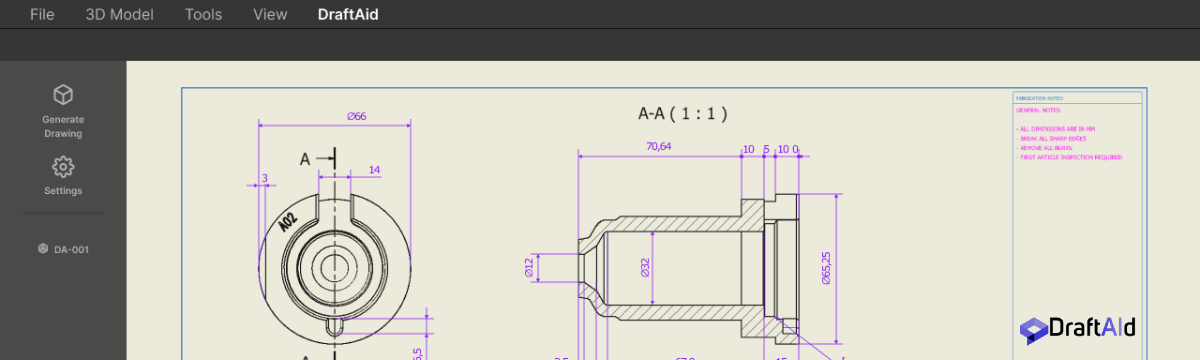
DraftAid is an AI-powered tool that automates the creation of 2D manufacturing drawings from 3D CAD models. It …

49.6K

About Manufacturing

AI Manufacturing tools are a class of software that apply artificial intelligence to optimize, automate, and enhance production processes. These tools leverage machine learning, computer vision, and predictive analytics to monitor equipment, improve quality control, and streamline supply chains. Their primary purpose is to increase operational efficiency, reduce costly downtime, and minimize defects, paving the way for smart factories. By analyzing vast amounts of production data, they uncover insights that are beyond human capability, enabling data-driven decision-making on the factory floor.

Core Features

  • Predictive Maintenance: Analyzes sensor data from machinery to forecast potential failures before they occur, allowing for proactive servicing.
  • Automated Quality Control: Uses computer vision to automatically detect defects, anomalies, or inconsistencies on the production line with high accuracy.
  • Supply Chain Optimization: Employs algorithms to forecast demand, manage inventory levels, and optimize logistics for greater efficiency.
  • Generative Design: Creates optimal designs for parts and components based on specified constraints like weight, material, and performance.
  • Production Scheduling: Develops and adjusts production schedules in real-time to maximize throughput and resource utilization.

Use Cases

These tools are crucial in industries with complex production lines and strict quality standards, such as automotive, aerospace, electronics, and pharmaceuticals. Production managers use them to monitor overall equipment effectiveness (OEE), quality engineers deploy them for zero-defect initiatives, and supply chain planners rely on them for accurate demand forecasting.

How to Choose

When selecting an AI Manufacturing tool, consider its integration capabilities with your existing Manufacturing Execution Systems (MES) and ERP software. Evaluate the accuracy and adaptability of its AI models for your specific use case. Also, assess the platform's scalability to handle your production volume and data security protocols to protect sensitive operational data.


ManufacturingUse Cases

1

Predictive Maintenance for Assembly Lines

A plant manager at an automotive factory uses an AI predictive maintenance tool to prevent costly shutdowns. The system continuously analyzes vibration, temperature, and power consumption data from hundreds of robotic arms on the assembly line. By identifying subtle anomalies that precede failures, the AI predicts a specific motor will fail within the next 72 hours. This allows the maintenance team to schedule a replacement during a planned shift change, avoiding an estimated 8 hours of unplanned downtime and saving thousands in lost production.

2

Automated Visual Quality Inspection

A quality control engineer in an electronics manufacturing facility deploys an AI-powered computer vision system to inspect circuit boards. The system uses high-resolution cameras and a trained machine learning model to detect microscopic defects like faulty soldering or misplaced components, which are often missed by human inspectors. It inspects over 1,000 boards per hour with 99.9% accuracy, reducing the defect rate in final products by 60% and freeing up engineers to focus on process improvement rather than repetitive inspection tasks.

3

AI-Powered Supply Chain Demand Forecasting

A supply chain planner for a large consumer goods company uses an AI tool to improve demand forecasting accuracy. The platform analyzes historical sales data, seasonal trends, promotional activities, and even external factors like weather patterns and social media sentiment. The AI model generates forecasts that are 25% more accurate than previous statistical methods. This leads to optimized inventory levels, reducing carrying costs by 15% and minimizing stockouts, ensuring better product availability for customers.

4

Generative Design for Lighter, Stronger Parts

An aerospace engineer is tasked with designing a new bracket for an aircraft wing that must be lighter without sacrificing strength. Using a generative design tool, the engineer inputs key parameters: material properties, load conditions, and spatial constraints. The AI algorithm explores thousands of design permutations, generating an organic, lattice-like structure that is 30% lighter than the original human-designed part but meets all safety and performance requirements. This weight reduction contributes to significant fuel savings over the aircraft's lifespan.

5

Optimizing Production Schedules with AI

A production scheduler at a chemical processing plant uses an AI optimization tool to manage complex production runs. The tool considers hundreds of variables, including machine availability, raw material delivery times, changeover durations, and energy costs. It generates an optimal schedule that minimizes idle time and reduces energy consumption by 12%. When an unexpected machine breakdown occurs, the AI can instantly recalculate and provide a new, optimized schedule in minutes, a task that would have taken a human planner hours to complete.

6

Real-time Process Control in Steel Manufacturing

In a steel mill, a process engineer uses an AI system to maintain optimal conditions in a continuous casting machine. The AI analyzes real-time data from sensors measuring temperature, pressure, and chemical composition. It then automatically adjusts process parameters, such as cooling rates and casting speed, to ensure the final product meets precise quality specifications. This real-time control reduces material waste by 5% and improves the consistency and quality of the steel produced, leading to higher customer satisfaction.

ManufacturingFrequently Asked Questions