
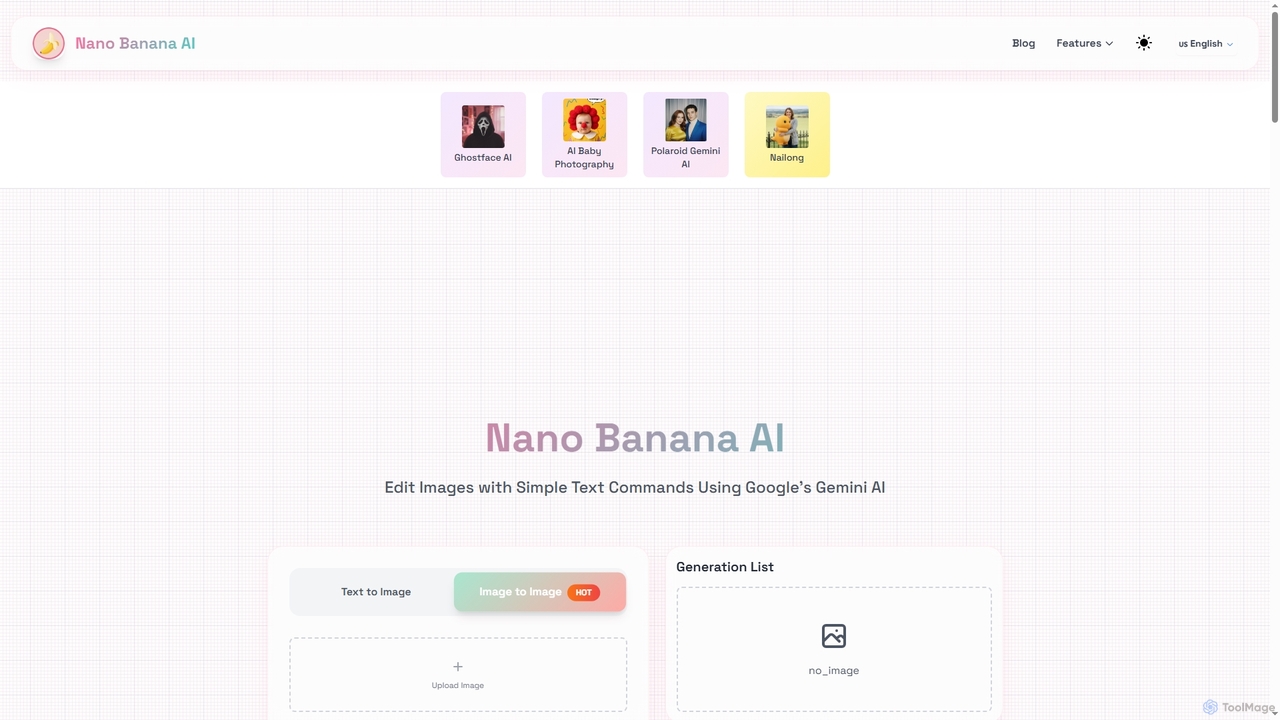
Nano Banana AI
Nano Banana AI is a cutting-edge image editing tool powered by Google's Gemini 2.5 Flash. It allows users …
Nano Banana AI is a cutting-edge image editing tool powered by Google's Gemini 2.5 Flash. It allows users to modify images using simple text commands, ensuring character consistency and understanding real-world context. Experience fast, intelligent photo editing directly in your browser.
About Image To Image
Image to Image tools are a specialized category of AI that transforms an existing image into a new one based on user instructions. Unlike traditional editors that merely modify pixels, these tools use the source image as a structural or stylistic guide, combined with a text prompt, to generate a completely new visual output. This process enables creative reinterpretations, style transfers, and controlled generation of complex scenes. They are valuable for artists, designers, and creators seeking to iterate on ideas rapidly or explore visual styles without starting from scratch.
Core Features
- Style Transfer: Applies the artistic style of one image (e.g., a painting) to the content of another (e.g., a photograph).
- Prompt-Based Restyling: Fundamentally alters an input image according to a text description, such as changing a daytime photo to a nighttime scene.
- Structural Guidance: Uses elements like pose, depth maps, or outlines from a source image to control the composition of a new generation.
- Sketch-to-Image Rendering: Transforms simple drawings, sketches, or line art into detailed, fully rendered images.
Use Cases
These tools are widely used in creative industries. Concept artists use them to quickly explore variations of a character sketch. Architects and interior designers turn basic 3D models into photorealistic visualizations with specific materials and lighting. Fashion designers can also generate product mockups with different patterns on a base clothing item.
How to Choose
When selecting an Image to Image tool, consider the level of control it offers, such as support for specific structural guidance models. Evaluate the quality and diversity of its style models, its processing speed, and its integration capabilities. Also, assess the user interface's intuitiveness and the pricing model, especially regarding generation credits or subscription tiers.
Image To ImageUse Cases
Concept Art and Design Iteration
A concept artist for a video game starts with a simple digital sketch of a character's pose. Instead of manually painting dozens of variations, they upload the sketch to an Image to Image tool. Using prompts like 'fantasy armor, glowing runes, dark forest background' or 'sci-fi exosuit, neon lights, futuristic city,' they can generate a wide array of high-quality, fully rendered concepts in minutes. This process drastically accelerates the ideation phase, allowing the creative team to visualize and approve a final design direction much faster.
Architectural and Interior Visualization
An architect creates a basic 3D line model of a building's exterior. To present a compelling vision to a client, they need photorealistic images. They input the line model into an Image to Image tool with the prompt 'modern glass and steel facade, sunny day, with oak trees'. The AI generates a realistic rendering, transforming the simple structure into a lifelike building. Similarly, an interior designer can upload a photo of an empty room and generate various decor styles like 'Scandinavian minimalist' or 'bohemian chic' to show clients potential designs instantly.
Fashion and Product Design Mockups
A fashion designer has a photograph of a plain white t-shirt. They want to visualize how different graphic designs would look on it. Using an Image to Image tool, they can upload the t-shirt photo and use prompts like 'a vintage-style tiger graphic on the front' or 'a repeating pattern of small geometric shapes'. The tool generates realistic mockups, showing the designs conforming to the fabric's folds and shadows. This method is much faster than using traditional graphic design software and allows for rapid exploration of hundreds of creative possibilities for apparel and other products.
Creating Stylized Social Media Content
A content creator wants to maintain a unique, consistent visual theme for their Instagram feed. They take a standard portrait photo and use an Image to Image tool to transform it. With a prompt like 'transform into a watercolor painting' or 'reimagine as a 1980s anime character', they can instantly create eye-catching, stylized images that stand out. This allows them to apply a complex artistic style to any photo without needing advanced artistic skills, ensuring their brand's visual identity remains strong and cohesive across all posts.
Maintaining Character Consistency in Storytelling
An independent comic artist or writer needs to generate multiple images of the same character in different scenes and poses. Creating this manually is time-consuming. By using an Image to Image tool with structural guidance (like ControlNet), they can use a reference image of the character's face and another image for the desired pose. With a prompt describing the scene, the AI generates a new image where the original character is now in the new pose and setting, maintaining facial consistency. This is a powerful technique for creating storyboards, comic panels, or illustrations for a novel.
AI-Powered Interior Redecorating
A homeowner wants to remodel their living room but is unsure which style to choose. They take a photo of their current living room and upload it to an Image to Image tool. They can then experiment with prompts like 'redecorate in a modern minimalist style with oak furniture and large windows' or 'change to an industrial loft style with exposed brick and metal fixtures'. The AI uses the layout of the original photo to generate realistic visualizations of the redecorated space, providing a powerful and inspiring way to make design decisions before committing to any purchases or physical changes.