Mockuplabs
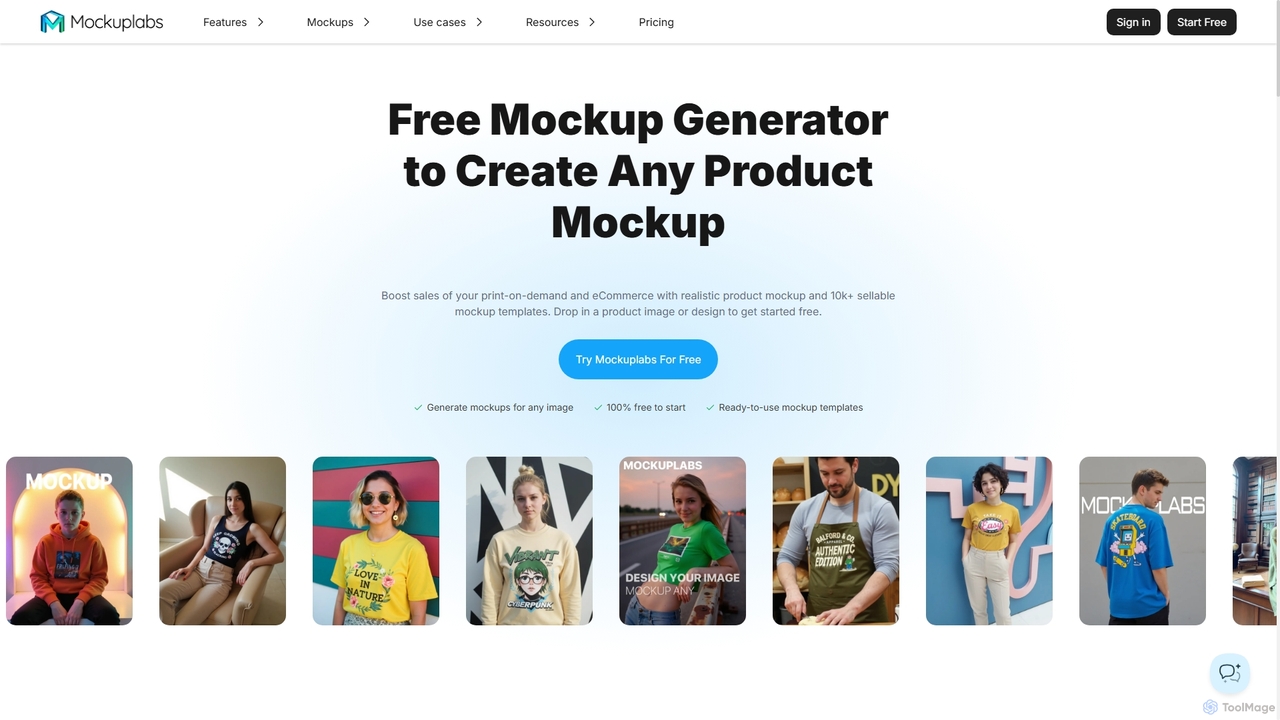
Mockuplabs is an AI-powered mockup generator designed to help e-commerce sellers, print-on-demand businesses, and designers create realistic product …
Mockuplabs is an AI-powered mockup generator designed to help e-commerce sellers, print-on-demand businesses, and designers create realistic product visuals quickly. It offers a suite of tools for generating, editing, and customizing mockups, including AI color changing, all-over print application, and image enhancement features.
About Product Visualization
AI Product Visualization tools are specialized applications that generate photorealistic, high-quality digital images and 3D models of products. They leverage generative AI and 3D rendering to transform basic product photos, sketches, or text descriptions into compelling visuals for various contexts. This allows businesses, particularly in e-commerce and marketing, to create entire virtual photoshoots, customize product appearances on the fly, and showcase items in diverse settings without the need for physical logistics. These tools can dramatically reduce production costs and time-to-market for new product campaigns.
Core Features
- AI Scene Generation: Automatically place products into relevant and customizable virtual environments or lifestyle scenes.
- 3D Model Creation: Convert 2D product images or sketches into interactive 3D models for web or AR use.
- Material & Texture Customization: Instantly apply different materials, textures, and colors to a product model to show variations.
- Virtual Photoshoots: Generate unlimited, high-resolution images from any angle or lighting condition without a physical camera.
- Augmented Reality (AR) Integration: Enable customers to preview products in their own physical space using a smartphone or tablet.
Use Cases
These tools are primarily used by e-commerce brands, marketing agencies, furniture designers, fashion retailers, and industrial product developers. They are essential for creating dynamic product catalogs, generating advertising creatives, and providing interactive online shopping experiences that boost engagement and sales.
How to Choose
When selecting a tool, consider the quality and realism of the output, the range of supported product types (e.g., apparel, furniture, electronics), integration capabilities with platforms like Shopify, and the balance between ease of use for marketers and advanced features for 3D artists. Also, evaluate the pricing model to ensure it aligns with your usage volume.
Product VisualizationUse Cases
Generate E-commerce Lifestyle Images
An e-commerce manager for a furniture brand needs to showcase a new armchair in various home settings. Instead of organizing expensive photoshoots, they upload a single studio shot of the chair to an AI Product Visualization tool. Using text prompts like 'armchair in a modern Scandinavian living room with natural light,' the tool generates hundreds of unique, photorealistic lifestyle images. This process reduces image creation costs by over 90% and allows the marketing team to A/B test different visual styles on product pages and social media ads to see which converts best.
Create Interactive 3D Product Configurators
A direct-to-consumer sneaker company wants to offer customers a highly personalized shopping experience. They use an AI tool to convert 2D images of their new shoe model into a high-fidelity 3D model. This model is then embedded on their website as an interactive configurator. Customers can rotate the sneaker 360 degrees, zoom in on details, and change the color of the laces, sole, and upper material in real-time. This immersive experience increases user engagement and has been shown to boost conversion rates and reduce returns.
Develop Virtual Try-On for Apparel
A fashion retailer aims to solve the online fitting problem. They integrate an AI visualization tool that allows shoppers to upload a photo of themselves or select a model with similar body measurements. The AI then realistically drapes digital versions of garments onto the model, showing how the fabric hangs and fits. This virtual try-on feature helps customers make more confident purchasing decisions, significantly lowering the rate of returns due to poor fit and enhancing the overall online shopping experience.
Automate Ad Creative Production
A marketing agency managing a beverage brand's new product launch needs a high volume of ad creatives for different platforms. They use an AI tool to place the product bottle into various scenes, such as a beach party, a rooftop bar, or a cozy cafe. The tool can automatically adjust lighting, shadows, and reflections to match each environment perfectly. Within hours, the agency generates hundreds of on-brand, high-quality ad variations, enabling them to run highly targeted campaigns across social media, display networks, and email marketing.
Prototype Designs with Realistic Renders
An industrial designer is developing a new electronic device. Early in the design process, they use an AI visualization tool to turn their CAD files or even simple sketches into photorealistic renders. This allows them to experiment with different materials like brushed aluminum, matte plastic, or wood finishes without creating physical prototypes. They can share these realistic visuals with stakeholders for feedback, accelerating the design iteration cycle and making crucial decisions before committing to expensive manufacturing processes.
Enable AR Previews for Home Goods
An online store selling home decor and art wants to help customers overcome purchase hesitation. Their mobile app incorporates an AI-powered AR feature. Customers can select a painting or a vase from the catalog and, using their phone's camera, see a true-to-scale 3D model of the item placed on their own wall or table. This 'try before you buy' functionality provides a powerful sense of ownership and spatial context, leading to higher customer satisfaction and increased sales for larger or more expensive items.