
ToolMage
Sign in

Best 1 Image Description AI tools for Image

Popular Image Description AI tools in Image include Image Describer, helping you work more efficiently.

Image Describer
Freemium

Image Describer

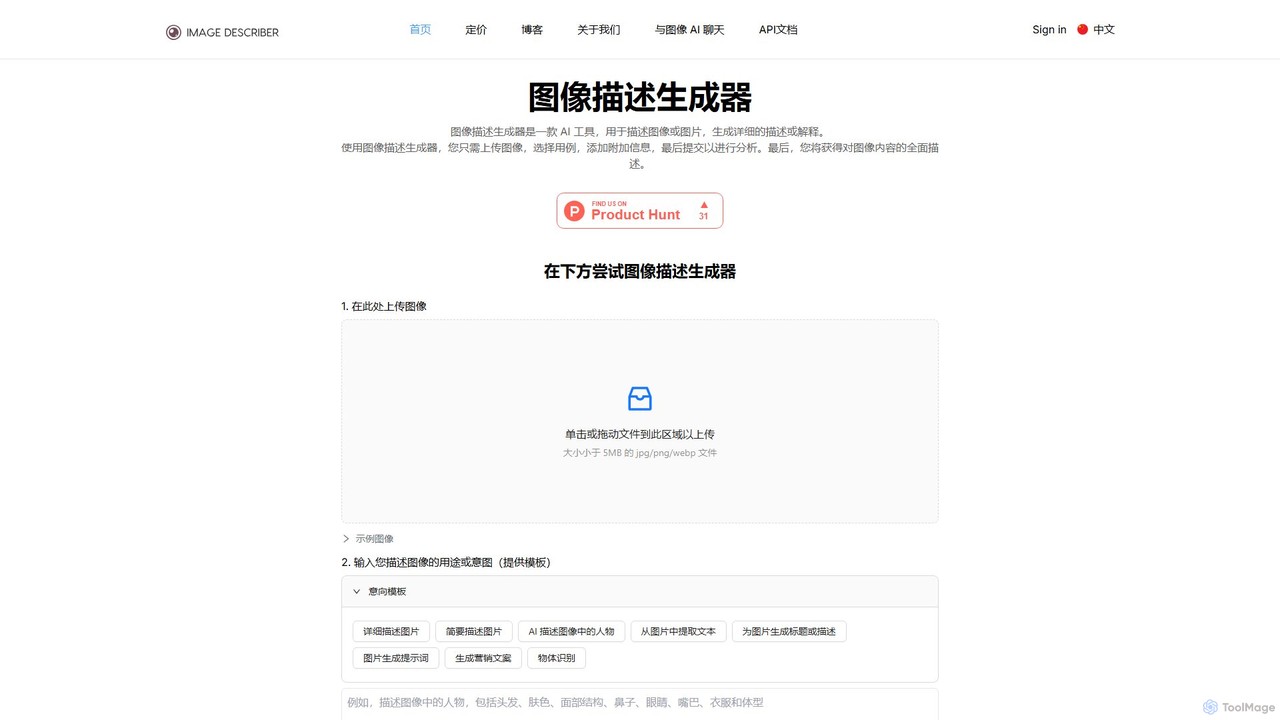
An AI-powered tool that analyzes images to generate detailed descriptions, alt text, social media captions, marketing copy, and AI art prompts. It supports custom instructions to tailor descriptions for various purposes, from accessibility to creative content generation.

Assistive Technology
Visits 157.3KFavorites 107Likes 110

About Image Description

Image Description tools are a specialized class of AI that automatically generate human-readable text from visual content. These tools utilize advanced computer vision to analyze an image's elements—such as objects, scenes, and actions—and then employ natural language generation (NLG) to construct a coherent descriptive sentence or paragraph. Their primary value lies in making visual content accessible and understandable to search engines and visually impaired users, significantly improving SEO and web accessibility. They also streamline the process of cataloging large digital asset libraries.

Core Features

  • Alt Text Generation: Automatically creates concise, descriptive alternative text for images, crucial for web accessibility (WCAG) and SEO.
  • Detailed Captioning: Produces longer, more narrative descriptions that capture the context, mood, and details of an image for content or cataloging purposes.
  • Object and Scene Recognition: Identifies and lists all key objects, people, and environmental settings present within the image.
  • Keyword and Tag Extraction: Analyzes the image content to suggest relevant keywords and tags for better searchability in digital asset management systems.
  • Multi-language Descriptions: Capable of generating descriptions in various languages to serve a global audience.

Use Cases

These tools are widely used in digital marketing for SEO and content creation, in e-commerce for automating product descriptions, and in large enterprises for managing extensive Digital Asset Management (DAM) systems. Tech companies also integrate this technology into applications to provide assistive services for visually impaired users.

How to Choose

When selecting an Image Description tool, consider the following: the accuracy and level of detail in the generated text, the availability of an API for integration, the range of supported languages, and the processing speed for handling bulk image analysis. The pricing model, whether per-image or subscription-based, is also a critical factor for scalability.

Featured tool rankings

Image Description use cases

1

Automating Alt Text for Web Accessibility & SEO

For web developers and SEO specialists, manually writing descriptive alt text for thousands of images is a time-consuming task. An Image Description tool automates this process entirely. By integrating it via an API, every image uploaded to a content management system (CMS) can instantly receive accurate, context-aware alt text. This ensures compliance with Web Content Accessibility Guidelines (WCAG), allows screen readers to describe images to visually impaired users, and provides search engines with valuable context, boosting image search rankings.

2

Enhancing Digital Asset Management (DAM) Systems

Large organizations, such as media houses and marketing agencies, manage millions of visual assets. Finding a specific image in a vast library based on its content can be nearly impossible with only filename-based searches. By integrating an Image Description tool, every asset can be automatically tagged with detailed descriptions and keywords. This transforms the DAM into a powerful, searchable database where users can find images using natural language queries like 'a person smiling at a laptop in a modern office,' dramatically improving workflow efficiency.

3

Streamlining E-commerce Product Tagging

For e-commerce platforms with thousands of products, writing unique descriptions and relevant search tags for each item is a major operational bottleneck. An Image Description tool can analyze product photos to automatically generate descriptive text highlighting key features (e.g., 'red cotton t-shirt with a crew neck'). It can also extract attributes like color, material, and style as tags. This not only speeds up the product listing process but also improves on-site search functionality and product discoverability for customers, leading to better conversion rates.

4

Powering Assistive Technology for the Visually Impaired

Developers creating applications for visually impaired users can leverage Image Description APIs to build powerful assistive tools. A smartphone app, for instance, could use the phone's camera to capture a scene and have the AI describe it aloud in real-time, helping a user navigate their surroundings or identify objects. This technology can also be integrated into web browsers or operating systems to describe on-screen images that lack proper alt text, making the digital world significantly more accessible.

5

Automating Social Media Caption Generation

Social media managers and content creators often struggle to write fresh, engaging captions for a high volume of visual posts. An Image Description tool can serve as a creative assistant, instantly generating several descriptive caption options for an image. A user can then select the best one or edit it to match their brand's tone of voice. This significantly reduces the time spent on content creation, allowing managers to focus on strategy and community engagement rather than routine writing tasks.

6

Analyzing Visual Data for Market Research

Market researchers can use Image Description tools to analyze large volumes of user-generated content from social media or review sites. By converting images into structured text, they can identify trends, brand logos, products, and consumer behaviors at scale. For example, an analysis of thousands of Instagram posts could reveal how customers are using a product in real-world settings or which competing brands appear most frequently alongside their own. This provides valuable, unsolicited insights that are difficult to obtain through traditional surveys.

Image Description FAQ

What is an AI Image Description tool?

An AI Image Description tool is a software application that uses a combination of computer vision and natural language processing to analyze an image and generate a written description of its contents. Instead of just identifying objects, it aims to create a coherent, human-like sentence that describes the scene, the actions taking place, and the relationships between objects. Its primary function is to translate visual information into textual information automatically.

How to choose the right AI Image Description tool?

Choosing the right tool depends on your specific needs. Consider these factors:

  • Accuracy and Detail: Does the tool generate precise and sufficiently detailed descriptions for your use case (e.g., simple alt text vs. rich product descriptions)?
  • API and Integration: Does it offer a well-documented API for easy integration into your existing workflows, such as a CMS or DAM system?
  • Scalability and Speed: Can the tool handle the volume of images you need to process in a timely manner? Check its performance on bulk processing.
  • Language Support: Does it support all the languages required for your target audience?
  • Cost: Evaluate the pricing model (per-image, monthly subscription, etc.) and how it aligns with your budget and expected usage.
What's the difference between Image Description and Image Tagging?

The key difference lies in the output format and level of detail. Image Tagging (or classification) analyzes an image and outputs a list of keywords or labels (e.g., 'dog,' 'park,' 'frisbee'). It identifies what is in the image. Image Description, on the other hand, goes a step further. It uses the identified objects and their relationships to generate a full, descriptive sentence (e.g., 'A brown dog is jumping to catch a red frisbee in a grassy park'). It describes what is happening in the image.

What are the main benefits of using AI for image descriptions?

The primary benefits are efficiency, scalability, and consistency. AI can describe thousands of images in the time it would take a human to do just a few, making it highly scalable for large projects. It also ensures a consistent style and level of detail across all descriptions. Furthermore, it improves accessibility by providing alt text for visually impaired users and boosts SEO by making visual content understandable to search engine crawlers.

Can AI accurately describe complex or abstract images?

Current AI models are highly proficient at describing common, real-world scenes and objects with impressive accuracy. However, they can struggle with highly complex, nuanced, or abstract images. For example, describing the emotional intent of a piece of abstract art or correctly interpreting a very unusual or surreal scene can be challenging. While the technology is constantly improving, for highly subjective or artistic content, human oversight may still be necessary to capture the full context and meaning.