ClawCloud Run
ClawCloud Run is a cloud-native development platform designed to simplify the application lifecycle. It enables developers to build, …
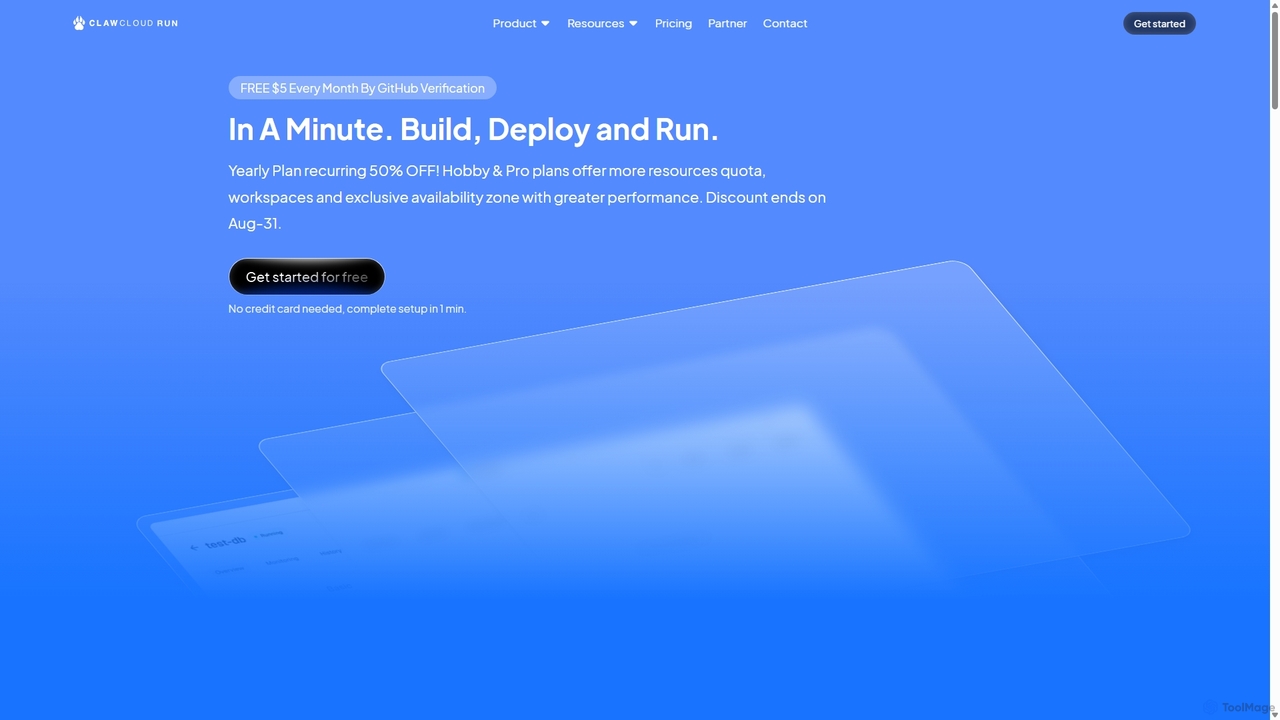
ClawCloud Run is a cloud-native development platform designed to simplify the application lifecycle. It enables developers to build, deploy, manage, and run applications in a unified cloud environment without writing complex YAML files. Featuring a visual canvas, one-click templates, and integrated database management, it accelerates the go-to-market process.
About Hosting
AI Hosting services provide specialized infrastructure designed to deploy, run, and scale artificial intelligence models and applications. These platforms are built with GPU acceleration and high-throughput computing capabilities, essential for handling the intensive workloads of machine learning inference. They enable developers and businesses to make their AI models accessible via APIs with low latency and high availability. This ensures that AI-powered features can be integrated seamlessly into user-facing products and internal systems.
Core Features
- GPU Acceleration: Provides access to powerful GPUs (like NVIDIA A100 or H100) crucial for fast AI model inference.
- Scalable Endpoints: Automatically adjusts computing resources based on API traffic to handle fluctuating demand efficiently.
- Pre-configured Environments: Offers ready-to-use software stacks with popular frameworks like TensorFlow, PyTorch, and ONNX.
- Low-Latency Infrastructure: Optimized network and hardware for real-time responses, critical for interactive applications.
- Model Management: Includes tools for versioning, monitoring, and managing the lifecycle of deployed AI models.
Use Cases
AI Hosting is vital for technology companies, startups, and enterprises integrating AI into their services. It's commonly used to deploy customer service chatbots, power real-time recommendation engines, host computer vision APIs for image analysis, and serve natural language processing (NLP) models for text classification or translation. Any application requiring immediate AI-driven responses benefits from this specialized infrastructure.
How to Choose
When selecting an AI Hosting service, evaluate the available GPU types and their performance. Consider the pricing model—whether it's pay-per-use, based on time, or fixed-cost for dedicated resources. Assess the ease of deployment, integration with MLOps pipelines, and the level of support for your specific AI frameworks. Finally, check security features and data compliance certifications relevant to your industry.
HostingUse Cases
Deploying a Real-Time Translation API
A mobile app developer needs to integrate instant translation features into their application for a global audience. Using an AI Hosting platform, they deploy a pre-trained neural machine translation (NMT) model. The platform provides a scalable API endpoint that can handle thousands of concurrent requests. The low-latency infrastructure ensures that users receive translations in milliseconds, creating a seamless in-app experience. The developer avoids the complexity of managing GPU servers, focusing solely on application development while the hosting service ensures high availability and performance.
Hosting a Generative AI Art Service
A startup launches a web service for generating AI art based on text prompts. This requires significant GPU power for each generation request. They use a managed AI Hosting service that provides access to high-end GPUs like the NVIDIA A100. The service's auto-scaling feature is critical, as it automatically provisions more GPUs during peak usage times (e.g., after a marketing campaign) and scales down during quiet periods to save costs. This pay-as-you-go model allows the startup to offer a powerful service without a massive upfront investment in hardware.
Powering a Private LLM for Enterprise Data Analysis
A financial institution wants to use a large language model (LLM) to analyze sensitive internal documents without exposing data to public APIs. They opt for a dedicated AI Hosting solution. This provides them with a private, secure environment to host a powerful open-source LLM. The hosting provider manages the hardware, security patches, and network infrastructure, allowing the institution's data science team to focus on fine-tuning the model and building internal applications on top of it. The dedicated resources ensure consistent performance and compliance with strict data privacy regulations.
Serving a Computer Vision Model for Retail Analytics
A retail tech company develops a computer vision model to analyze in-store camera feeds for foot traffic patterns. The model needs to process multiple video streams in real-time. They deploy this model on an AI Hosting platform optimized for low-latency inference. The platform's geographically distributed servers ensure that data processing happens close to the store locations, minimizing network delay. This setup allows the company to provide retailers with real-time dashboards on customer behavior, helping them optimize store layouts and staffing without needing to build and maintain a complex, distributed infrastructure themselves.
Creating a Scalable Environment for AI Model Fine-Tuning
A data science team regularly needs to fine-tune open-source models on proprietary datasets. Instead of purchasing and maintaining expensive in-house GPU servers, they use an AI Hosting platform that offers on-demand access to powerful compute instances. They can spin up an environment with multiple A100 GPUs for a few hours to run a fine-tuning job, and then shut it down to stop incurring costs. The platform's pre-configured environments with Jupyter notebooks and necessary libraries allow them to start working immediately, significantly accelerating their model development and experimentation cycle.
Powering a Real-Time Recommendation Engine
An e-commerce platform wants to provide personalized product recommendations to users as they browse the site. Their machine learning model needs to process user behavior data in real-time to generate relevant suggestions. They deploy the model using an AI Hosting service. The service's ability to handle high-throughput, low-latency API calls is crucial. As traffic to the e-commerce site grows, the hosting platform automatically scales the resources allocated to the model, ensuring that the recommendation engine remains fast and responsive, which directly contributes to improved user engagement and higher conversion rates.