Infrastructure Best in category 1 results Mlops AI Tool

Popular AI tools in the Mlops field of Infrastructure include Cerebrium, etc., helping you quickly improve efficiency.

Cerebrium

Cerebrium

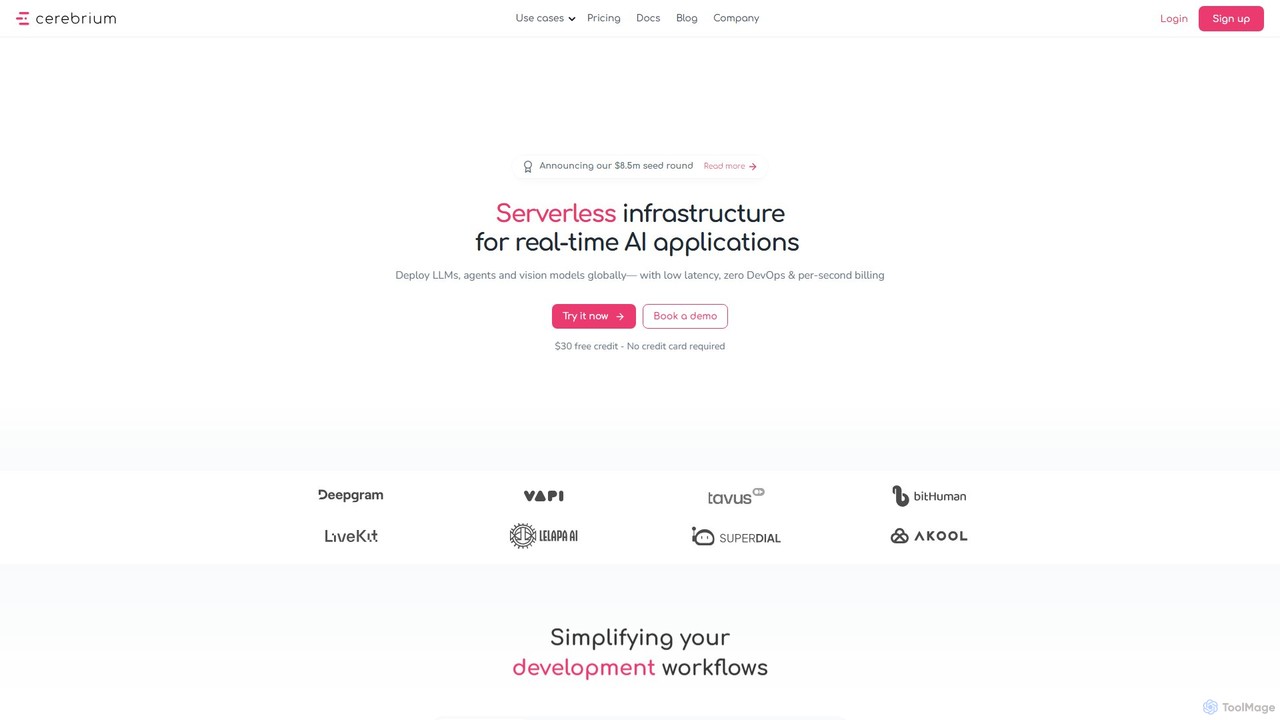
Cerebrium is a serverless AI infrastructure platform designed for developers to deploy, manage, and scale machine learning models …

55.9K

About Mlops

MLOps tools are platforms designed to automate and manage the entire machine learning lifecycle. They apply DevOps principles to machine learning, integrating data pipelines, model training, deployment, and monitoring into a unified, continuous process. This approach accelerates the delivery of ML models into production, improves their reliability, and simplifies ongoing maintenance. As a key part of the AI Infrastructure, MLOps platforms provide the critical framework for scaling AI applications within an organization.

Core Features

  • CI/CD/CT Pipelines: Automate the continuous integration, delivery, and training of machine learning models.
  • Model Registry: A central repository to store, version, manage, and share trained models before deployment.
  • Experiment Tracking: Log and compare parameters, metrics, and artifacts from different model training runs.
  • Production Monitoring: Continuously track model performance, data drift, and concept drift to ensure reliability.
  • Feature Store: A centralized system to manage, share, and serve features for both model training and inference.

Use Cases

MLOps tools are essential for organizations moving machine learning from research to production. They are widely used by ML engineers, data scientists, and DevOps teams in sectors like finance for fraud detection, e-commerce for recommendation systems, and healthcare for predictive diagnostics. The goal is to create reproducible workflows and maintain model performance over time.

How to Choose

When selecting an MLOps tool, consider its integration with your existing cloud infrastructure (e.g., AWS, GCP, Azure) and data sources. Evaluate the scope of its features—whether you need an end-to-end platform or specific components like monitoring or a feature store. Also, assess the tool's scalability and the technical expertise required by your team, comparing code-centric frameworks with low-code graphical interfaces.

MlopsUse Cases

1

Automating Model Retraining and Deployment

An e-commerce company's data science team needs to keep its product recommendation model up-to-date with the latest user behavior. Using an MLOps platform, they build a CI/CD/CT pipeline that automatically triggers a retraining job every 24 hours using fresh data. After training, the model's performance is automatically validated against a test set. If it meets the predefined accuracy threshold, the platform automatically deploys it to production, replacing the old model without any downtime or manual intervention from an engineer.

2

Monitoring for Model Drift in Fraud Detection

A fintech company deploys a machine learning model to detect fraudulent transactions. Over time, fraudsters change their tactics, causing the model's performance to degrade—a phenomenon known as model drift. An MLOps platform continuously monitors the live model's predictions and the statistical properties of incoming data. When it detects a significant drift from the training data distribution, it automatically alerts the ML engineering team. The platform's dashboard helps them visualize the drift, diagnose the cause, and trigger a retraining pipeline with newly labeled data to adapt to the new fraud patterns.

3

Ensuring Reproducibility for Collaborative Projects

A large data science team is collaborating on a customer churn prediction model. To avoid inconsistencies, they use an MLOps platform's experiment tracking and versioning features. Every training run is logged, capturing the exact code version, dataset hash, hyperparameters, and resulting metrics. The trained model artifact is then stored in a central model registry. This ensures that any team member can reproduce a specific experiment perfectly, compare results fairly, and retrieve the exact model version that was approved for deployment, creating a transparent and auditable workflow.

4

Managing a Centralized Feature Store

In a large organization, multiple teams are building different models (e.g., for marketing, sales, and support) but often require the same data features, like 'customer lifetime value'. Instead of each team calculating this feature independently, they use an MLOps platform with a feature store. An engineering team defines and populates the feature store with high-quality, up-to-date features. Data science teams can then simply pull these pre-computed features for both training their models and for real-time inference in production. This saves computation time, prevents training-serving skew, and ensures consistency across all models.

5

A/B Testing Models in Production

A marketing team wants to test a new ad-targeting model against the current one. Using an MLOps tool, they perform a champion-challenger deployment. The platform routes 90% of the traffic to the existing 'champion' model and 10% to the new 'challenger' model. It collects performance metrics (like click-through rates) for both models in real-time. After a week, the team analyzes the results on a comparative dashboard. Since the challenger model shows a 15% improvement, they use the platform to seamlessly promote it to become the new champion, now serving 100% of the traffic.

6

Governing and Auditing ML Models for Compliance

A financial institution is required by regulators to explain its loan approval model's decisions and maintain a clear audit trail. They use an MLOps platform that provides robust model governance features. The platform's model registry stores not only the model binary but also its lineage—including the data used for training, the code, and the responsible data scientist. When an audit is required, they can instantly generate a report detailing a model's entire history. This ensures compliance with regulations like GDPR and provides transparency into how and why models are making their predictions.

MlopsFrequently Asked Questions