
Zeabur
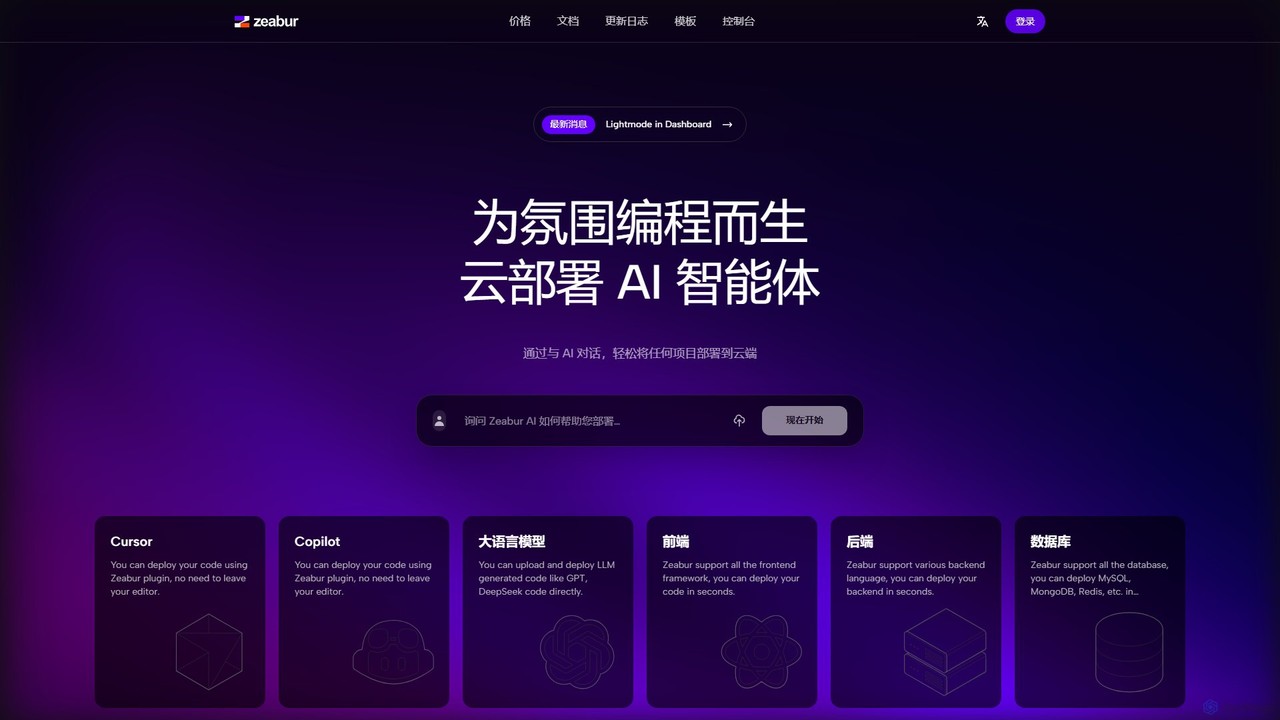
Zeabur is an AI-powered deployment platform (PaaS) designed for developers. It enables one-click deployment for any project, including …
Zeabur is an AI-powered deployment platform (PaaS) designed for developers. It enables one-click deployment for any project, including front-end, back-end, databases, and AI agents, directly from code or through conversational AI. Featuring a pay-as-you-go model, automatic configuration, and auto-scaling, Zeabur simplifies cloud infrastructure, allowing developers to focus solely on coding.
About Paas
PaaS (Platform as a Service) is a cloud computing model that provides a complete, ready-to-use development and deployment environment in the cloud. As a key component within cloud infrastructure, PaaS abstracts away the underlying hardware and operating systems, allowing developers to focus entirely on writing and deploying applications. It offers a comprehensive suite of tools, services, and infrastructure for building, running, and managing applications without the complexity of maintaining the underlying stack. This significantly accelerates development cycles and simplifies operational overhead.
Core Features
- Integrated Development Environment: Provides pre-configured tools, libraries, and frameworks for various programming languages.
- Automated Deployment & Scaling: Simplifies application deployment, scaling resources up or down automatically based on demand.
- Database & Middleware Services: Offers managed database services, message queues, and caching solutions out-of-the-box.
- Monitoring & Logging: Built-in tools for tracking application performance, health, and collecting logs.
- Security & Compliance: Handles infrastructure security, patching, and often provides compliance certifications.
Applicable Scenarios
PaaS is ideal for organizations seeking to streamline their software development lifecycle. It's widely used for hosting web applications, developing APIs, and deploying microservices architectures. Developers leverage PaaS to quickly iterate on new features and deploy updates without worrying about server provisioning or configuration.
How to Choose
When selecting a PaaS solution, consider the supported programming languages and frameworks to ensure compatibility with your tech stack. Evaluate its scalability and performance capabilities to meet anticipated traffic demands. Assess integration options with existing tools and services, and carefully review the pricing model to understand cost implications as your application scales. Finally, consider the level of vendor lock-in and data portability.
PaasUse Cases
Rapid Web Application Development
Software development teams use PaaS to quickly build, test, and deploy web applications. By abstracting infrastructure management, developers can focus on coding features, significantly reducing time-to-market for new products and updates.
API Development and Management
Enterprises leverage PaaS to create, host, and manage robust APIs for internal systems or external partners. The platform provides necessary tools for API gateway, versioning, and security, simplifying the entire API lifecycle.
Microservices Architecture Deployment
Organizations adopting microservices can use PaaS to deploy and orchestrate numerous independent services. PaaS simplifies the management of individual service instances, scaling, and inter-service communication, enhancing agility and resilience.
Mobile Backend Development
Mobile app developers utilize PaaS to build and manage backend services like user authentication, data storage, push notifications, and analytics. This allows them to focus on the mobile client experience rather than complex server-side infrastructure.
DevOps Pipeline Automation
DevOps teams integrate PaaS into their CI/CD pipelines to automate the build, test, and deployment processes. PaaS environments provide consistent platforms for staging and production, ensuring smooth transitions and faster release cycles.
Data Analytics and Processing Platforms
Data scientists and analysts deploy data processing applications, machine learning models, and analytics dashboards on PaaS. The platform provides scalable compute resources and integrates with data storage solutions, facilitating efficient data insights.