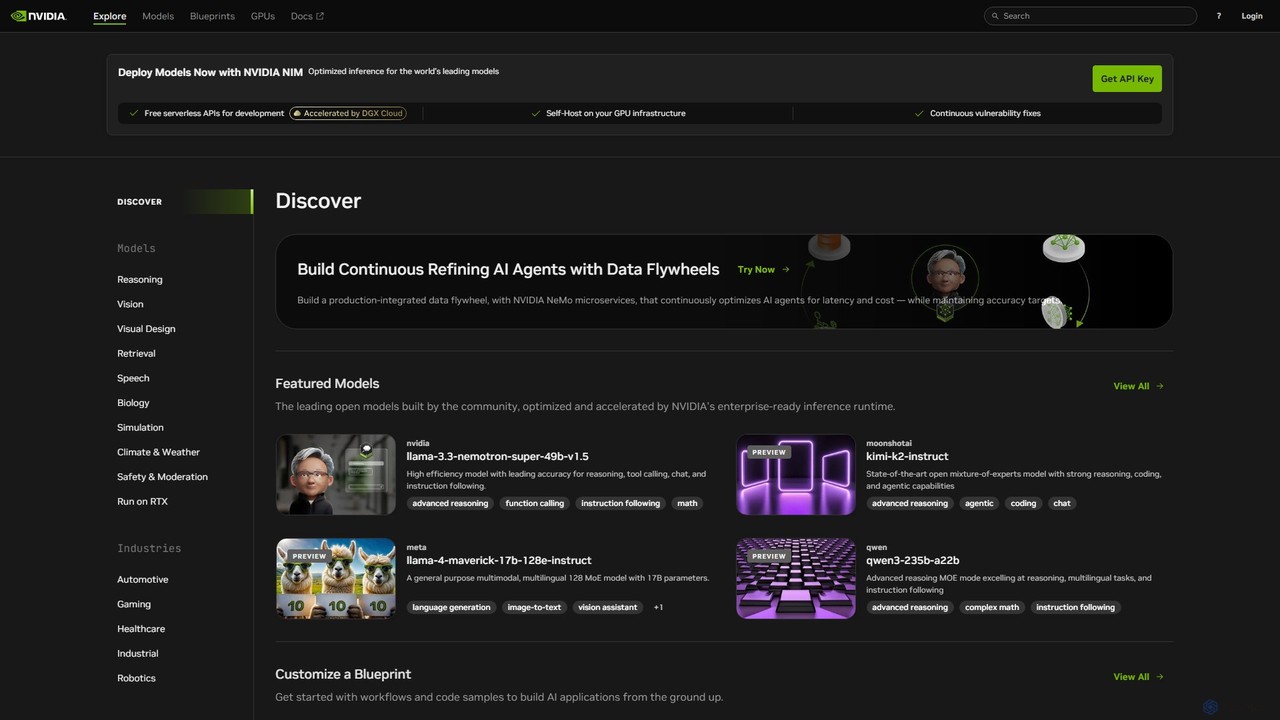
NVIDIA Build
NVIDIA Build is a comprehensive platform for developers and enterprises to discover, customize, and deploy production-ready generative AI …
NVIDIA Build is a comprehensive platform for developers and enterprises to discover, customize, and deploy production-ready generative AI models. It features a vast catalog of optimized models, NVIDIA NIM microservices for high-performance inference, and application blueprints to accelerate development.
About Platform As A Service (Paas)
Platform as a Service (PaaS) is a cloud computing model that provides a complete, ready-to-use platform for developing, running, and managing applications. It abstracts away the underlying infrastructure, offering developers a streamlined environment with operating systems, programming language execution environments, databases, and web servers. This allows teams to focus solely on application code and deployment, accelerating development cycles and reducing operational overhead. PaaS solutions are ideal for agile development and scalable application hosting.
Core Features
- Integrated Development Environment (IDE): Provides tools and services for coding, testing, and debugging applications directly within the platform.
- Application Deployment & Scaling: Automates the deployment process and offers elastic scaling capabilities to handle varying workloads.
- Database & Storage Services: Includes managed database instances and storage solutions, simplifying data management for applications.
- Middleware & Runtime Environments: Offers pre-configured runtime environments for various programming languages and essential middleware components.
- Monitoring & Management Tools: Provides dashboards and tools for tracking application performance, resource usage, and managing deployments.
Applicable Scenarios
PaaS is widely adopted by software development teams, startups, and enterprises seeking to accelerate application delivery. It's particularly beneficial for building web applications, mobile backends, APIs, and microservices. Developers can quickly provision environments for new projects, test new features, and deploy updates without managing servers or operating systems.
How to Choose
When selecting a PaaS provider, consider the supported programming languages and frameworks, integration capabilities with existing tools, scalability options, and pricing model. Evaluate the platform's ecosystem for available services like databases, message queues, and authentication, as well as the level of vendor lock-in and community support.
Platform As A Service (Paas)Use Cases
Rapid Web Application Development
Software startups and agile development teams use PaaS to quickly build and deploy new web applications. Developers can provision a full environment—including runtime, database, and web server—in minutes, allowing them to focus on coding features rather than infrastructure setup. This significantly reduces time-to-market for new products and services.
Mobile Backend Hosting
Mobile app developers leverage PaaS to host the backend services for their applications, such as user authentication, data storage, and API endpoints. PaaS handles the scaling of these services automatically, ensuring the mobile app remains responsive and reliable even with fluctuating user loads, without requiring manual server management.
API Development and Management
Enterprises and SaaS providers utilize PaaS to develop, deploy, and manage robust APIs for internal and external consumption. The platform provides tools for API gateway management, versioning, and security, enabling developers to expose application functionalities securely and efficiently, facilitating integration with other systems.
Microservices Architecture Deployment
Teams adopting a microservices architecture find PaaS ideal for deploying and orchestrating individual services. PaaS platforms offer containerization support and service mesh capabilities, simplifying the management of numerous independent services, enabling faster iteration, and improving overall system resilience and scalability.
DevOps Pipeline Acceleration
DevOps engineers integrate PaaS into their continuous integration/continuous deployment (CI/CD) pipelines to automate application builds, tests, and deployments. PaaS environments streamline the transition from code commit to production, reducing manual intervention and ensuring consistent, reliable deployments across different stages.
Data Processing and Analytics Backends
Data scientists and analysts use PaaS to host backend services for data processing, machine learning model deployment, and real-time analytics applications. PaaS provides scalable compute and storage resources, along with managed database services, allowing teams to focus on data insights and model performance rather than infrastructure provisioning.