
Bounie
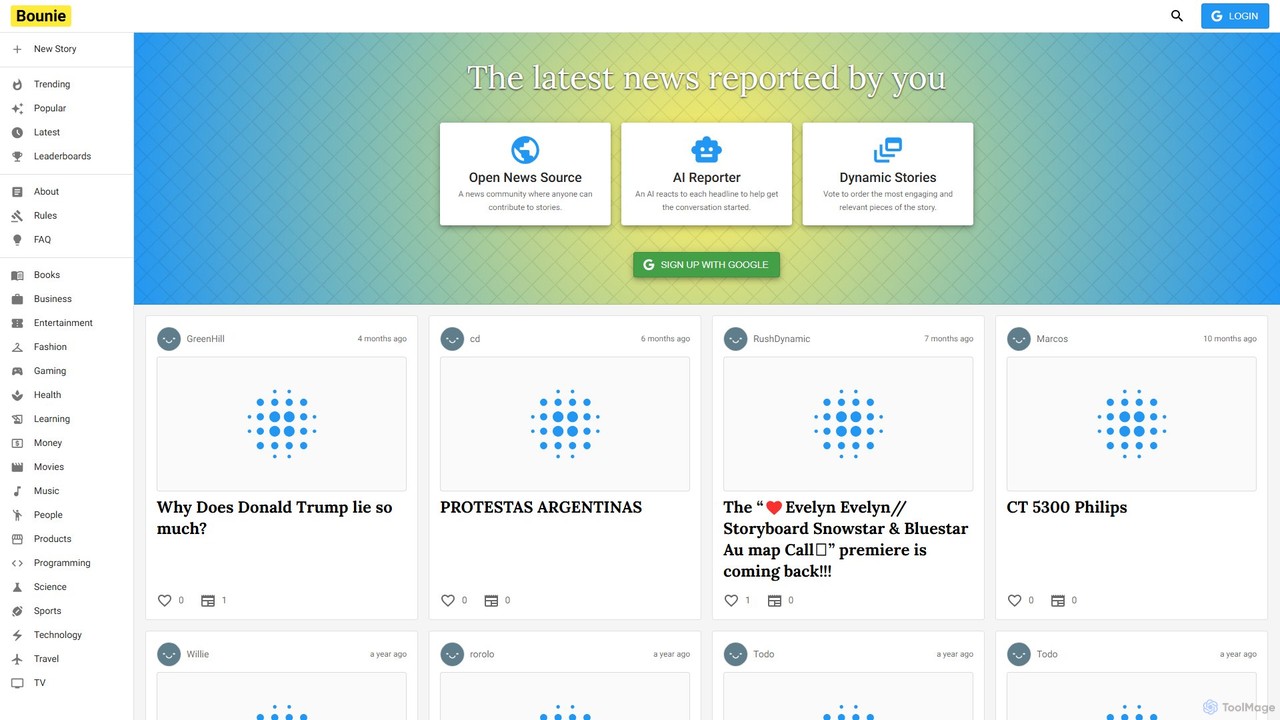
Bounie is an open, collaborative news platform where anyone can contribute to building stories. Starting with a headline, …
Bounie is an open, collaborative news platform where anyone can contribute to building stories. Starting with a headline, users collectively add information, images, links, and opinions to create dynamic, evolving articles. It's a community-driven space for tracking and discussing topics from technology and AI to entertainment and science, reinventing how news is created and consumed.
About Collaborative Platform
AI Collaborative Platforms for news are specialized digital workspaces that integrate artificial intelligence to streamline the entire journalistic workflow. These tools leverage AI for automated data analysis, real-time transcription, and content verification to enhance team productivity. They enable newsrooms to accelerate research, ensure factual accuracy, and manage complex stories with greater efficiency and cohesion. Unlike general project management software, these platforms offer industry-specific features like integrated fact-checking and multi-format content adaptation.
Core Features
- AI-Assisted Research: Automatically gathers and summarizes information from diverse sources to quickly build context for a story.
- Automated Transcription: Converts audio and video interviews into searchable text with high accuracy, identifying speakers and key topics.
- Collaborative AI Editor: Allows multiple journalists to co-write content with real-time AI suggestions for style, grammar, and clarity.
- Integrated Fact-Checking: Flags potential misinformation by cross-referencing claims with verified databases and sources.
- Multi-Channel Content Generation: Adapts a single core report into various formats suitable for web articles, social media posts, and video scripts.
Use Cases
These platforms are primarily used by modern newsrooms, investigative journalism teams, and digital media publishers. They are particularly effective for managing breaking news coverage where speed and accuracy are critical, coordinating long-form investigative reports involving large datasets, and streamlining the daily production of content across multiple digital channels.
How to Choose
When selecting an AI Collaborative Platform, consider its integration capabilities with your existing Content Management System (CMS). Evaluate the accuracy and reliability of its core AI features, such as transcription and fact-checking. Prioritize platforms with robust security protocols to protect sensitive sources and information. Finally, ensure the tool's workflow can be customized to fit your newsroom's specific editorial processes.
Collaborative PlatformUse Cases
Coordinate Breaking News Coverage
A digital news team covering a major, rapidly developing event uses an AI collaborative platform to centralize information. Field reporters upload raw video and audio clips, which are automatically transcribed and summarized by the AI. Editors in the newsroom use a shared workspace to draft articles, pulling in AI-generated summaries and key quotes. The platform's fact-checking module continuously scans the content against verified sources, flagging potential inaccuracies in real-time. This allows the team to publish accurate updates across their website and social media channels minutes faster than competitors.
Manage Long-Form Investigative Reports
An investigative journalism unit works on a complex, data-heavy story over several months. They use the platform as a secure, central repository for all documents, interview transcripts, and data sets. The AI's analytical tools help journalists identify patterns, connections, and anomalies within thousands of pages of documents that would be difficult to spot manually. Team members can securely comment, assign tasks, and track progress on different parts of the investigation. This structured approach ensures that no lead is missed and that the final report is built on a thoroughly vetted foundation of evidence.
Streamline Daily Content Production Workflow
A digital media publisher produces dozens of articles daily. Their editorial team uses a collaborative platform to manage the entire content lifecycle. Writers submit drafts, which are automatically checked by AI for grammar, style guide adherence, and plagiarism. Editors are then notified to review the content. Once approved, the AI assists in generating SEO-friendly headlines, meta descriptions, and social media posts. The platform's calendar view provides a clear overview of all content statuses, from 'draft' to 'published', ensuring a smooth and efficient daily production pipeline.
Automate Interview Transcription and Analysis
A podcast producer or journalist conducts several long interviews for a feature story. Instead of spending hours manually transcribing the audio, they upload the files to the collaborative platform. The AI transcribes the conversations in minutes, automatically identifying different speakers and creating a time-stamped, searchable text document. Furthermore, the AI can analyze the transcript to identify recurring themes, key entities (names, places), and sentiment, providing the journalist with a high-level summary and helping them quickly locate the most impactful quotes for their article.
Facilitate Remote Team Collaboration
A news organization has journalists and editors working from different cities and time zones. The AI collaborative platform acts as their virtual newsroom. A journalist in London can file a story draft, and an editor in New York can review it hours later, leaving comments and suggestions. The AI can summarize the changes made for quick review. The platform's centralized dashboard shows the status of all ongoing stories, ensuring the entire distributed team remains synchronized without constant meetings or long email chains, maintaining productivity across the globe.
Repurpose Content for Multiple Channels
After publishing a major investigative piece on their website, a media outlet wants to maximize its reach. Using the collaborative platform, the social media manager inputs the original article. The AI then generates multiple content variations: a concise summary for a Twitter thread, a visually-oriented post for Instagram with suggested imagery, a professional summary for LinkedIn, and a short video script outline for TikTok or YouTube Shorts. This allows a small team to efficiently adapt a single piece of core content for different audiences and platforms, significantly increasing engagement without a proportional increase in workload.