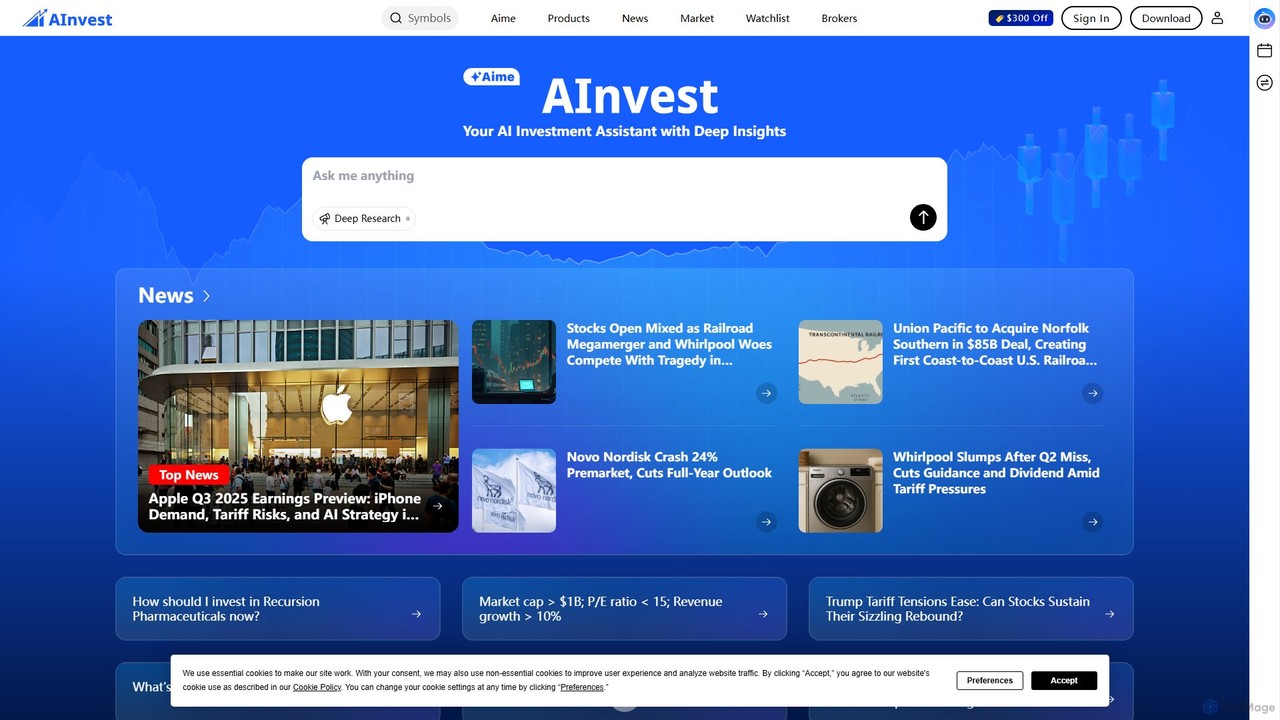
Financial News AI tools are specialized platforms that leverage artificial intelligence to analyze, summarize, and deliver real-time financial market information. These tools utilize natural language processing (NLP), machine learning, and sentiment analysis to process vast amounts of data from news articles, social media, and regulatory filings. They provide investors, traders, and financial analysts with actionable insights, helping them make informed decisions and stay ahead of market trends.
Core Features
- Real-time Data Aggregation: Gathers and processes financial news from thousands of sources globally in real time.
- Sentiment Analysis: Identifies and quantifies the emotional tone of news articles and social media mentions related to specific assets or markets.
- Automated Summarization: Generates concise summaries of lengthy financial reports, earnings calls, and news articles.
- Predictive Analytics: Uses historical data and news patterns to forecast potential market movements or asset performance.
- Customizable Alerts: Delivers personalized notifications for breaking news, significant market events, or changes in sentiment for selected portfolios.
Use Cases
Financial professionals, from individual investors to institutional traders, utilize these tools to gain a competitive edge. They are crucial for monitoring portfolio-relevant news, identifying emerging risks or opportunities, and understanding the broader economic landscape. For example, a hedge fund manager might use them to detect early signs of market shifts based on news sentiment, while a retail investor could track news impacting their stock holdings.
How to Choose
When selecting a Financial News AI tool, consider its data source breadth and quality, the speed of its real-time processing, and the accuracy of its sentiment analysis. Evaluate the customization options for alerts and dashboards, its integration capabilities with existing trading or analysis platforms, and the clarity of its predictive insights. User interface and pricing models are also important factors for long-term usability and cost-effectiveness.