Uansa
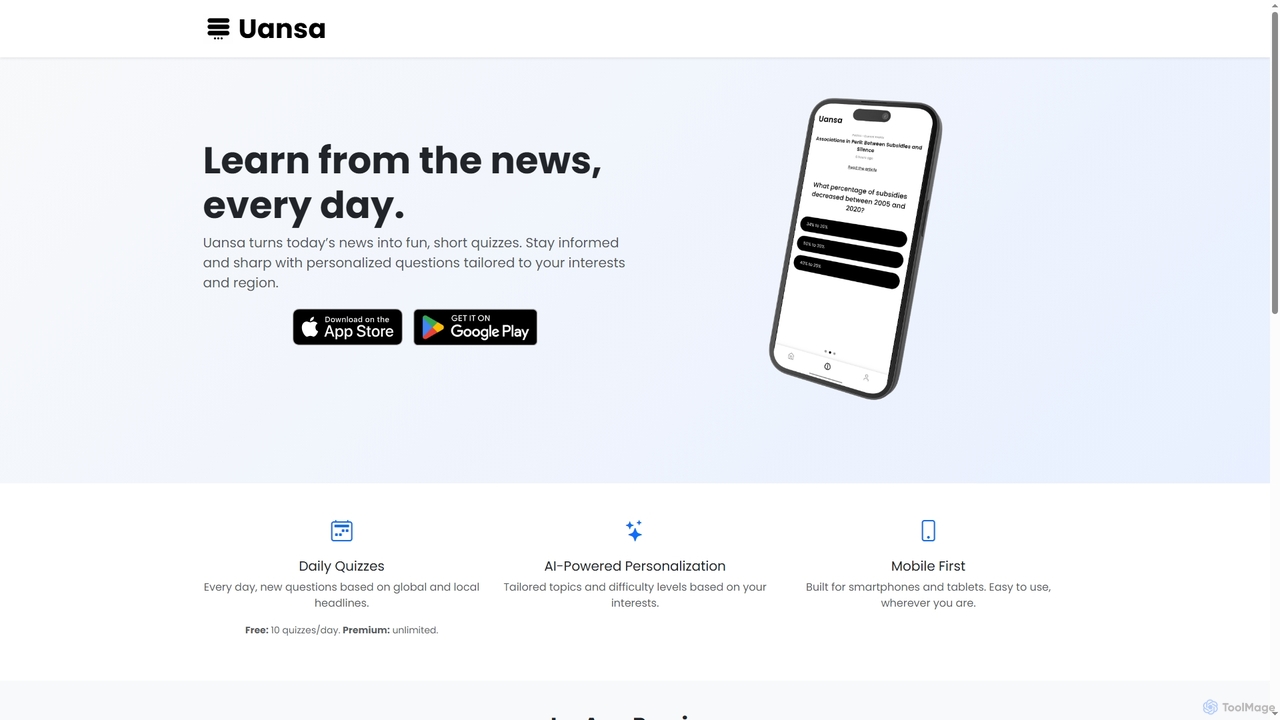
Uansa is an AI-powered mobile application offering daily smart news quizzes based on global and local headlines. It …
Uansa is an AI-powered mobile application offering daily smart news quizzes based on global and local headlines. It provides personalized learning experiences by tailoring topics and difficulty levels to user interests, helping individuals stay informed and sharpen their knowledge on the go.
About Current Events
AI Current Events tools are a specialized category of news applications that use artificial intelligence to monitor, analyze, and summarize breaking news and real-time global events. These tools leverage Natural Language Processing (NLP) to process vast streams of information from sources like news outlets, social media, and official reports. This enables users such as journalists, financial analysts, and risk managers to rapidly understand complex situations, detect emerging trends, and track public sentiment as events unfold. Unlike general news aggregators, they focus on the velocity and dynamic nature of information, providing deep analytical insights beyond simple headlines.
Core Features
- Real-time Event Detection: Automatically identifies and surfaces breaking stories from thousands of sources the moment they happen.
- Sentiment Analysis: Gauges the emotional tone (positive, negative, neutral) of news coverage and public discussion surrounding an event.
- Automated Summarization: Condenses multiple articles and reports into concise, easy-to-digest summaries to save reading time.
- Trend & Anomaly Detection: Pinpoints unusual spikes in conversation or emerging narratives related to specific topics or entities.
- Source Triangulation: Cross-references information from various sources to help assess credibility and identify conflicting reports.
Use Cases
These tools are critical for professionals in fast-paced environments. For instance, financial traders use them to detect market-moving news before it impacts stock prices. Public relations teams monitor brand mentions during a crisis to manage reputation in real-time. Government agencies and NGOs use them for geopolitical risk analysis and monitoring public discourse on policy issues.
How to Choose
When selecting an AI Current Events tool, consider the breadth and type of sources it covers (e.g., global news, social media, financial wires). Evaluate the depth of its analytical features—do you need simple alerts or complex trend and sentiment analysis? Also, assess the update frequency (latency) and the ability to customize dashboards and alerts to filter out noise and focus on what matters to you.

Current EventsUse Cases
Crisis Management and Brand Reputation Monitoring
A public relations manager for a global corporation uses an AI Current Events tool to monitor brand reputation. When a negative story begins to circulate online, the system immediately sends an alert. The manager uses the dashboard to track the story's velocity across news sites and social media, analyze the public's sentiment in real-time, and identify key journalists or influencers driving the narrative. This allows the communications team to craft a precise, data-informed response within minutes, rather than hours, helping to mitigate reputational damage before the story spirals out of control.
Identifying Financial Market Opportunities
A quantitative analyst at a hedge fund relies on an AI Current Events tool to gain a competitive edge. They configure custom alerts for keywords related to geopolitical tensions, central bank policy shifts, and supply chain disruptions for specific commodities. The AI continuously scans thousands of global sources, including obscure local news and official government releases. When the tool detects a credible, market-moving event, it provides an instant summary and sentiment score. This allows the analyst to execute trades based on new information seconds or minutes before it becomes widely known, capturing alpha from information asymmetry.
Geopolitical Risk Analysis for Supply Chains
A supply chain manager for a manufacturing company uses an AI tool to monitor geopolitical risks in regions where they have key suppliers. They set up a dashboard tracking terms like 'protests,' 'elections,' 'tariffs,' and 'port closures' in specific countries. The tool aggregates and analyzes local news in native languages, providing translated summaries and trend alerts. When the AI detects a rising trend of labor unrest near a critical factory, it alerts the manager. This early warning enables them to proactively reroute shipments or increase inventory from alternative suppliers, preventing costly production delays.
Enhancing Journalistic Research and Story Discovery
A journalist covering international affairs uses an AI Current Events tool to discover new story angles. Instead of manually sifting through hundreds of articles, they use the tool to identify emerging narratives around a diplomatic summit. The AI clusters articles by theme, highlights quotes from key officials, and surfaces eyewitness accounts from social media that larger outlets may have missed. It also provides a timeline of events, helping the journalist quickly get up to speed. This process reduces research time by over 70% and helps them uncover unique, underreported aspects of the story for their publication.
Tracking Public Policy and Election Campaigns
A policy analyst working for a non-profit organization tracks public sentiment regarding a new environmental regulation. They use an AI Current Events tool to monitor news coverage and social media conversations across different states. The tool's sentiment analysis reveals that public support is high in coastal regions but low in industrial areas. It also identifies key arguments and misinformation spreading in opposing communities. These insights are compiled into a report that helps the organization tailor its advocacy and public education campaigns to address specific concerns in different regions, making their efforts more effective.
Academic Research on Media Bias and Framing
A team of university researchers is studying media framing of a major international conflict. Manually analyzing thousands of articles would be prohibitive. Instead, they use an AI Current Events tool to collect news articles from hundreds of outlets across 20 countries over a six-month period. The AI automatically tags entities (people, organizations), extracts key themes, and performs sentiment analysis on the coverage from each country. The researchers can then easily compare how different national media outlets frame the same events, providing quantitative data to support their analysis of media bias and its influence on public perception.