
ToolMage
Sign in

Best 1 Newsletter AI tools for News

Popular Newsletter AI tools in News include tldl, helping you work more efficiently.

tldl
Free

tldl

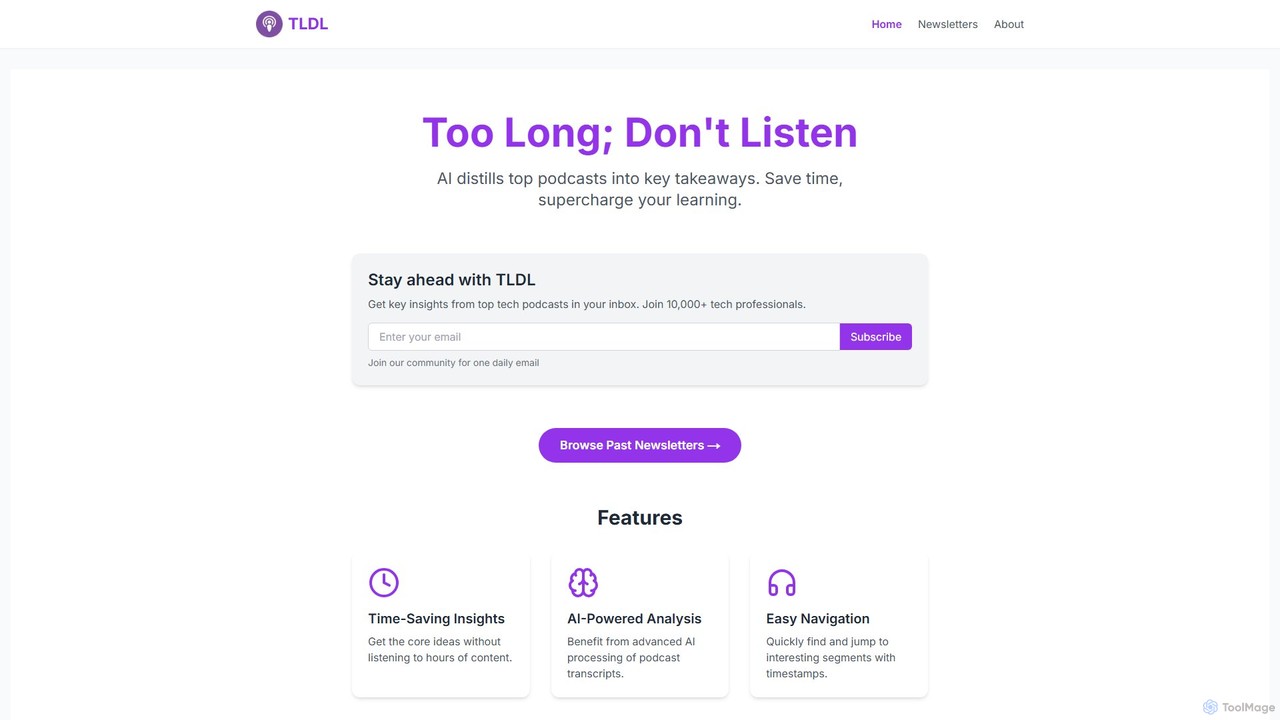
tldl (Too Long; Don't Listen) is an AI-powered service that saves you time by distilling long-form tech and AI podcasts into concise, actionable insights. It analyzes podcast transcripts to extract key takeaways, quotes, and timestamps, delivering them directly to your inbox as a daily newsletter. This service is perfect for busy tech professionals who want to stay ahead of industry trends in AI, startups, and infrastructure without spending hours listening to content.

Learning
Visits 58.8KFavorites 163Likes 151

About Newsletter

AI Newsletter tools are a class of applications that automate the creation and distribution of email newsletters. They leverage artificial intelligence to curate content from various sources, generate summaries, and even draft entire articles. This significantly reduces the manual effort required in content gathering and writing, allowing creators to produce high-quality, relevant newsletters consistently. These tools are particularly valuable for delivering personalized content at scale and maintaining audience engagement with minimal time investment.

Core Features

  • Automated Content Curation: Scans predefined sources like RSS feeds, websites, and social media to automatically gather relevant articles and links.
  • AI-Powered Summarization and Writing: Utilizes natural language processing (NLP) to generate concise summaries or draft original content based on curated materials.
  • Content Personalization: Dynamically tailors newsletter content for different audience segments based on their interests and past engagement.
  • Template and Design Assistance: Suggests or automatically applies layouts and designs to ensure newsletters are visually appealing and easy to read.
  • Performance Analytics: Tracks metrics like open rates and click-throughs, providing insights to optimize future content strategy.

Use Cases

AI Newsletter tools are ideal for content creators, marketers, community managers, and corporate communication teams. For instance, a solo creator can use them to publish a weekly industry digest without spending hours on research. A marketing team can nurture leads by sending personalized content roundups. Internal communications can use them to automate the distribution of company news and updates.

How to Choose

When selecting an AI Newsletter tool, consider the quality and variety of content sources it can integrate with. Evaluate the sophistication of its AI writing and summarization capabilities—does it produce natural-sounding text? Also, assess the level of customization available for templates and content, the depth of its analytics, and whether the pricing model aligns with your subscriber count and sending frequency.

Newsletter use cases

1

Automate a Weekly Industry Digest

A solo content creator or industry analyst needs to send a weekly newsletter summarizing the top news and trends in their niche. Instead of spending 8-10 hours manually searching for articles, reading, and writing summaries, they use an AI Newsletter tool. They connect their trusted sources (blogs, news sites, Twitter lists) to the tool. The AI automatically curates the most relevant content, generates concise summaries for each link, and drafts the entire newsletter in a pre-designed template. The creator then spends just 30 minutes reviewing, editing, and adding their personal commentary before scheduling the send, saving over 90% of their production time.

2

Power Corporate Internal Communications

An HR or internal communications manager is tasked with keeping employees informed about company news, industry updates, and team achievements. Manually compiling this information from different departments is time-consuming. By using an AI Newsletter tool, they can set up automated feeds from the company blog, press releases, and specific internal channels. The tool aggregates all updates into a single draft. The manager can then quickly organize the content, use the AI writer to draft an introduction, and ensure a consistent, professional-looking newsletter is sent out every week, boosting employee engagement and information transparency.

3

Create Personalized Lead Nurturing Campaigns

A B2B marketing team wants to nurture leads with content relevant to their specific industry or interests. Creating dozens of newsletter variations manually is not feasible. They use an AI Newsletter tool that integrates with their CRM. The tool can pull curated content and tag it by topic (e.g., 'finance', 'healthcare', 'AI'). It then automatically assembles different newsletter versions for segmented lists, ensuring that leads in the finance sector receive articles about financial technology, while healthcare leads get content about medical innovations. This hyper-personalization increases click-through rates and moves leads further down the sales funnel.

4

Generate Content for Niche Communities

A community manager for an online forum or a special interest group wants to re-engage members with a weekly summary of the best discussions and content. Manually tracking all conversations is impossible. They use an AI tool to monitor the community platform (e.g., via RSS feeds of specific forums or keyword alerts). The AI identifies the most popular threads and user-generated content, summarizes them, and compiles a 'Best of the Week' newsletter. This not only saves the manager's time but also highlights valuable community contributions, encouraging more active participation.

5

Curate Educational Content for Students

An educator or an online course platform wants to provide supplementary learning materials to their students via a weekly newsletter. They need to find the latest articles, studies, and videos related to their course topics. Using an AI Newsletter tool, they can set up curation from academic journals, educational blogs, and YouTube channels. The AI gathers relevant materials and provides summaries, which the educator can then frame with their own teaching points and questions. This provides continuous value to students beyond the core curriculum and establishes the educator as an authority in their field, all with minimal weekly effort.

6

Monitor Competitors and Market Trends

A strategy or product marketing team needs to stay updated on competitor activities and market trends. They set up an AI Newsletter tool to monitor the blogs, press releases, and social media of their key competitors. The tool automatically pulls any new content, summarizes it, and compiles it into a daily or weekly internal briefing. This automated intelligence gathering ensures the team never misses a critical update, such as a new product launch or a significant partnership announcement. It allows them to react faster and make more informed strategic decisions without dedicating a person to manual monitoring.

Newsletter FAQ

What are AI Newsletter tools?

AI Newsletter tools are specialized applications designed to automate the process of creating and distributing email newsletters. Unlike traditional email platforms, their core strength lies in using artificial intelligence to automatically curate content from various online sources, generate summaries or drafts, and sometimes even suggest layouts. They help users save significant time on content discovery and writing, enabling them to send relevant, high-quality newsletters more consistently.

How do AI Newsletter tools differ from traditional email marketing platforms?

The primary difference lies in content creation. Traditional email marketing platforms (like Mailchimp or ConvertKit) focus on list management, email delivery, and template building, but require you to manually write or find all the content. AI Newsletter tools, on the other hand, focus on automating the content gathering and writing process itself. They act as a content engine *before* the email is sent, using AI to find articles, summarize them, and assemble a draft, which can then be sent via their own system or integrated with a traditional platform.

How to choose the right AI Newsletter tool?

When selecting an AI Newsletter tool, consider these factors:

  • Content Sources: Check which sources it can pull content from (RSS, websites, Twitter, etc.) and ensure they align with your needs.
  • AI Quality: Evaluate the quality of the AI-generated summaries and text. Does it sound natural and capture the key points accurately?
  • Customization: Assess how much control you have over the final look and feel, including templates, branding, and content arrangement.
  • Integration: Determine if it integrates with your existing tools, such as your primary email service provider or CRM.
  • Pricing: Understand the pricing model. Is it based on subscribers, number of newsletters sent, or features used?
What are the main benefits of using an AI Newsletter tool?

The primary benefits are significant time savings and improved content quality. By automating the repetitive tasks of finding and summarizing content, these tools free up creators to focus on strategy, analysis, and adding their unique voice. This leads to more consistent publishing schedules, which can improve audience engagement. Additionally, the AI can often discover relevant content from a wider range of sources than a human might monitor manually, leading to richer and more diverse newsletters.

Can AI completely replace a human in newsletter creation?

While AI is powerful for automation, it doesn't completely replace the need for human oversight. The best approach is to use AI as an assistant. The AI handles the heavy lifting of content curation and initial drafting. A human editor then reviews the content for accuracy, adds personal insights, commentary, and strategic context, and ensures the final newsletter aligns with the brand's voice and goals. This combination of AI efficiency and human creativity produces the best results.