AlphaInquire
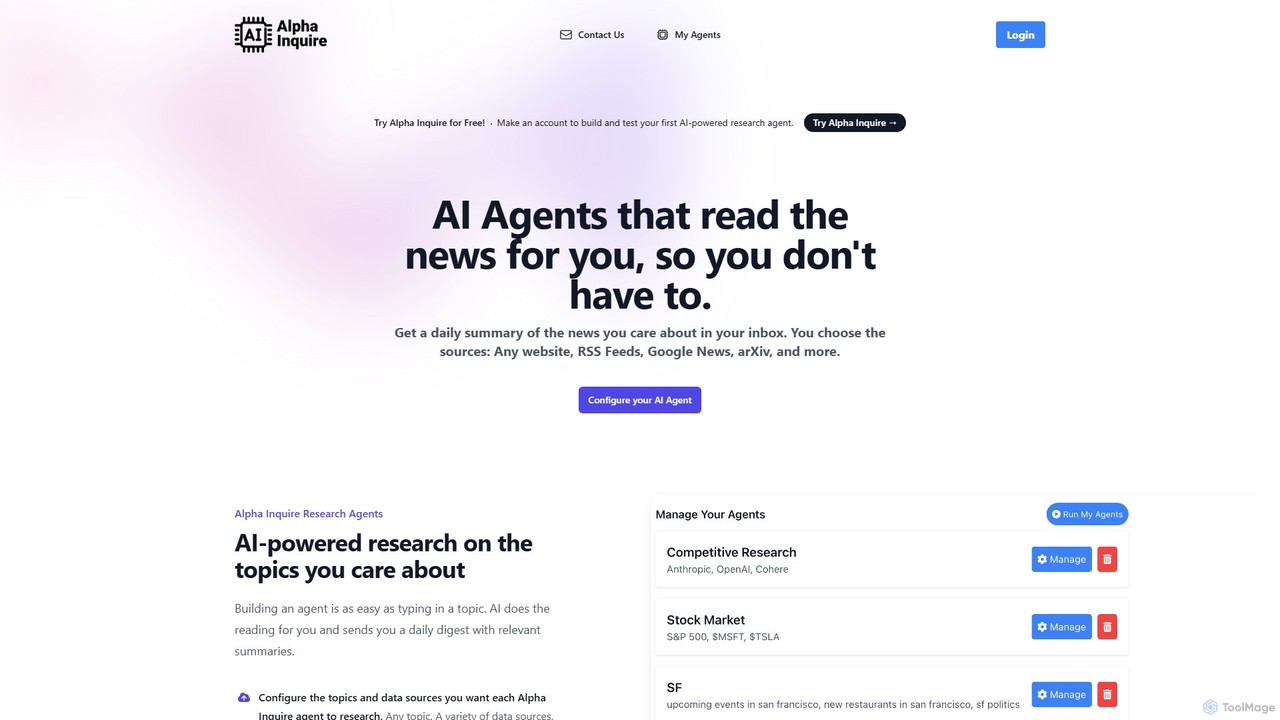
AlphaInquire is an AI-powered research platform that creates autonomous agents to monitor news, websites, and data sources for …
AlphaInquire is an AI-powered research platform that creates autonomous agents to monitor news, websites, and data sources for you. It delivers personalized daily summaries directly to your inbox, saving you time and keeping you informed on the topics you care about most.
Telborg
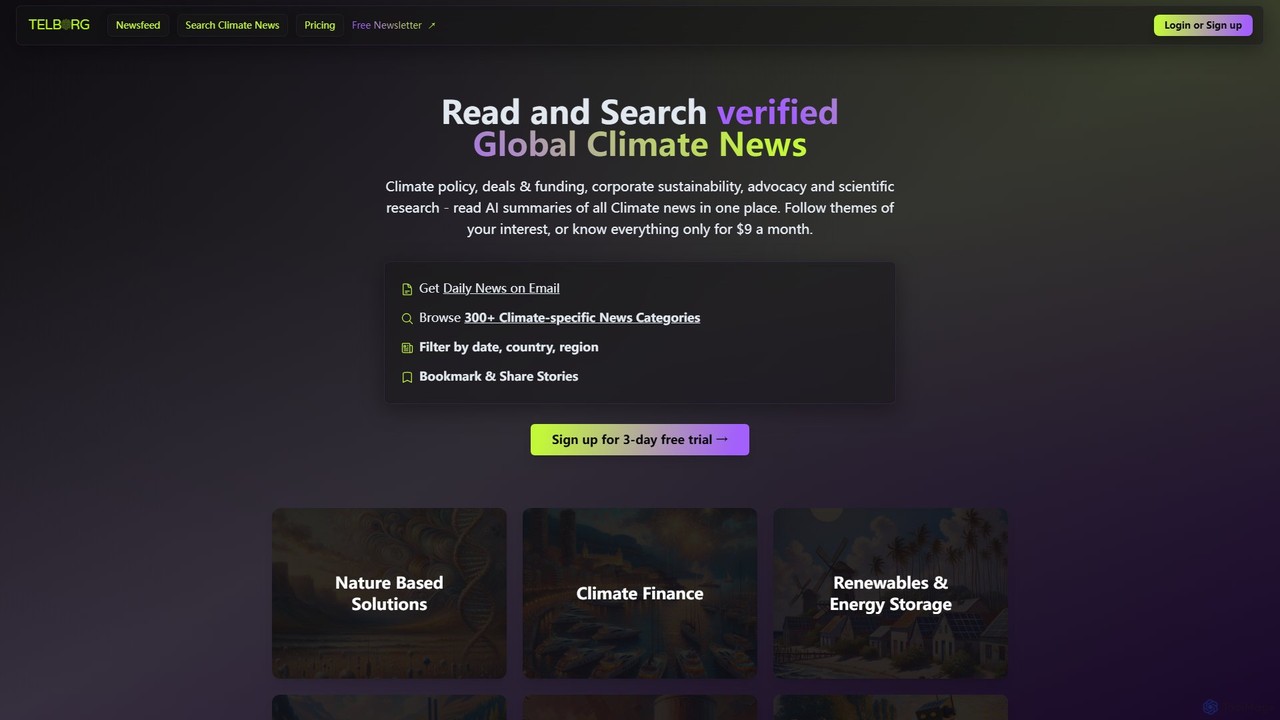
Telborg is an AI-powered news platform delivering concise, verified global climate news. It sources information directly from official …
Telborg is an AI-powered news platform delivering concise, verified global climate news. It sources information directly from official bodies like governments, corporations, and research institutions, providing AI-generated summaries across 300+ specific climate categories. It's designed for professionals who need credible, up-to-date insights on climate policy, finance, technology, and sustainability.
About Research
AI Research tools are a specialized category of AI News tools designed for automated information gathering, analysis, and synthesis. They leverage natural language processing (NLP) and machine learning to scan vast datasets from news, academic journals, and reports to identify relevant information and generate concise insights. These tools are essential for professionals who need to quickly understand complex topics, track developing stories, or conduct in-depth analysis. They transform raw data into structured, actionable intelligence.
Core Features
- Automated Data Aggregation: Gathers and consolidates information from a wide range of sources like news outlets, scientific papers, and social media.
- Semantic Search: Understands the context and intent behind a query to deliver more relevant and nuanced search results than keyword-based search.
- AI-Powered Summarization: Condenses long articles, reports, or multiple documents into key points, saving significant reading time.
- Trend & Anomaly Detection: Identifies emerging topics, shifts in sentiment, or unusual patterns within large volumes of text data over time.
- Source Analysis: Provides metadata about information sources, helping users evaluate credibility and context.
Use Cases
AI Research tools are widely used by academic researchers, market analysts, journalists, and corporate strategists. For instance, an analyst can use these tools to monitor industry trends and competitor activities, while a journalist can quickly gather background information and identify key sources for a story. They are invaluable for anyone performing literature reviews, due diligence, or competitive intelligence.
How to Choose
When selecting an AI Research tool, consider the breadth and quality of its data sources. Evaluate the sophistication of its analytical features, such as summarization accuracy and trend analysis capabilities. Also, assess its user interface for ease of use and its ability to integrate with your existing workflows, such as exporting data or connecting to other applications. Finally, consider the pricing model and whether it aligns with your usage frequency and team size.
ResearchUse Cases
Market Trend Analysis for Investment Firms
An investment analyst uses an AI research tool to monitor the renewable energy sector. The tool continuously scans global news, financial reports, and patent filings. It automatically identifies and summarizes emerging trends, such as breakthroughs in battery technology or shifts in government policy. This provides the analyst with a daily intelligence briefing, enabling them to spot investment opportunities and risks far more quickly than through manual research, directly influencing portfolio strategy.
Accelerating Academic Literature Reviews
A PhD student researching genetics uses an AI tool to conduct a literature review. Instead of manually searching databases, they input their research query, and the tool scans thousands of academic papers. It identifies seminal works, summarizes key findings from recent publications, and visualizes the connections between different research streams. This reduces the time for a comprehensive review from months to weeks, allowing the researcher to focus on analysis and experimentation sooner.
Competitive Intelligence for Product Managers
A product manager at a tech company sets up an AI research tool to track competitors. The tool monitors news articles, blog posts, press releases, and social media for mentions of rival products. It provides real-time alerts on new feature launches, pricing changes, and significant customer complaints. The AI summarizes this information into a weekly competitive landscape report, helping the product manager make informed decisions about their own product roadmap and positioning.
Investigative Journalism Story Development
An investigative journalist uses an AI research tool to uncover connections within a complex network of shell corporations. By feeding the tool company names and director details from public records, the AI cross-references this data with news archives and leaked documents. It visualizes hidden relationships and flags anomalies, such as directors appearing in multiple unrelated companies. This allows the journalist to identify key patterns and focus their investigation on the most promising leads, a task that would be nearly impossible manually.
Public Relations Crisis Monitoring
A corporate communications team uses an AI research tool for real-time brand monitoring. The tool tracks mentions of their company across news sites, forums, and social media 24/7. When it detects a sudden spike in negative sentiment or the rapid spread of misinformation, it sends an immediate alert to the PR team. The alert includes a summary of the issue and links to the primary sources, allowing the team to quickly assess the situation and formulate a response before it becomes a major crisis.
Policy Analysis for Government Agencies
A policy analyst at a government agency uses an AI research tool to track public discourse on a new environmental regulation. The tool aggregates news coverage, academic studies, and public comments from social media and forums. It performs sentiment analysis to gauge public opinion across different regions and demographic groups. The AI generates reports that summarize key arguments for and against the policy, helping the analyst draft more informed and responsive policy briefs for lawmakers.