
News Best in category 1 results Summarization AI Tool

Popular AI tools in the Summarization field of News include Simply News, etc., helping you quickly improve efficiency.

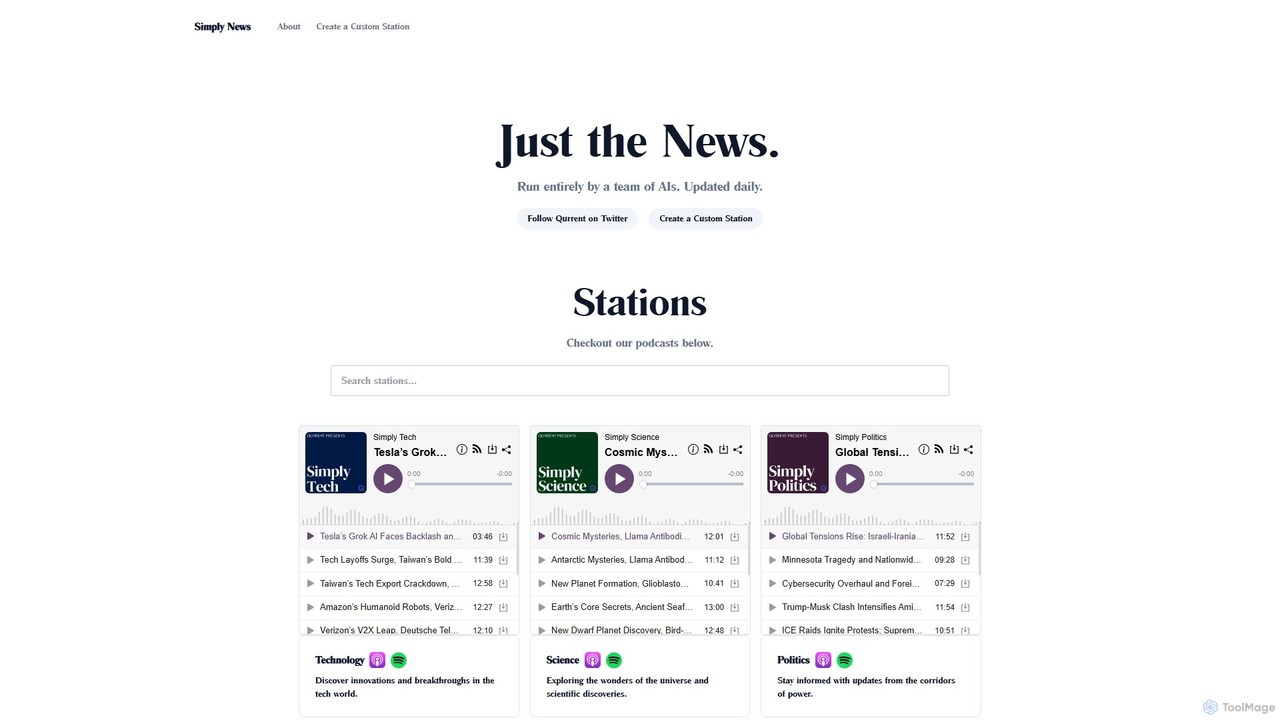
Simply News

Simply News

Simply News is an innovative news platform entirely run by a team of AI agents. It delivers daily, …

2.7K

About Summarization

AI Summarization tools are a class of software that use natural language processing (NLP) to condense long texts into concise, coherent summaries. These tools analyze the source content to identify key ideas and crucial information, presenting them in a shortened format. This is particularly effective for quickly digesting news articles, research papers, and business reports, saving significant time while retaining core insights. They can generate summaries of varying lengths and styles, from simple bullet points to narrative paragraphs.

Core Features

  • Extractive & Abstractive Methods: Tools may use extractive summarization to pull key sentences directly from the source or abstractive methods to generate new, human-like sentences that capture the essence of the text.
  • Customizable Summary Length: Users can typically specify the desired output length, whether as a percentage of the original text, a specific word count, or a number of bullet points.
  • Key Information Extraction: Automatically identifies and highlights main topics, named entities (people, places, organizations), and critical data points within the document.
  • Multi-Format Input: Supports summarizing content from various sources, including pasted text, uploaded documents (PDF, DOCX), and web page URLs.
  • Multi-Language Support: Capable of processing and summarizing text in numerous languages, breaking down language barriers in information consumption.

Use Cases

AI Summarization tools are invaluable for professionals and students who handle large volumes of text. Journalists and market analysts use them to quickly process daily news feeds and competitor reports. Researchers and academics accelerate their literature review process by summarizing dense papers. Business executives can stay informed on industry trends without reading lengthy documents, making it a key tool for efficient information management.

How to Choose

When selecting an AI Summarization tool, consider the quality and coherence of the generated summaries. Evaluate its support for different input formats (e.g., PDF, URL) and languages you require. For business use, check for API availability for integration into existing workflows. Finally, review the tool's privacy policy to understand how your data is handled, especially when summarizing sensitive or confidential documents.

SummarizationUse Cases

1

Accelerate Market Research and Competitive Analysis

A market analyst is tasked with creating a daily briefing on industry news and competitor activities. Instead of manually reading dozens of articles and reports, they use an AI summarization tool. By feeding URLs of news articles and uploading PDF reports, the tool generates concise, bullet-point summaries for each source within seconds. This allows the analyst to quickly identify key trends, product launches, and strategic shifts, compiling a comprehensive briefing in under an hour, a task that previously took half a day. The result is a more timely and efficient intelligence gathering process.

2

Efficient Literature Review for Academic Research

A postgraduate student is working on a literature review for their thesis, which requires them to analyze over 100 academic papers. To manage this volume, the student uses an AI summarizer. They upload PDFs of the papers, and the tool extracts the abstract, methodology, key findings, and conclusions for each one. This provides a high-level overview, helping the student quickly decide which papers are most relevant and require a full read-through. This process reduces the initial screening time by over 70%, enabling a more focused and comprehensive review of the core literature.

3

Repurposing Long-Form Content for Social Media

A content marketing team publishes a detailed, 3000-word blog post. To maximize its reach, a social media manager uses an AI summarizer to repurpose the content. They paste the blog post's text into the tool and request several outputs: a 280-character summary for Twitter, a three-bullet-point summary for a LinkedIn post, and a concise paragraph for an Instagram caption. The tool generates these variations in minutes, providing ready-to-use copy that maintains the core message of the original article. This streamlines the content distribution workflow and ensures consistent messaging across all platforms.

4

Quickly Grasping Meeting Transcripts

A project manager who missed an important hour-long virtual meeting receives the automated transcript. Instead of reading the entire text, they use an AI summarizer to get the key takeaways. The tool processes the transcript and produces a summary highlighting the main decisions made, action items assigned (with names), and deadlines agreed upon. This allows the manager to get up to speed in less than five minutes, ensuring they don't miss critical follow-ups. It's particularly useful for global teams working across different time zones where attending every meeting is not feasible.

5

Streamlining Legal Document Review

A paralegal needs to review a large volume of case files and legal precedents for an upcoming trial. The documents are often lengthy and dense. By using an AI summarization tool, the paralegal can quickly generate summaries of each document, highlighting key arguments, rulings, and relevant facts. This initial pass allows them to categorize and prioritize documents efficiently. It significantly reduces the manual reading time required, freeing them up to focus on deeper analysis and strategy development for the case, rather than getting bogged down in preliminary reading.

6

Creating Executive Summaries from Business Reports

A business analyst has just completed a comprehensive 50-page quarterly performance report filled with data and charts. Before sending it to the executive team, they need to create a one-page executive summary. Using an AI summarization tool, they upload the full report. The tool analyzes the text, identifies the most critical performance metrics, key achievements, and areas for improvement, and generates a well-structured narrative summary. The analyst can then refine this draft, saving hours of work in distilling the report's essence and ensuring leadership receives a clear, concise overview for quick decision-making.

SummarizationFrequently Asked Questions