ToolMage
Sign in

Best 2 Summarizer AI tools for News

Popular Summarizer AI tools in News include AiKeeda and last24, helping you work more efficiently.

last24
Freemium

last24

last24 is an AI-powered news summarizer that transforms the latest articles and reports from the last 24 hours into simple, visual summaries. It covers diverse topics like stock markets, cryptocurrency, politics, and health, helping users stay informed efficiently and cut through information overload.

Market Analysis
Visits 5.8KFavorites 113Likes 134
AiKeeda
Free

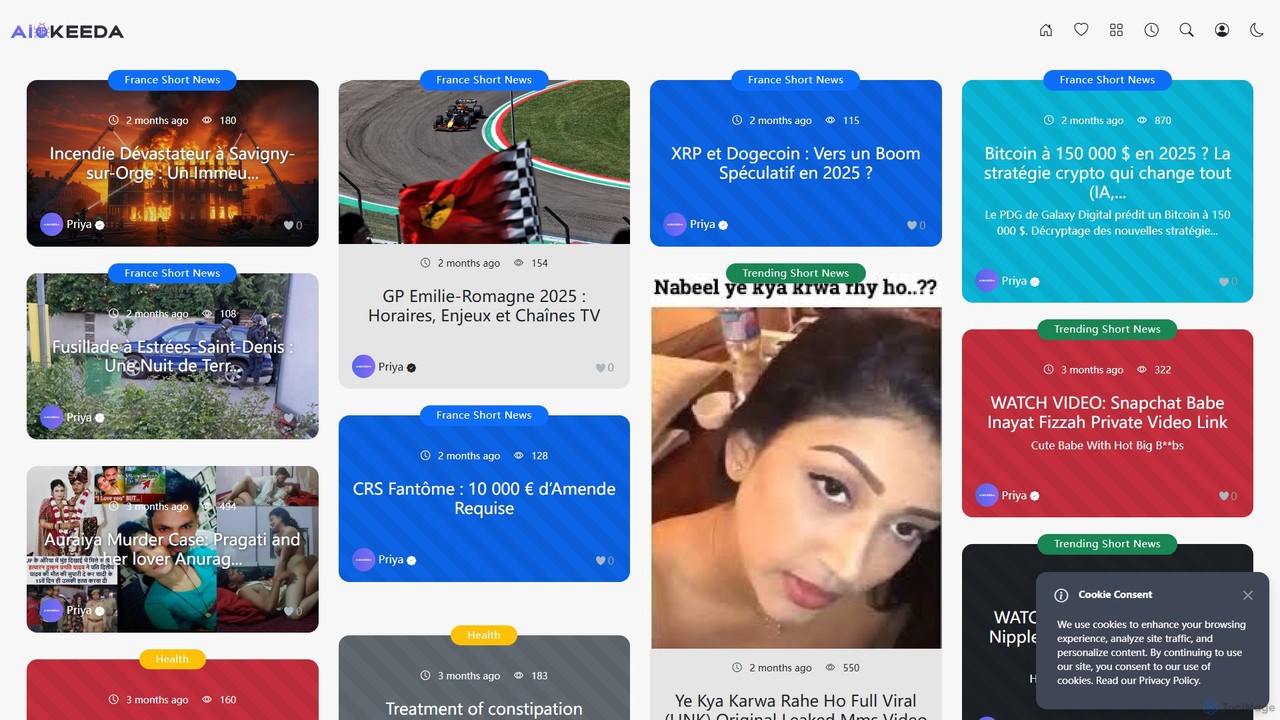
AiKeeda

AiKeeda is an AI-powered news platform that delivers concise summaries of trending and important news from around the world. It covers a wide range of topics including general news, health, lifestyle, and viral trends, presenting them in a quick, easy-to-read format for users who want to stay informed on the go.

Updates
Visits 27.6KFavorites 98Likes 103

About Summarizer

Summarizer tools are AI-powered applications designed to condense long texts, such as news articles and reports, into concise and coherent summaries. They leverage Natural Language Processing (NLP) models to identify key information and main ideas from the source material. This allows users to quickly grasp the essence of extensive documents without reading them in their entirety. These tools are particularly valuable for professionals and researchers who need to process large volumes of information efficiently.

Core Features

  • Adjustable Summary Length: Allows users to specify the desired length of the summary, from a single sentence to a detailed paragraph.
  • Key Point Extraction: Automatically identifies and lists the most critical sentences or bullet points from the text.
  • Extractive & Abstractive Methods: Employs extractive summarization (pulling direct quotes) or abstractive summarization (generating new, human-like sentences).
  • Multiple Input Formats: Supports various inputs, including pasted text, document uploads (PDF, DOCX), and direct web page URLs.

Use Cases

These tools are widely used by journalists, financial analysts, and market researchers to stay updated on breaking news and industry trends. Students and academics use them to quickly review research papers and articles. Corporate teams also utilize summarizers to condense meeting transcripts, internal reports, and competitor analyses into actionable insights.

How to Choose

When selecting a summarizer, consider the accuracy and coherence of the generated summaries. Evaluate the range of supported languages and document formats. For professional use, check for features like API access for integration and robust data privacy policies, especially when handling sensitive information. Finally, compare the user interface and pricing models to find a tool that fits your workflow and budget.

Summarizer use cases

1

Accelerating Academic Research

A university student is writing a literature review for their thesis and needs to analyze dozens of academic papers. Instead of spending days reading each paper fully, they use an AI summarizer. By inputting the PDF of each paper, the tool generates a structured summary with key findings, methodology, and conclusions in minutes. This allows the student to quickly assess the relevance of each paper, identify core themes across the literature, and save over 80% of their initial research time, focusing instead on critical analysis and writing.

2

Daily Market and News Briefings

A financial analyst needs to stay on top of market news, press releases, and economic reports published daily. They set up an AI summarizer to monitor a list of key news sources via URLs. Each morning, the tool automatically fetches and summarizes the top 20 articles, presenting them as a concise daily briefing. This automated process transforms hours of manual reading into a 15-minute review, enabling the analyst to quickly identify market-moving events and make more informed trading decisions.

3

Condensing Meeting Transcripts

A project manager concludes a two-hour virtual meeting with multiple stakeholders. The meeting transcript is over 30 pages long. To create a concise record, the manager uploads the transcript file to an AI summarizer. The tool processes the text and generates a one-page summary highlighting key decisions made, action items assigned (with owners and deadlines), and unresolved questions. This summary is then circulated to all attendees, ensuring everyone is aligned and saving the manager hours of manual review and note-taking.

4

Legal Document First-Pass Review

A paralegal is tasked with reviewing a lengthy legal contract to identify key clauses and potential risks. As a first step, they use an AI summarizer to get a high-level overview. The tool extracts critical sections such as liability limitations, termination conditions, and payment terms. While this does not replace a detailed legal analysis by a lawyer, it significantly speeds up the initial review process, allowing the legal team to quickly focus their attention on the most important parts of the document.

5

Creating Social Media Content from Articles

A content marketer finds a comprehensive industry report they want to share with their audience on social media. The report is 50 pages long. They paste the URL of the report into an AI summarizer and request a bullet-point summary. The tool generates five key takeaways. The marketer then easily adapts these bullet points into a compelling Twitter thread and a LinkedIn post, complete with relevant hashtags. This process reduces content creation time from hours to minutes, enabling them to share timely insights more frequently.

6

Internal Knowledge Base Management

A large organization maintains an extensive internal knowledge base with thousands of technical documents, project reports, and policy updates. To improve searchability and accessibility, a knowledge manager uses an AI summarizer API. They build a script that automatically generates a short, two-sentence summary for every new document added. These summaries are used as meta descriptions in the knowledge base, allowing employees to quickly understand a document's content from the search results page before clicking, significantly improving knowledge discovery and efficiency.

Summarizer FAQ

What is an AI Summarizer tool?

An AI Summarizer is a software tool that uses artificial intelligence, specifically Natural Language Processing (NLP), to condense a long piece of text into a shorter version. It identifies the most important information in a document, such as a news article or research paper, and presents it as a concise summary. This helps users save time and quickly understand the core message of the content without reading it all.

How to choose the right AI Summarizer?

To choose the right AI summarizer, consider these factors:

  • Accuracy and Quality: Test the tool with a sample text to see if the summary is coherent, accurate, and captures the main points.
  • Input Options: Check if it supports the formats you use, such as text pasting, URL links, or document uploads (PDF, DOCX).
  • Customization: Look for features that allow you to control the summary length or choose between bullet points and paragraph format.
  • Integration: If you need to use it within other applications, check for browser extensions or API access.
  • Privacy: For sensitive information, ensure the tool has a clear privacy policy and does not store your data insecurely.
What's the difference between extractive and abstractive summarization?

Extractive and abstractive are two main techniques for AI summarization. Extractive summarization works by identifying and selecting the most important sentences or phrases directly from the original text and combining them to form a summary. It's like using a highlighter. Abstractive summarization is more advanced; it involves the AI understanding the text's context and then generating new, unique sentences to summarize the main points in its own words, much like a human would. Abstractive summaries are often more fluent and coherent but can be more computationally complex.

Can AI Summarizers accurately handle news articles and reports?

Yes, AI summarizers are generally very effective at handling structured content like news articles and reports. They are trained on vast datasets of text, which makes them proficient at identifying main arguments, key facts, and conclusions. However, accuracy can vary depending on the complexity and nuance of the source text. For critical applications, it's a good practice to use the summary as a starting point or a guide and refer back to the original source to verify important details, especially when dealing with sensitive or complex topics.

Who benefits most from using Summarizer tools?

A wide range of users benefit from summarizer tools, especially those dealing with information overload. Key groups include:

  • Students and Researchers: To quickly screen academic papers and articles for relevance.
  • Journalists and Analysts: To stay updated on breaking news, financial reports, and market trends.
  • Business Professionals: To condense meeting minutes, long emails, and internal reports into actionable summaries.
  • Content Creators: To repurpose long-form content like articles or reports into social media posts or newsletters.
  • General Readers: To quickly catch up on topics of interest without spending hours reading.