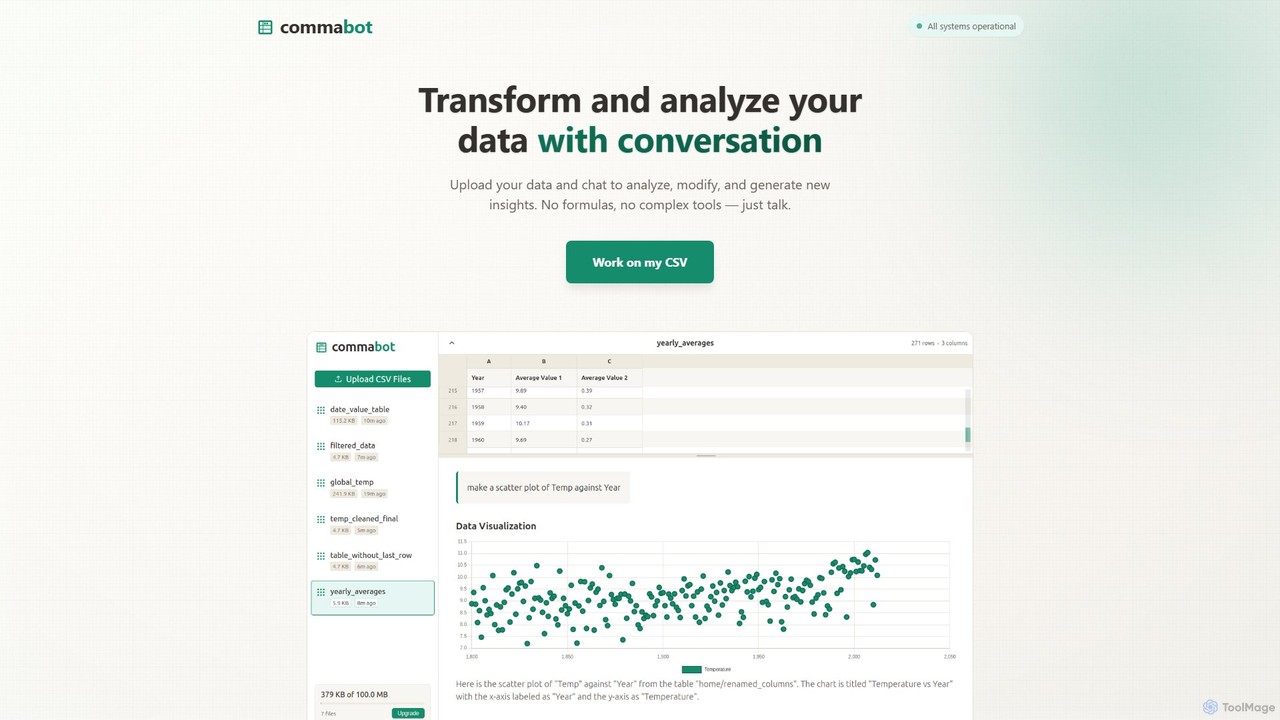
AI-powered Spreadsheets are a category of no-code tools that integrate artificial intelligence directly into the familiar spreadsheet interface. These tools leverage AI to automate data processing, enhance analysis, and simplify complex tasks, transforming traditional data management into an intelligent, interactive experience. They empower users to derive deeper insights and streamline workflows without requiring advanced coding skills, making sophisticated data operations accessible to everyone.
Core Features
- Natural Language Querying: Users can ask questions about their data in plain English (or other languages) and receive instant answers or generate formulas, charts, and summaries automatically.
- Automated Data Cleaning & Transformation: AI algorithms can identify and correct errors, standardize formats, remove duplicates, and transform raw data into usable structures with minimal manual effort.
- Intelligent Formula Generation: AI assists in creating complex formulas by suggesting functions, completing formulas, or even generating them based on natural language descriptions of desired outcomes.
- Predictive Analytics & Forecasting: Built-in AI models can analyze historical data to predict future trends, forecast sales, or identify potential risks, often with simple prompts.
- Smart Data Entry & Extraction: AI can automate data entry from unstructured text, images, or documents, and intelligently extract relevant information directly into cells.
Use Cases
AI-powered spreadsheets are invaluable for business analysts, marketing professionals, financial planners, and small business owners. They are used for automating routine data tasks, performing quick ad-hoc analysis, generating reports, and creating interactive dashboards. For example, a marketing team might use them to analyze campaign performance by simply asking "What was our ROI last quarter?" or a finance department could forecast next year's budget based on historical spending patterns.
How to Choose
When selecting an AI spreadsheet tool, consider its integration capabilities with existing data sources (e.g., CRM, ERP), the breadth and depth of its AI features (e.g., NLP, predictive modeling), ease of use for non-technical users, and scalability for your data volume. Evaluate the accuracy of its AI suggestions and the flexibility of its customization options. Pricing models and community support are also important factors to ensure long-term value and adoption.