DevBlogs
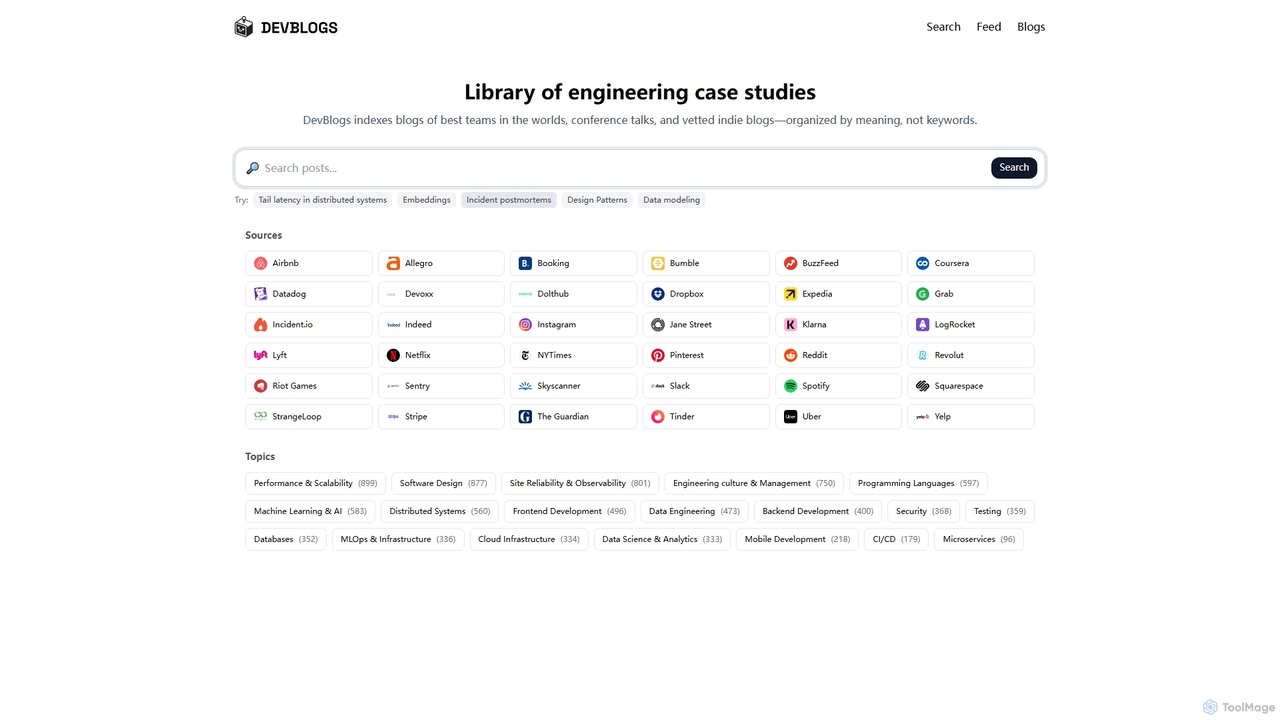
DevBlogs is a curated library indexing engineering case studies, tech blogs, and conference talks from leading global teams. …
DevBlogs is a curated library indexing engineering case studies, tech blogs, and conference talks from leading global teams. It organizes content by meaning and specific technical topics, providing a valuable resource for developers and engineers to discover insights and best practices.
About Site Reliability
Site Reliability tools are AI-powered solutions designed to ensure the continuous availability, performance, and efficiency of complex software systems. These tools leverage artificial intelligence and machine learning to automate monitoring, detect anomalies, predict potential outages, and streamline incident response within the broader field of operations. Their primary value lies in proactively maintaining system health, minimizing downtime, and optimizing resource utilization, ultimately enhancing user experience and business continuity.
Core Features
- AI-driven Anomaly Detection: Automatically identifies unusual patterns in system behavior that indicate potential issues, often before they escalate.
- Predictive Outage Analysis: Uses historical data and machine learning models to forecast future system failures or performance bottlenecks.
- Intelligent Incident Correlation: Aggregates and analyzes alerts from various sources to identify root causes and reduce alert fatigue.
- Automated Remediation: Triggers predefined actions or scripts to automatically resolve common issues, reducing manual intervention.
- Performance Optimization Recommendations: Provides data-driven suggestions for improving system configuration and resource allocation.
Applicable Scenarios
These tools are indispensable for organizations managing large-scale, distributed systems, such as cloud-native applications, e-commerce platforms, and critical financial services. They are crucial for SRE teams, DevOps engineers, and IT operations personnel who need to maintain high uptime and performance under dynamic conditions. From real-time monitoring of microservices to ensuring the resilience of global infrastructure, AI Site Reliability tools provide the intelligence needed to operate at scale.
How to Choose
When selecting an AI Site Reliability tool, consider its integration capabilities with your existing observability stack (monitoring, logging, tracing). Evaluate its real-time analytics and predictive power, focusing on the accuracy of anomaly detection and outage predictions. Assess the level of automation offered, particularly for incident response and remediation. Finally, consider scalability, ease of use, and the vendor's support for your specific technology stack and compliance requirements.

Site ReliabilityUse Cases
Proactive Anomaly Detection in Microservices
A DevOps engineer managing a complex microservices architecture uses an AI Site Reliability tool to continuously monitor service health. The AI detects subtle deviations in latency or error rates that human eyes might miss, flagging potential issues in a specific service before it impacts end-users, allowing for preemptive intervention.
Automated Incident Triage and Routing
During a critical system incident, an SRE team relies on an AI tool to process thousands of alerts from various monitoring systems. The AI correlates related alerts, identifies the probable root cause, and automatically routes the consolidated incident to the correct on-call team with relevant context, significantly reducing mean time to acknowledge (MTTA).
Predictive Capacity Planning for Cloud Resources
A cloud operations manager utilizes AI Site Reliability tools to analyze historical resource utilization and traffic patterns. The AI predicts future spikes in demand for specific cloud services, recommending optimal scaling adjustments or resource provisioning ahead of time, preventing performance degradation during peak loads and optimizing costs.
Accelerated Root Cause Analysis for Outages
Following a system outage, an incident responder employs an AI-powered SRE platform to quickly pinpoint the root cause. The tool analyzes logs, metrics, and traces across distributed systems, highlighting critical events and dependencies that led to the failure, drastically shortening mean time to resolution (MTTR) compared to manual investigation.
Automated Remediation of Common Database Issues
A database administrator configures an AI Site Reliability tool to monitor database performance. When the AI detects a common issue like a slow query or connection pool exhaustion, it automatically triggers a predefined script to optimize the query or restart the connection pool, resolving the problem without manual intervention and ensuring continuous database availability.
Optimizing Application Performance Through AI Recommendations
An application owner uses an AI Site Reliability tool to continuously analyze application performance metrics. The AI identifies inefficient code segments or suboptimal configurations, providing specific, actionable recommendations for code changes or infrastructure adjustments that can significantly improve application response times and resource efficiency.