
ToolMage
Sign in

Best 1 Prospecting AI tools for Real Estate

Popular Prospecting AI tools in Real Estate include Terrakotta, helping you work more efficiently.

Terrakotta
Paid

Terrakotta

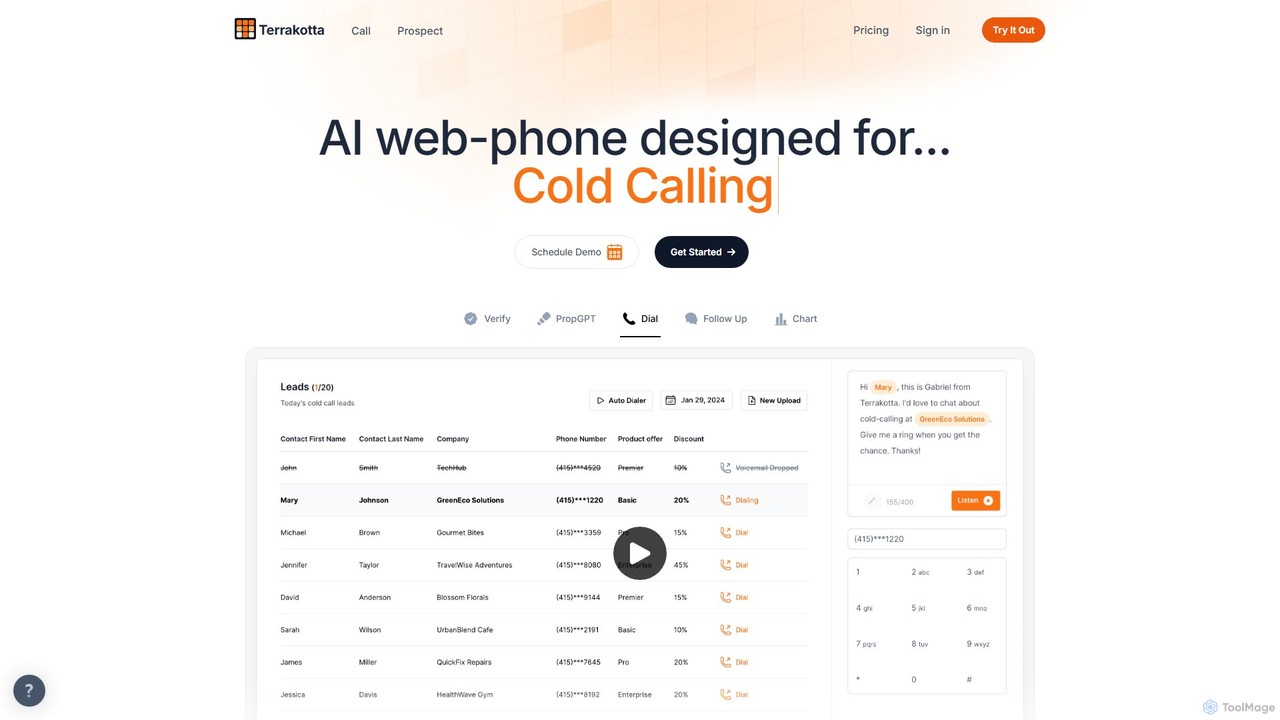
Terrakotta is an AI-powered web-phone designed for sales and real estate professionals. It automates cold calling with advanced voice cloning, personalized AI voicemails, and an autodialer. Enhance your outreach with data enrichment, phone number verification, and seamless CRM integrations to significantly boost lead generation and efficiency.

Voice Marketing
Visits 29.5KFavorites 102Likes 100

About Prospecting

AI Prospecting tools for real estate are specialized platforms that automate the identification and qualification of potential property buyers and sellers. These tools leverage machine learning and big data to analyze property records, market trends, and consumer behavior signals. This enables real estate agents and investors to discover high-intent leads, predict listing opportunities, and personalize outreach with data-driven insights. Unlike general sales tools, they are fine-tuned with real estate-specific datasets for higher accuracy.

Core Features

  • Predictive Analytics: Identifies homeowners who are statistically likely to sell their property in the near future.
  • Lead Scoring: Automatically ranks potential leads based on their motivation and readiness to transact.
  • Data Enrichment: Augments contact information with property details, ownership history, and demographic data.
  • Off-Market Opportunity Detection: Finds potential investment properties like distressed homes or absentee owners before they are publicly listed.
  • Automated Outreach Sequences: Creates and manages targeted email or text message campaigns for different lead segments.

Use Cases

These tools are primarily used by real estate agents, brokerage firms, and property investors. Agents use them to build a pipeline of potential sellers in a specific neighborhood, while investors leverage them to find off-market deals. Brokerages can use them to qualify and distribute inbound leads more efficiently across their team.

How to Choose

When selecting a tool, consider the quality and recency of its data sources (e.g., MLS, public records). Evaluate its integration capabilities with your existing CRM system. Assess the accuracy and transparency of its predictive models and ensure its geographic coverage includes your target markets. Finally, consider the user interface and the level of support provided.

Prospecting use cases

1

Identify Likely-to-Sell Homeowners

A real estate agent aims to proactively find new listings in a competitive neighborhood. Using an AI prospecting tool, they apply predictive analytics to scan the area for properties with a high 'sell score'. This score is based on factors like length of ownership, home equity, recent life events, and local market trends. The tool generates a targeted list of 50 high-potential homeowners, allowing the agent to focus their direct mail and calling campaigns on prospects who are most likely to be receptive, significantly increasing their listing appointment conversion rate.

2

Find Off-Market Investment Properties

A real estate investor is looking for undervalued properties before they hit the open market. They configure their AI prospecting tool to identify properties with indicators of distress or motivation to sell, such as pre-foreclosure notices, tax liens, or long-term absentee owners. The AI continuously scans public records and other data sources, providing the investor with a daily or weekly curated list of potential off-market deals. This gives them a significant competitive advantage, allowing them to approach owners directly and negotiate deals without bidding against other buyers.

3

Qualify and Prioritize Inbound Buyer Leads

A large brokerage receives hundreds of online leads daily from their website and property portals. An inside sales agent (ISA) team uses an AI prospecting tool to automatically enrich and score these leads. The tool pulls data like social media profiles, estimated income, and property ownership history to create a comprehensive profile. It then assigns a priority score based on engagement level and financial readiness. This allows the ISA team to immediately focus on the top 20% of high-quality leads, reducing response times and ensuring the most promising buyers receive prompt attention.

4

Target Niche Buyer Segments for New Developments

A marketing manager for a new luxury condominium project needs to find qualified buyers. Instead of broad advertising, they use an AI prospecting tool to identify individuals with specific demographic and psychographic profiles. They can filter for criteria like high income levels, interest in luxury goods, proximity to the development, and life stages such as 'empty nesters'. The tool generates a highly targeted list for a digital advertising campaign, improving ad spend efficiency and resulting in more qualified tour requests from the ideal buyer persona.

5

Automate Sphere of Influence (SOI) Nurturing

An experienced agent has a large database of past clients and contacts (their SOI). Manually tracking everyone is impossible. They connect their database to an AI prospecting tool that monitors for 'life event' signals, such as social media posts about a new job, a growing family, or changes in property data associated with their contacts. The tool sends the agent timely alerts, suggesting they reconnect with specific individuals. This transforms a passive database into an active source of repeat and referral business by enabling perfectly timed, relevant outreach.

6

Enhance Commercial Real Estate Tenant Acquisition

A commercial real estate broker needs to find suitable tenants for a vacant retail space. They use an AI prospecting tool to analyze local business data. The tool identifies companies that are expanding, have expiring leases nearby, or fit the ideal tenant profile for the property (e.g., high-foot-traffic retail). The broker receives a targeted list of businesses to contact. The tool also provides insights into each business's needs, allowing the broker to personalize their pitch and demonstrate how the space meets their specific growth trajectory, leading to a faster and more successful leasing process.

Prospecting FAQ

What are AI Prospecting tools for Real Estate?

AI Prospecting tools for real estate are specialized software that use artificial intelligence to find and qualify potential property buyers and sellers. Unlike general sales tools, they analyze real estate-specific data like property records, MLS data, and demographic trends. Their core function is to use predictive analytics to identify individuals who are most likely to transact in the near future, helping agents and investors focus their efforts more effectively.

How do you choose the right AI Real Estate Prospecting tool?

To choose the right tool, consider these key factors:

  • Data Quality and Coverage: Ensure the tool uses accurate, up-to-date data sources (like public records, MLS) and covers your specific geographic market.
  • CRM Integration: Check if it seamlessly integrates with your existing Customer Relationship Management system to avoid manual data entry.
  • Predictive Model Accuracy: Ask for case studies or data on the model's success rate in identifying likely sellers or buyers.
  • Ease of Use: The platform should be intuitive for real estate agents, not just data analysts, with a clear interface and actionable insights.
What's the difference between an AI Prospecting tool and a standard CRM?

The main difference lies in their primary purpose. A standard CRM (Customer Relationship Management) is designed to manage existing relationships and track interactions with known contacts. An AI Prospecting tool is designed to find new leads and identify opportunities within a market or database. While a prospecting tool generates new leads, a CRM helps you nurture those leads through the sales funnel. Many modern workflows involve integrating an AI prospecting tool to feed high-quality leads directly into a CRM.

What are the main benefits of using AI for real estate prospecting?

The main benefits include:

  • Proactive Lead Generation: Instead of waiting for leads, agents can proactively identify potential sellers before they even decide to list their property.
  • Increased Efficiency: Automates the time-consuming process of researching properties and potential clients, allowing agents to focus on building relationships.
  • Higher Conversion Rates: By focusing on data-qualified, high-intent leads, agents can improve their conversion from contact to client.
  • Data-Driven Strategy: Enables marketing and outreach efforts to be based on predictive insights rather than intuition or guesswork.
Can these tools predict exactly when someone will sell their house?

No, these tools do not predict with 100% certainty. Instead, they use predictive analytics to calculate a probability or a 'sell score'. They identify homeowners who are statistically more likely to sell in the near future compared to the average person, based on hundreds of data points. This allows agents to prioritize their outreach and focus their marketing budget on a smaller, more qualified group of prospects, significantly increasing their chances of success.