Khorus
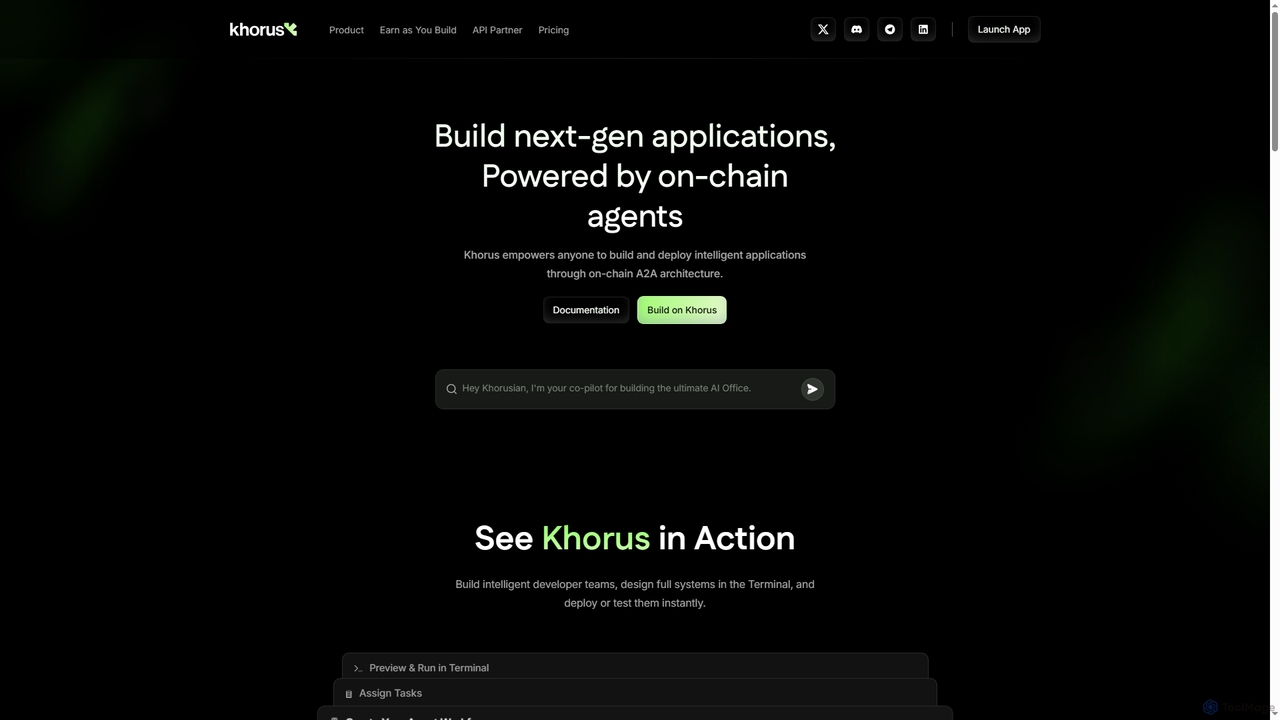
Khorus is a universal communication layer for intelligent systems, empowering developers to build and deploy next-gen AI applications …
Khorus is a universal communication layer for intelligent systems, empowering developers to build and deploy next-gen AI applications through an on-chain Agent-to-Agent (A2A) architecture. It facilitates real-time collaboration, task delegation, and autonomous execution among AI agents and robotics, fostering a decentralized agent economy and marketplace for scalable modules and workflows.
About Ai Robotics
Ai Robotics refers to the integration of artificial intelligence into robotic systems, enabling them to perceive, reason, learn, and adapt to complex environments and tasks. These advanced systems move beyond pre-programmed actions, leveraging machine learning, computer vision, and natural language processing to perform sophisticated operations autonomously. They are designed to enhance flexibility, efficiency, and decision-making capabilities in various industrial, service, and exploration applications. This fusion allows robots to handle unstructured environments, interact more naturally with humans, and continuously improve their performance over time.
Core Features
- Intelligent Perception: Utilize sensors and AI algorithms (e.g., computer vision, LiDAR) to understand surroundings and objects.
- Autonomous Navigation: Employ AI for real-time path planning, obstacle avoidance, and self-localization in dynamic spaces.
- Machine Learning & Adaptation: Learn from data and experience to improve task execution, grasp patterns, and decision-making.
- Human-Robot Interaction (HRI): Facilitate natural communication and collaboration through voice, gesture, and intent recognition.
- Complex Task Automation: Execute multi-step, non-repetitive tasks requiring problem-solving and dynamic adjustments.
Use Cases
Ai Robotics tools are crucial in sectors requiring high adaptability and precision. They are deployed in advanced manufacturing for flexible assembly lines, in logistics for intelligent sorting and delivery, and in healthcare for surgical assistance and patient care. These systems excel in environments where traditional robots are limited by rigid programming, offering solutions for dynamic challenges and human-centric operations.
How to Choose
When selecting Ai Robotics solutions, consider the complexity of tasks the robot needs to perform, its required level of autonomy and adaptability, and the integration capabilities with existing infrastructure. Evaluate the AI's learning potential, the robustness of its perception systems, and its safety features for human interaction. Scalability, vendor support, and compliance with industry standards are also critical factors for long-term deployment.

Ai RoboticsUse Cases
Automated Warehouse Inventory Management
Logistics managers can deploy AI-powered robots to autonomously navigate large warehouses, scan shelves, and update inventory records in real-time. These robots use computer vision to identify products, detect misplaced items, and report discrepancies, significantly reducing manual counting errors and improving stock accuracy. This frees human workers for more complex tasks and ensures efficient supply chain operations.
Precision Agriculture Crop Monitoring
Farmers utilize AI robots equipped with multispectral cameras and machine learning algorithms to monitor crop health across vast fields. The robots can identify early signs of disease, pest infestations, or nutrient deficiencies by analyzing plant images and soil data. This enables targeted intervention, optimizing resource use (water, fertilizer, pesticides) and maximizing yield with minimal environmental impact.
Elderly Care and Companionship
Healthcare providers and families can use AI companion robots to assist elderly individuals with daily routines, medication reminders, and social interaction. These robots can engage in natural language conversations, provide gentle prompts, and even alert caregivers in case of emergencies, offering a sense of companionship and enhancing the quality of life for seniors living independently.
Hazardous Environment Inspection
Industrial safety teams deploy AI robots for inspecting dangerous or inaccessible environments, such as nuclear power plants, deep-sea oil rigs, or collapsed structures. Equipped with advanced sensors and AI for anomaly detection, these robots can identify structural damage, gas leaks, or other hazards without risking human lives, providing critical data for maintenance and emergency response.
Customized Manufacturing Assembly
Manufacturers in industries like automotive or electronics leverage AI robots for flexible assembly lines that can adapt to varying product designs and specifications. These robots use AI to recognize different components, adjust their gripping force, and perform complex assembly sequences without extensive re-programming, enabling mass customization and reducing production changeover times.
Autonomous Delivery and Last-Mile Logistics
Retailers and logistics companies employ AI delivery robots for efficient last-mile delivery in urban and suburban areas. These robots autonomously navigate sidewalks and streets, avoiding pedestrians and obstacles, to deliver packages directly to customers. This reduces delivery costs, speeds up service, and offers a sustainable alternative to traditional vehicle-based delivery methods.