
Brieflane
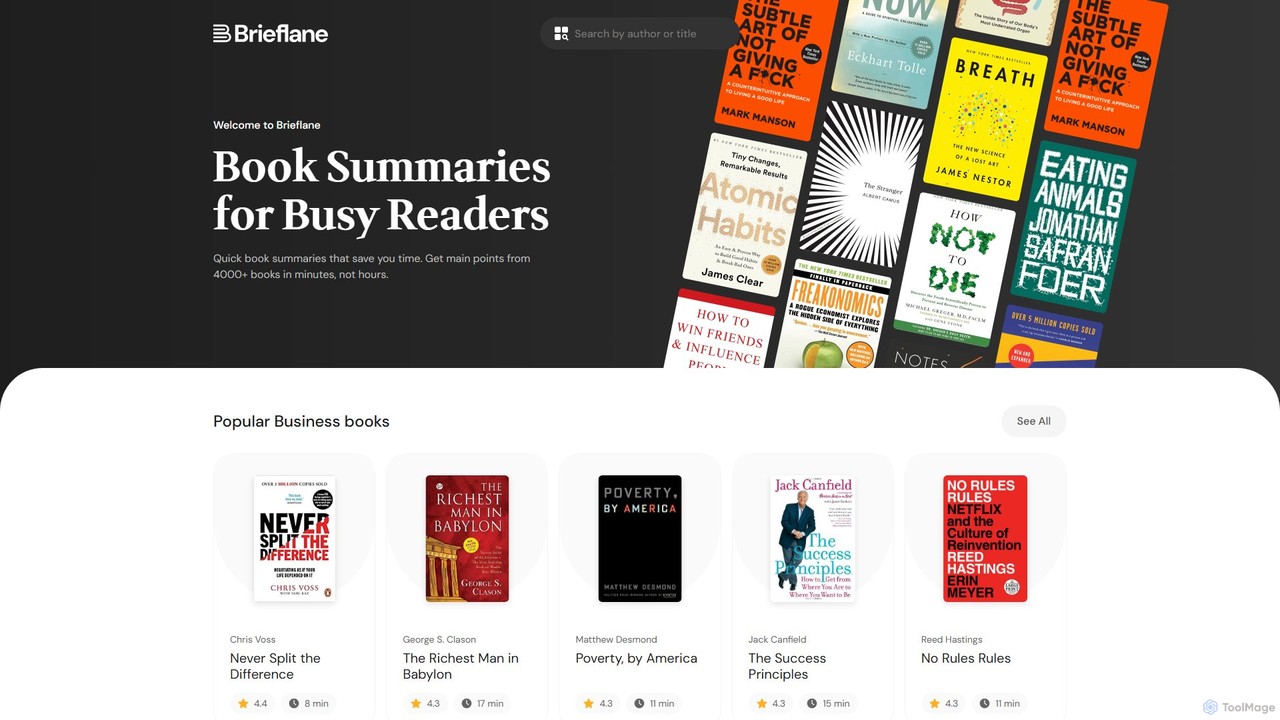
Brieflane is an AI-powered service offering concise summaries of over 4,000 non-fiction books. Designed for busy professionals, students, …
Brieflane is an AI-powered service offering concise summaries of over 4,000 non-fiction books. Designed for busy professionals, students, and lifelong learners, it distills key ideas and actionable insights from bestsellers in business, self-help, and health into 15-minute reads. Save time while absorbing vast knowledge and discovering your next great read.
About Learning
AI Learning tools are applications that leverage artificial intelligence to create personalized and efficient educational experiences. They utilize technologies like machine learning and natural language processing to adapt to an individual's learning pace, style, and knowledge gaps. This results in more effective knowledge acquisition and long-term retention compared to traditional one-size-fits-all methods. These tools transform study materials into interactive sessions, making learning more engaging and accessible for everyone.
Core Features
- Personalized Learning Paths: Dynamically adjusts curriculum and difficulty based on user performance and goals.
- AI-Powered Tutoring: Provides instant, conversational feedback, answers questions, and explains complex concepts 24/7.
- Automated Content Curation: Generates summaries, flashcards, and quizzes from uploaded documents, videos, or web links.
- Intelligent Spaced Repetition: Optimizes review schedules based on cognitive science principles to enhance long-term memory.
- Skill Assessment & Gap Analysis: Identifies areas of weakness and suggests specific topics for improvement.
Use Cases
These tools are ideal for students preparing for exams, professionals seeking to upskill or acquire new certifications, and lifelong learners exploring new subjects. For instance, a software developer can use an AI tutor to master a new programming language, while a medical student can use an AI flashcard generator to memorize complex terminology. They are also valuable in corporate training for personalized employee development.
How to Choose
When selecting an AI Learning tool, consider the subject matter it covers and its teaching methodology (e.g., conversational tutoring, micro-learning). Evaluate its ability to import your own content and the quality of its progress tracking and analytics. Finally, assess the user interface for ease of use and check its pricing model to ensure it aligns with your budget and learning frequency.
LearningUse Cases
Efficient Exam Preparation for Students
A university student facing final exams uploads weeks of lecture notes, PDF textbooks, and presentation slides into an AI learning tool. The platform automatically processes the material, generating concise summaries for quick review, interactive flashcards for key terms, and a series of practice quizzes. The student uses the AI tutor feature to ask clarifying questions about complex topics, receiving instant, detailed explanations. This approach transforms passive reading into an active learning process, significantly reducing study time while improving comprehension and retention of critical information needed to excel in the exams.
Professional Upskilling in Technology
A software developer aims to learn a new programming language for a career move. They use an AI learning platform that offers a personalized curriculum based on their existing coding knowledge. The tool provides interactive coding exercises with real-time feedback and debugging suggestions from an AI assistant. When they encounter a difficult concept, they can converse with the AI tutor to get different explanations and code examples. The platform's spaced repetition system schedules regular reviews of key syntax and concepts, ensuring long-term mastery rather than short-term memorization.
Accelerated Language Learning for Travelers
Someone preparing for an international trip uses an AI language learning app to acquire conversational skills quickly. Instead of static lessons, the app features an AI chatbot for realistic conversation practice. The user can speak or type, and the AI responds naturally, correcting grammar and pronunciation in real-time. The tool identifies recurring mistakes and creates personalized mini-lessons focusing on those specific weak points. This targeted, interactive approach helps the traveler build practical communication confidence much faster than traditional methods like textbooks or pre-recorded audio lessons.
Mastering Complex Research Papers
A graduate student or researcher is faced with dozens of dense, technical academic papers. They use an AI learning tool to upload these documents. The AI first generates a high-level summary of each paper's abstract, methodology, and conclusions, allowing the researcher to quickly triage which papers are most relevant. For key papers, they use the tool to 'chat' with the document, asking specific questions like "What was the sample size for this experiment?" or "Explain the main limitation of this study." This transforms the static PDF into an interactive knowledge base, accelerating literature review and deepening comprehension.
Personalized Corporate Training and Onboarding
A company's HR department uses an AI learning platform for new employee onboarding. Instead of a generic program, each new hire receives a personalized learning path based on their role and pre-assessment results. The platform delivers bite-sized content, interactive simulations of company software, and quizzes to check understanding. An AI chatbot answers common questions about company policies and procedures, freeing up HR staff. The system tracks each employee's progress, flagging areas where they might need additional human support, ensuring a more efficient and effective onboarding experience for everyone.
Developing Hobbies and Lifelong Learning
A retiree wants to learn to play the piano. They use an AI-powered learning app connected to a digital keyboard. The app listens to their playing and provides instant feedback on note accuracy, rhythm, and timing, much like a patient human teacher. It starts with simple exercises and gradually introduces more complex pieces based on the user's progress. The AI can also break down difficult passages into smaller, manageable parts and create custom practice drills. This makes learning a new, complex skill less intimidating and allows the user to progress at their own comfortable pace.