
Self Improvement Best in category 1 results Online Courses AI Tool

Popular AI tools in the Online Courses field of Self Improvement include Skillme.ai, etc., helping you quickly improve efficiency.

Skillme.ai

Skillme.ai

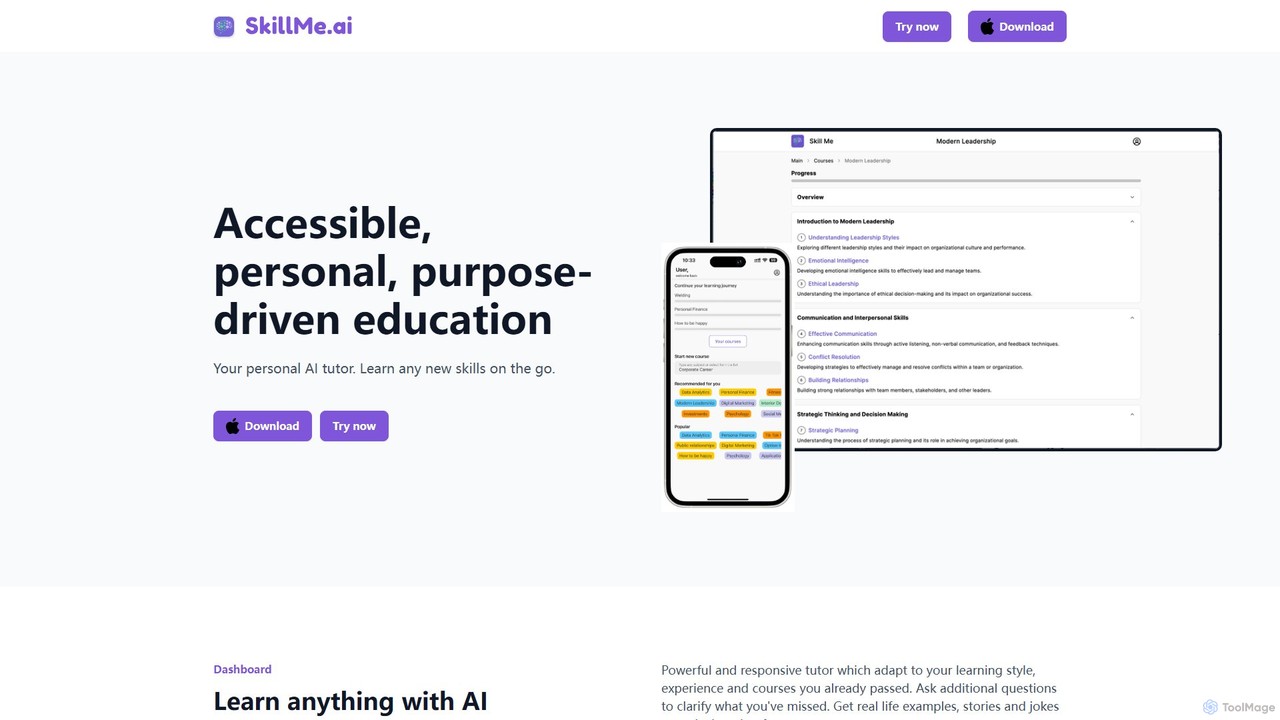
Skillme.ai is a personal AI tutor designed to help you learn any new skill. It creates customized learning …

3.8K

About Online Courses

AI Online Courses are structured digital learning programs designed to teach artificial intelligence concepts, skills, and tool usage. They often utilize AI-powered platforms for personalized learning paths, interactive coding environments, and real-time feedback. These courses empower individuals and teams to upskill in high-demand fields like machine learning and prompt engineering, directly contributing to their self-improvement and career growth. Many platforms offer hands-on projects and industry-recognized certifications, bridging the gap between theoretical knowledge and practical application.

Core Features

  • Interactive Learning Environments: Practice coding or apply concepts directly in the browser with instant feedback, removing setup barriers.
  • Personalized Learning Paths: AI algorithms adapt the curriculum based on your progress, skill level, and learning goals.
  • Real-World Projects: Apply learned skills to solve practical problems, building a portfolio to showcase your abilities.
  • Expert-Led Instruction: Learn from industry professionals and leading academics through video lectures, tutorials, and Q&A sessions.
  • Verifiable Certifications: Earn credentials upon completion to validate your skills and enhance your professional profile.

Applicable Scenarios

These courses are ideal for professionals seeking to transition into AI-related roles, such as software developers or data analysts. They are also valuable for students needing to acquire foundational AI knowledge for academic pursuits and for companies looking to upskill their entire workforce to stay competitive in an AI-driven market.

How to Choose

When selecting an AI online course, first define your learning goals—are you aiming for a specific job, learning a new tool, or seeking certification? Assess the prerequisites to ensure it matches your current skill level. Consider the instruction format (video, project-based, text) and evaluate the course's reputation, instructor credibility, and the value of its certification in the industry.

Online CoursesUse Cases

1

Aspiring Data Scientist Mastering Machine Learning

A recent graduate with a background in statistics aims to qualify for entry-level data scientist positions. They enroll in a comprehensive online course covering Python libraries like Scikit-learn and TensorFlow, featuring interactive coding notebooks. The course culminates in a capstone project where they analyze a real-world dataset to predict customer churn. This hands-on experience allows them to build a strong portfolio, gain practical coding skills, and confidently pass technical interviews, ultimately securing a data scientist role.

2

Software Developer Integrating AI into Applications

An experienced software engineer needs to add intelligent features to their company's products. They take a specialized, project-based online course on AI API integration and prompt engineering. Through the course, they learn to use services like OpenAI's GPT to build a customer support chatbot. This targeted upskilling enables them to implement new AI-powered functionalities, significantly increasing the product's value and enhancing their own professional capabilities within weeks, rather than months.

3

Marketing Manager Learning Prompt Engineering

A marketing manager wants to improve the efficiency of content creation using generative AI. They complete an online course focused on advanced prompt engineering for marketing. The curriculum covers techniques for crafting detailed prompts to generate ad copy, blog posts, and social media updates that align with the brand's voice. As a result, the manager learns to guide AI tools effectively, reducing content creation time by over 50% and improving the consistency and creativity of marketing campaigns.

4

Business Leader Understanding AI Strategy

A non-technical executive needs to grasp the business implications of AI to make informed strategic decisions. They enroll in an executive-level online course covering AI concepts, industry use cases, ethics, and implementation strategies. The course uses case studies from finance and healthcare to illustrate key points. This provides the leader with the necessary vocabulary and conceptual framework to lead AI initiatives, evaluate vendor proposals, and confidently align AI adoption with overarching business goals.

5

Student Preparing for University AI Studies

A high school student planning to major in computer science wants a head start on their university AI coursework. They use an online learning platform with courses specifically designed as prerequisites, covering foundational mathematics like linear algebra and essential Python programming. The platform's interactive quizzes and guided exercises help reinforce complex concepts. By completing these courses, the student enters their university program well-prepared, excels in introductory AI classes, and is better positioned for early research opportunities.

6

Creative Professional Exploring Generative AI Art

A graphic designer wants to incorporate AI into their creative workflow. They join an online course focused on generative AI art tools like Midjourney and Stable Diffusion. The course teaches advanced prompt crafting, parameter tuning for different artistic styles, and techniques for integrating AI-generated elements into existing design projects using Photoshop. This empowers the designer to expand their creative toolkit, produce novel artwork for their portfolio, and offer new, AI-enhanced services to clients, setting them apart in a competitive market.

Online CoursesFrequently Asked Questions