Visibility
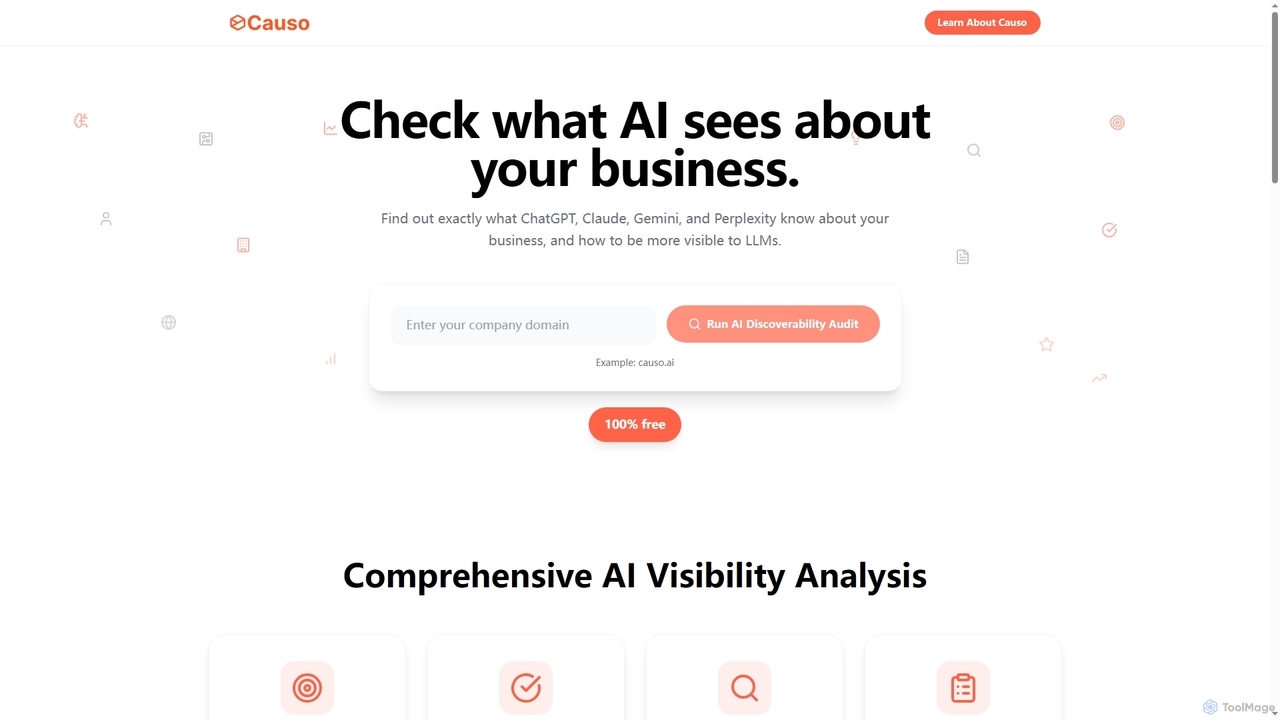
A free AI-powered tool that audits your business's visibility across major LLMs like ChatGPT, Claude, Gemini, and Perplexity. …
A free AI-powered tool that audits your business's visibility across major LLMs like ChatGPT, Claude, Gemini, and Perplexity. It provides a detailed report based on 10 criteria and offers actionable steps to improve your AI discoverability.
About Market Research
AI Market Research tools are a class of software that uses artificial intelligence to automate the collection, analysis, and interpretation of market data. These tools leverage machine learning and natural language processing (NLP) to sift through vast datasets from social media, customer reviews, competitor websites, and industry reports. They empower businesses to uncover consumer trends, analyze competitor strategies, and identify market opportunities with superior speed and accuracy. Within an SEO context, these insights are crucial for developing data-driven content strategies and understanding search intent at a deeper level.
Core Features
- Trend Analysis: Automatically identifies emerging topics, shifts in consumer interest, and predictive market patterns from real-time data.
- Competitor Intelligence: Monitors and analyzes competitors' online activities, marketing campaigns, product positioning, and customer sentiment.
- Sentiment Analysis: Gauges public opinion and customer emotions towards brands, products, or topics by analyzing text from reviews and social media.
- Audience Segmentation: Uses AI to identify and group target audiences based on complex behavioral, demographic, and psychographic data.
- Keyword Opportunity Identification: Discovers untapped and long-tail keywords by analyzing market conversations and search trends beyond traditional keyword tools.
Use Cases
These tools are essential for marketing managers, product developers, business strategists, and SEO specialists. They are used for tasks such as validating a new product idea by assessing market demand, refining marketing messages based on audience sentiment, and building a content strategy that directly addresses competitor weaknesses and market gaps.
How to Choose
When selecting an AI Market Research tool, consider the scope of data sources it covers (e.g., social media, news, forums). Evaluate the depth of its analytical capabilities, such as predictive forecasting and sentiment analysis. Also, assess its integration options with other marketing and SEO platforms and the clarity of its reporting dashboards.

Market ResearchUse Cases
Validate a New Product Idea
A product manager preparing for a new software launch uses an AI market research tool to analyze online discussions in tech forums and social media. The tool identifies a recurring complaint about existing solutions lacking a specific integration. By quantifying this demand and analyzing competitor feature sets, the manager validates the market need for their product's unique selling proposition, providing data-backed confidence to proceed with development and informing the initial marketing message.
Analyze Competitor SEO and Content Strategy
An SEO specialist aims to outperform a key competitor. They use an AI tool to analyze the competitor's entire blog and website content. The AI identifies their core content pillars, top-performing keywords, sentiment around their articles, and uncovers 'content gaps'—high-demand topics the competitor hasn't covered. This intelligence allows the specialist to create a superior content plan that targets the competitor's weaknesses and captures overlooked audience segments.
Monitor Brand Health and Public Sentiment
A marketing team for a consumer electronics brand uses an AI tool to continuously monitor brand mentions across social media, news sites, and review platforms. The tool's sentiment analysis feature alerts them in real-time to a spike in negative comments related to a recent software update. This early detection allows the PR and support teams to respond proactively, manage the crisis, and provide the product team with specific feedback for a patch, thus protecting brand reputation.
Identify Emerging Market Trends for Strategic Planning
A business strategist at a financial services firm uses an AI platform to scan thousands of industry reports, news articles, and academic papers. The AI identifies a nascent trend around 'decentralized finance for small businesses' by connecting disparate data points. It projects the growth trajectory of this trend and identifies key players. This insight allows the firm to develop a new service offering ahead of competitors, positioning them as a leader in an emerging market.
Refine Customer Personas with Data-Driven Insights
A UX research team wants to move beyond demographic-based personas. They feed thousands of customer support transcripts and online reviews into an AI analysis tool. The tool's NLP capabilities identify common pain points, desired features, and the specific language customers use to describe their problems. This results in the creation of highly accurate, psychographic-based personas that guide product development and marketing with a true understanding of user motivations and frustrations.
Discover Niche Keyword Opportunities for SEO
An e-commerce store selling specialty coffee wants to rank for more than just broad terms. An SEO analyst uses an AI market research tool to analyze discussions in coffee enthusiast forums and subreddits. The tool uncovers long-tail keywords and questions like "best single-origin coffee for cold brew" and "how to reduce acidity in pour-over coffee." By creating targeted blog posts and product descriptions around these niche topics, the store attracts highly qualified traffic and establishes authority in the specialty coffee community.