BirdVoz
BirdVoz is an AI-powered real-time messaging platform that breaks down language barriers. It uses advanced neural networks to …
BirdVoz is an AI-powered real-time messaging platform that breaks down language barriers. It uses advanced neural networks to translate conversations across 30+ languages instantly, allowing users to communicate and collaborate seamlessly with friends, colleagues, and clients worldwide. With a focus on privacy, security, and a simple user experience, BirdVoz enables communication beyond language.
YOUS
YOUS is an AI-powered messenger that provides real-time, two-way translation in over 17 languages. It breaks down language …
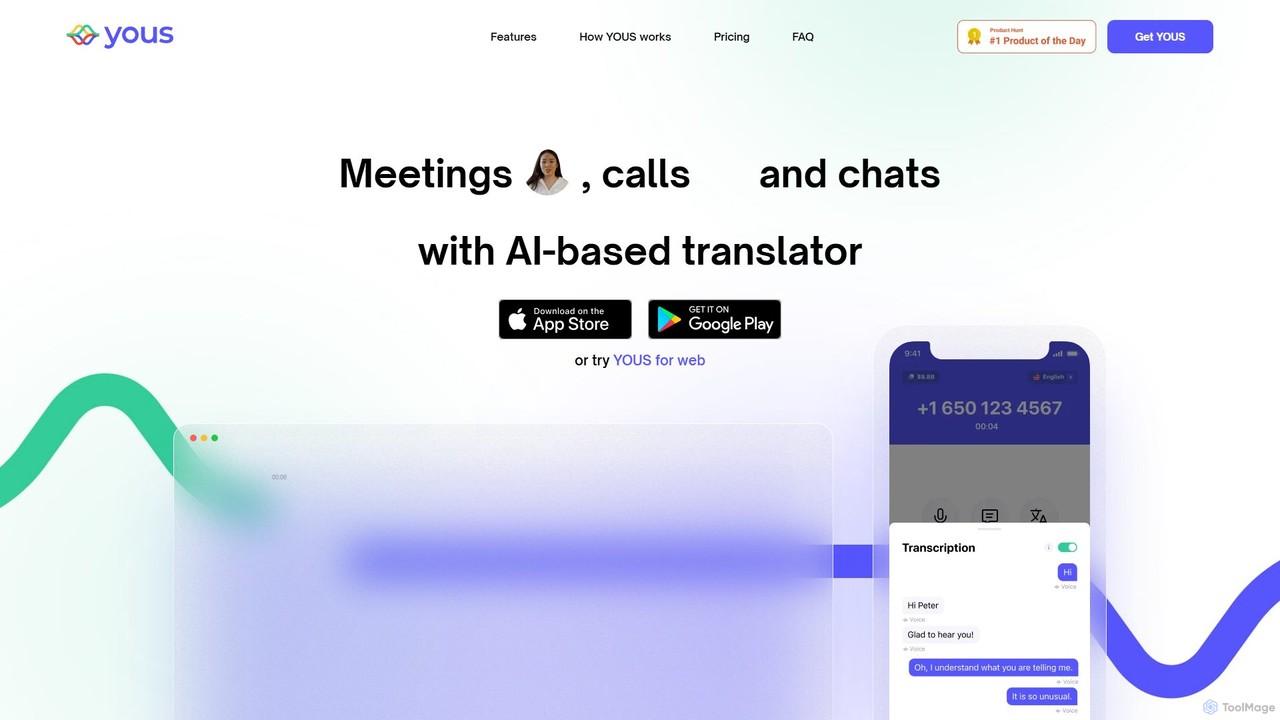
YOUS is an AI-powered messenger that provides real-time, two-way translation in over 17 languages. It breaks down language barriers, enabling seamless and affordable communication for international business, travel, and personal chats. Experience high-accuracy translations integrated directly into your conversations.
About Real Time Translation
Real Time Translation tools are AI applications designed to instantly convert spoken or written language from one language to another with minimal delay. These tools utilize a combination of advanced speech recognition, neural machine translation (NMT), and text-to-speech synthesis to process audio or text inputs and deliver translations almost simultaneously. Their primary value lies in breaking down communication barriers during live interactions, enabling fluid conversations in multilingual settings. Unlike standard translation which often involves a delay, the core advantage of real-time translation is its immediacy, making it suitable for dynamic environments.
Core Features
- Simultaneous Voice Translation: Instantly translates spoken words, allowing for natural, back-and-forth conversations.
- Live Captioning and Subtitling: Generates translated text overlays for live video streams, webinars, or in-person meetings.
- Conversation Mode: Provides a dedicated interface, often split-screen, for two or more people to communicate in different languages.
- Multi-Language Support: Handles translation between numerous language pairs, including various dialects and accents.
- Text-to-Speech (TTS) Output: Articulates the translated text in a clear, synthesized voice for audio-based communication.
Use Cases
These tools are widely used in international business for video conferences and negotiations, ensuring all participants can understand and contribute regardless of their native language. Event organizers use them to provide live interpretation for global audiences at conferences and webinars. They are also valuable in customer support, travel, healthcare, and education, where immediate cross-lingual communication is critical.
How to Choose
When selecting a Real Time Translation tool, consider its latency—how quickly the translation is delivered. Evaluate the accuracy and the range of supported languages and dialects. Assess its integration capabilities with other platforms like Zoom or Microsoft Teams. Also, consider the device compatibility (mobile vs. desktop) and the quality of its voice recognition and synthesis for your specific needs.
Real Time TranslationUse Cases
Facilitating International Business Meetings
A global marketing team with members in Japan, Germany, and Brazil uses a real-time translation tool integrated into their video conferencing platform. During their weekly strategy meeting, as the Japanese manager speaks, English and Portuguese subtitles appear instantly on screen for the other team members. When the Brazilian colleague responds in Portuguese, her speech is translated into Japanese and German audio for others. This eliminates the need for a human interpreter, reduces misunderstandings, and allows for a more dynamic and inclusive discussion, ensuring all strategic inputs are accurately captured.
Live Interpretation for Global Events
An event organizer hosting a hybrid tech conference provides attendees with a mobile app featuring real-time translation. As keynote speakers present on stage in English, remote and in-person attendees from Korea and France can listen to a live, AI-generated audio stream in their native language through their headphones. Simultaneously, live captions in Spanish and German are projected onto screens beside the main stage. This makes the event accessible and engaging for a diverse international audience without the high cost and logistical complexity of hiring multiple teams of simultaneous interpreters.
Enhancing Multilingual Customer Support
A customer support agent at an e-commerce company receives a call from a customer in Vietnam. The agent, who only speaks English, uses a real-time voice translation service integrated into their call center software. The customer describes their issue in Vietnamese, and the agent hears an instant English translation. The agent's English response is then translated back into Vietnamese for the customer. This seamless, two-way conversation allows the agent to resolve the issue quickly and effectively, improving customer satisfaction and reducing the need for a dedicated team of multilingual support staff.
Personal Communication for Travelers
A tourist visiting Italy uses a real-time translation app on their smartphone to communicate. At a local restaurant, they activate the app's conversation mode. They speak into the phone in English, asking for a menu recommendation. The app instantly plays back the question in Italian for the waiter. The waiter replies in Italian, and the tourist sees the English translation appear on their screen. This tool helps them navigate daily interactions like ordering food, asking for directions, and shopping, making their travel experience smoother and more immersive without needing to be fluent in the local language.
Accessible Global Online Education
A university professor conducts a live online lecture on quantum physics for a global student body. The lecture is delivered in German. Using a real-time captioning tool, students in Brazil, India, and China can view live, automatically generated subtitles in Portuguese, Hindi, and Mandarin on their screens. This technology democratizes access to specialized knowledge, allowing students worldwide to participate in courses from top institutions without language being a barrier. It also provides a written transcript for later review, aiding comprehension and study.
Critical Communication in Healthcare
In a hospital emergency room, a doctor needs to communicate with a patient who has just arrived and only speaks Spanish. The doctor uses a portable, real-time translation device. She speaks into the device in English, asking about the patient's symptoms. The device immediately vocalizes the question in Spanish. The patient responds in Spanish, and the device translates it back to English for the doctor. This rapid and accurate exchange of information is crucial for making a timely diagnosis and providing appropriate care, potentially saving lives in a critical situation where a human interpreter is not immediately available.