ToolMage
Sign in

Best 2 Tour Guide AI tools for Travel

Popular Tour Guide AI tools in Travel include Freeaiwalkingtour and herodot, helping you work more efficiently.

Freeaiwalkingtour
Free

Freeaiwalkingtour

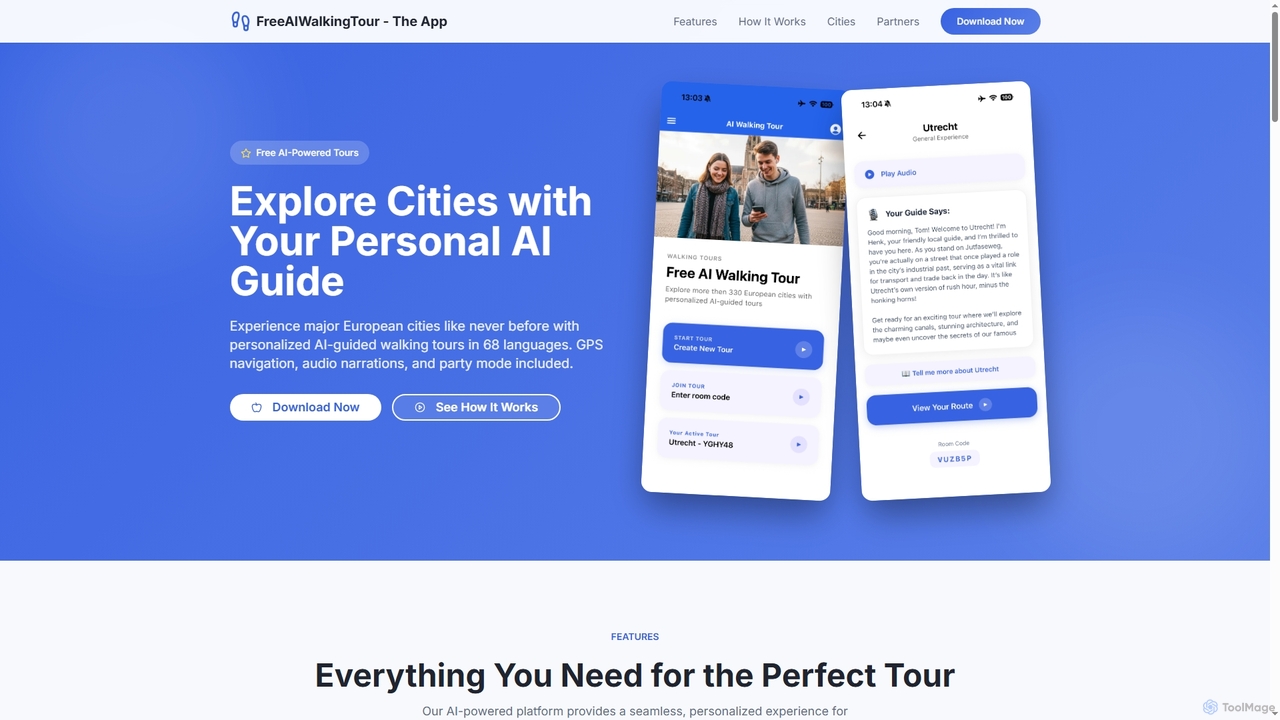
An AI-powered mobile application that creates personalized, free walking tours in major European cities. It features GPS navigation, audio narrations, offline support, and a unique 'Party Mode' for group exploration, all available in 68 languages.

Personalization
Visits 5.7KFavorites 133Likes 134
herodot
Freemium

herodot

Herodot is an AI-powered travel companion that transforms your smartphone into a personal audio guide. Explore cities, museums, and historical sites at your own pace. Simply take a photo of a landmark or tap on a map to receive immersive, narrated stories in multiple languages and from various AI personas, such as a historian or a local expert.

History
Visits 5.5KFavorites 122Likes 118

About Tour Guide

AI Tour Guides are applications that provide personalized, interactive, and context-aware travel guidance. These tools leverage technologies like GPS, augmented reality (AR), and natural language processing to act as a digital travel companion. They go beyond static maps by offering dynamic itineraries, real-time information about your surroundings, and immersive storytelling. This allows travelers to explore destinations at their own pace with the insights of a local expert.

Core Features

  • Personalized Itinerary Planning: Generates custom travel routes based on your interests, time constraints, and budget.
  • AR-Enhanced Exploration: Overlays digital information, historical reconstructions, and points of interest onto your camera's view.
  • Context-Aware Audio Guides: Automatically plays relevant stories and facts as you approach landmarks and attractions.
  • Real-time Local Recommendations: Suggests nearby restaurants, shops, and hidden gems tailored to your preferences.
  • Offline Accessibility: Provides access to maps, guides, and information without requiring a constant internet connection.

Use Cases

Ideal for independent travelers, families, and history enthusiasts who want a flexible and enriching exploration experience. They are used for self-guided city walks, interactive museum visits, and discovering local culture beyond typical tourist spots. Businesses in the tourism sector also use this technology to create unique experiences for their customers.

How to Choose

When selecting an AI Tour Guide, consider the destination coverage and the quality of its content. Evaluate its AR capabilities, offline functionality, and the level of personalization it offers. Also, check user reviews for accuracy of information and ease of use of the interface.

Tour Guide use cases

1

Self-Guided City Exploration for Solo Travelers

A solo traveler arrives in a new city like Rome and wants to explore historical sites without the constraints of a group tour. Using an AI Tour Guide app, they input their interests (ancient history, architecture) and available time (6 hours). The AI generates a personalized walking tour, providing turn-by-turn navigation to the Colosseum, Roman Forum, and Pantheon. As they approach each site, the app automatically plays an audio guide detailing its history and significance, creating an immersive and independent discovery experience.

2

Interactive Family Museum Visits

A family with young children visits a large natural history museum. To keep the kids engaged, they use an AI Tour Guide with augmented reality features. By pointing their tablet's camera at a dinosaur skeleton, an AR overlay appears, showing the dinosaur coming to life and providing fun facts. This gamified approach transforms a traditional museum visit into an interactive educational adventure, making learning more memorable for everyone.

3

Discovering Local Cuisine and Hidden Gems

A couple exploring Tokyo wants to experience authentic local food away from tourist traps. They use an AI Tour Guide that specializes in culinary recommendations. Based on their preferences for ramen and street food, the app suggests highly-rated, local-favorite small restaurants in less-traveled neighborhoods. It provides navigation, photos of signature dishes, and even helps with basic ordering phrases, enabling them to confidently explore the local food scene.

4

Immersive Historical Site Exploration with AR

A history enthusiast visits the ruins of Pompeii. A standard visit shows only what remains today. By using an AI Tour Guide with AR reconstruction, they can point their phone at the ruins and see a digital overlay of how the buildings, villas, and streets looked before the eruption of Vesuvius. This technology brings history to life, offering a deeper understanding and a more powerful connection to the past than a simple map or guidebook could provide.

5

Creating Accessible Travel Itineraries

A traveler with mobility challenges plans a trip to a city known for its hilly terrain, like Lisbon. They use an AI Tour Guide with accessibility features. The user specifies their need for wheelchair-friendly routes and avoidance of stairs. The AI then generates a custom itinerary that prioritizes accessible attractions, public transport with elevators, and step-free paths. This ensures a comfortable and enjoyable travel experience without the stress of navigating physical barriers.

6

Spontaneous Road Trip Planning

Two friends are on a cross-country road trip with a flexible schedule. Instead of rigidly planning each stop, they use an AI Tour Guide to discover points of interest in real-time. As they drive, the app alerts them to nearby attractions, scenic viewpoints, or historical markers that align with their interests (e.g., national parks, quirky roadside attractions). This allows for spontaneous detours and discoveries, making the journey as important as the destination.

Tour Guide FAQ

What is an AI Tour Guide?

An AI Tour Guide is a mobile application that acts as a personal, digital guide for travelers. It uses AI, GPS, and sometimes augmented reality (AR) to provide personalized itineraries, real-time navigation, and context-aware information about points of interest. Unlike static guidebooks, it offers an interactive and dynamic way to explore a destination at your own pace.

How do I choose the right AI Tour Guide tool?

To choose the right AI Tour Guide, consider these factors:

  • Destination Coverage: Ensure the app has detailed guides for the places you plan to visit.
  • Content Quality: Look for well-researched, engaging content, and check user reviews for accuracy.
  • Key Features: Decide if you need features like AR, offline maps, or multi-language support.
  • User Interface: The app should be intuitive and easy to use while you are on the move.

What is the difference between an AI Tour Guide and Google Maps?

The main difference is focus and content depth. Google Maps is primarily a navigation tool focused on getting you from point A to B, showing businesses and transit options. An AI Tour Guide is a content-rich exploration tool. It focuses on the 'why' of a location, providing curated stories, historical context, themed tours, and immersive experiences like AR, which are beyond the scope of a standard mapping service.

What are the main features of AI Tour Guides?

Key features typically include personalized itinerary creation based on user interests, GPS-triggered audio commentary for landmarks, augmented reality overlays to visualize history or information, real-time recommendations for food and activities, and often the ability to download maps and content for offline use. They combine navigation with rich, curated storytelling.

Who should use an AI Tour Guide?

AI Tour Guides are ideal for independent travelers who prefer flexibility over structured group tours. They are also great for families looking for engaging ways to explore museums and cities, history buffs wanting deeper context at historical sites, and any traveler who wants to discover hidden gems and local culture beyond the main tourist attractions. They empower users to become their own expert guides.