
Utilities Best in category 1 results Dictionary AI Tool

Popular AI tools in the Dictionary field of Utilities include Yomitai, etc., helping you quickly improve efficiency.

Yomitai

Yomitai

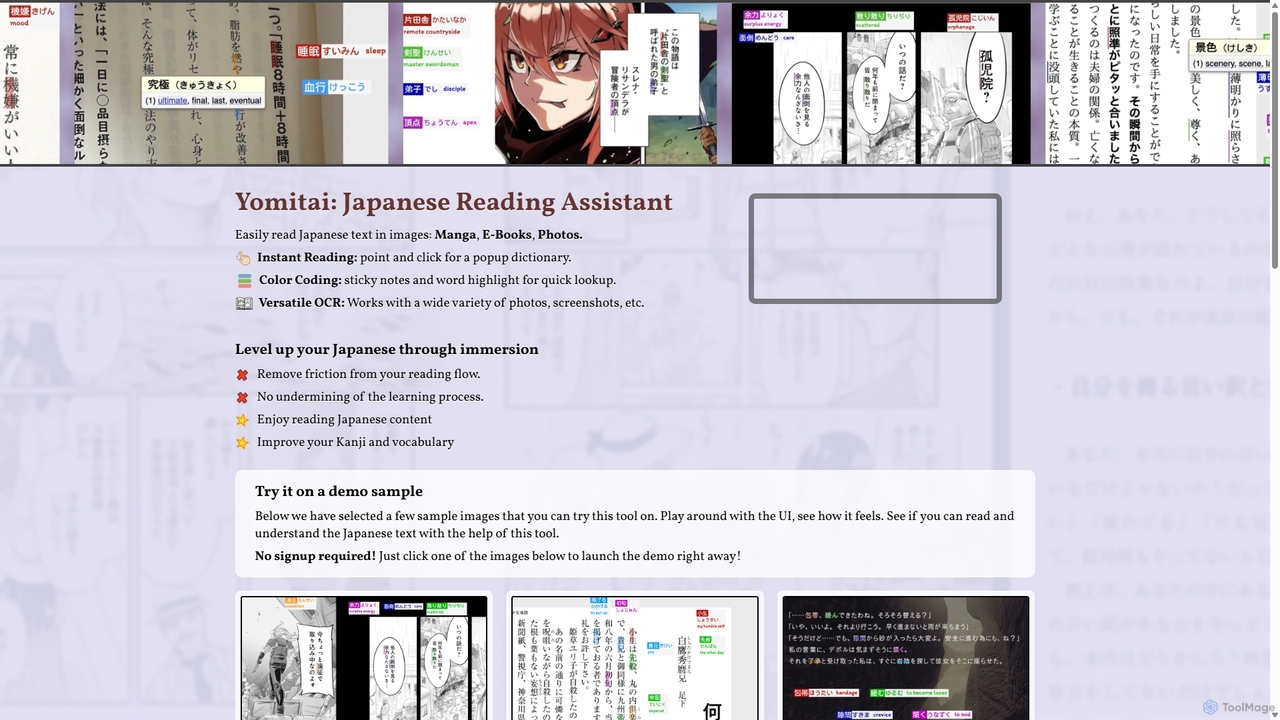
Yomitai is an AI-powered Japanese reading assistant for learners. It uses advanced OCR to instantly analyze text in …

3.4K

About Dictionary

AI Dictionaries are advanced language tools that use natural language processing (NLP) to provide deep, contextual word definitions and usage insights. Unlike traditional dictionaries, they analyze how words are used in sentences to deliver nuanced meanings, generate relevant example sentences, and explain subtle differences between synonyms. This helps users grasp the full scope of a word's meaning and its appropriate application in various contexts. As a specialized utility, they offer a more dynamic and comprehensive approach to language comprehension.

Core Features

  • Contextual Analysis: Provides definitions that adapt to the surrounding text for higher accuracy.
  • AI-Generated Examples: Creates diverse and relevant example sentences on demand to illustrate usage.
  • Nuanced Synonym Comparison: Explains the subtle differences in connotation and usage between similar words.
  • Multilingual Support: Offers in-depth definitions and translations that capture cultural and linguistic nuances.
  • Etymology and Word Relations: Traces word origins and visualizes semantic connections to other terms.

Use Cases

These tools are particularly valuable for language learners, professional writers, translators, and academics. They are frequently used in content creation to enhance vocabulary, in translation to ensure accuracy, and in linguistic research to explore word usage patterns. Anyone requiring a precise understanding of language beyond basic definitions can benefit.

How to Choose

When selecting an AI Dictionary, consider the range of supported languages and the depth of its contextual analysis. Evaluate its ability to integrate with your existing writing tools, such as browser extensions or text editors. Also, assess the quality of its example sentences and the clarity of its synonym explanations to find the tool that best fits your specific needs.

DictionaryUse Cases

1

Enhancing Academic Writing and Research

A university student writing a research paper needs to use precise and sophisticated terminology. Instead of a standard thesaurus, they use an AI Dictionary to look up a term like 'significant'. The tool not only provides synonyms but also analyzes sample texts from academic journals to show how 'substantial', 'considerable', or 'noteworthy' are used differently in scientific contexts. This allows the student to choose the most accurate term, elevating the quality and credibility of their paper.

2

Mastering Nuances for Language Learners

An intermediate learner of French is confused by the verbs 'savoir' and 'connaître', both meaning 'to know'. A traditional dictionary offers basic translations. An AI Dictionary, however, provides contextual examples: 'Je sais nager' (I know how to swim - a skill) versus 'Je connais Paris' (I know Paris - familiarity). It explains the grammatical and conceptual rules, helping the learner internalize the difference and use the correct verb confidently in conversation.

3

Improving Translation Accuracy and Style

A professional translator is working on a marketing slogan from English to Japanese. A literal translation of 'Think different' would be awkward. The translator uses an AI Dictionary to explore the core concept. The tool provides culturally relevant alternatives and explains the nuances of each, suggesting phrases that evoke 'innovation' or 'unconventional thinking' in a way that resonates with a Japanese audience. This moves beyond simple translation to true localization, ensuring the marketing message is effective.

4

Enriching Creative Writing Vocabulary

A novelist is describing a gloomy landscape and wants to avoid overusing the word 'sad'. They use an AI Dictionary to explore related concepts. The tool suggests words like 'melancholy', 'somber', 'wistful', and 'lugubrious'. For each word, it provides a nuanced definition and AI-generated sentences showing how it can be used to describe a mood, a person, or a place. This empowers the writer to paint a more vivid and emotionally resonant picture for the reader.

5

Clarifying Technical Jargon for Professionals

A junior lawyer is reading a complex contract and encounters the term 'indemnification'. A standard dictionary provides a basic definition. An AI Dictionary specialized in legal terms goes further. It defines the term within the context of contract law, provides examples of standard indemnification clauses, and explains how it differs from a 'guarantee' or 'warranty'. This deep, domain-specific knowledge helps the lawyer quickly grasp complex legal concepts and perform their job more effectively.

6

Improving Everyday Digital Communication

A non-native English speaker is writing an important email to a client. They want to sound professional but friendly. They use an AI Dictionary browser extension to check a phrase like 'get back to you'. The tool confirms its appropriateness and suggests alternatives like 'I will follow up with you' for a more formal tone or 'I'll let you know soon' for a more casual one. It provides confidence and helps the user navigate the subtle social cues of business communication, preventing misunderstandings.

DictionaryFrequently Asked Questions