
Utilities Best in category 1 results Privacy AI Tool

Popular AI tools in the Privacy field of Utilities include Inboxdetox, etc., helping you quickly improve efficiency.

Free
Inboxdetox

Inboxdetox

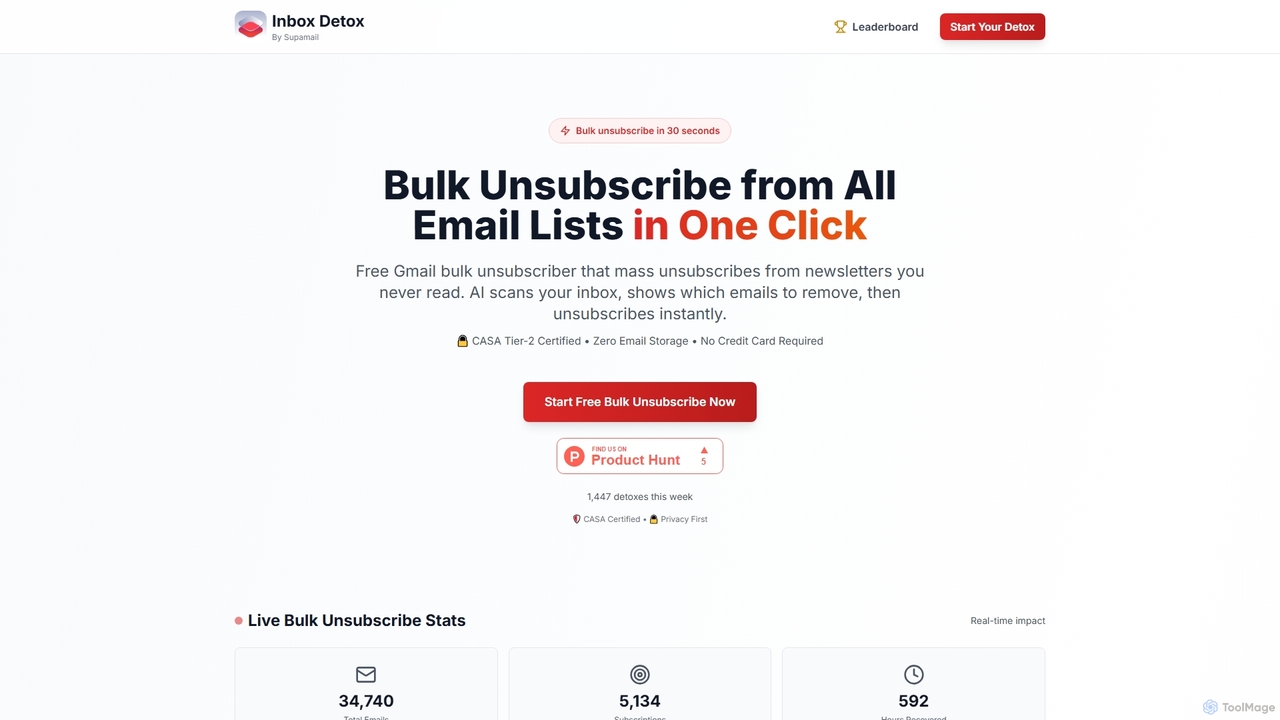
Inboxdetox is a free, AI-powered tool for Gmail that helps you bulk unsubscribe from unwanted newsletters and promotional …

2.5K

About Privacy

AI Privacy tools are a specialized class of utilities designed to protect sensitive data throughout the AI lifecycle. They employ advanced techniques like data anonymization, differential privacy, and synthetic data generation to safeguard personally identifiable information (PII). This enables organizations to develop and deploy powerful AI models while adhering to strict data protection regulations such as GDPR and CCPA. By creating a secure environment for data processing, these tools build trust and mitigate the risks associated with handling confidential information.

Core Features

  • Data Anonymization & Pseudonymization: Replaces or removes direct and indirect identifiers from datasets to prevent the identification of individuals.
  • Differential Privacy: Adds mathematically calibrated statistical noise to data outputs, providing strong, provable guarantees against re-identification attacks.
  • Synthetic Data Generation: Creates artificial datasets that mirror the statistical properties of real data, allowing for model training and testing without using sensitive information.
  • Privacy Auditing & Reporting: Scans datasets and models to identify potential privacy vulnerabilities and generates compliance reports for regulations.
  • Federated Learning Frameworks: Facilitates training AI models on decentralized data sources (e.g., mobile devices) without centralizing the raw data.

Use Cases

These tools are critical in sectors handling sensitive information, such as healthcare for protecting patient records in medical research, finance for securing transaction data in fraud detection models, and technology for analyzing user behavior without compromising individual privacy. They are essential for data scientists, machine learning engineers, and compliance officers.

How to Choose

When selecting an AI Privacy tool, consider the specific privacy guarantees required (e.g., k-anonymity, differential privacy's epsilon value). Evaluate its impact on model performance and accuracy, its ease of integration with your existing data pipelines and MLOps workflows, and its ability to generate compliance documentation for relevant regulations.

PrivacyUse Cases

1

Training Medical AI with Anonymized Patient Data

A healthcare research institute needs to train a diagnostic AI model on a vast dataset of patient electronic health records (EHRs). To comply with HIPAA and protect patient confidentiality, they use an AI Privacy tool. The tool automatically identifies and removes or pseudonymizes all PII, such as names, addresses, and social security numbers, from the records. This allows data scientists to safely use the rich clinical data to build an accurate predictive model without ever accessing sensitive personal information, accelerating research while maintaining the highest ethical standards.

2

Secure Financial Fraud Detection Modeling

A financial institution wants to improve its fraud detection system by training it on customer transaction data. To prevent exposure of individual spending habits, they apply differential privacy techniques. The AI Privacy tool injects a carefully measured amount of statistical noise into the aggregated data before it's used for training. This ensures that the model learns broad patterns indicative of fraud but cannot be reverse-engineered to reveal the transaction details of any single customer, balancing security enhancement with customer trust.

3

Generating Synthetic Data for Software Testing

A software development company is building a new CRM platform and needs realistic data to perform load testing and bug detection. Using real customer data in a development environment poses a significant security risk. Instead, they use an AI Privacy tool to generate a high-fidelity synthetic dataset. The tool analyzes the structure and statistical distributions of the real customer data and creates an entirely artificial dataset that mimics its properties. This allows developers and QA engineers to test the software thoroughly under realistic conditions without ever using actual sensitive customer information.

4

Privacy-Preserving Customer Behavior Analytics

An e-commerce platform aims to personalize user experience by analyzing shopping patterns. To respect user privacy, they employ privacy-enhancing technologies. Instead of tracking individuals, their system aggregates user interaction data (like clicks and purchases) and applies privacy techniques to the dataset. This allows their marketing and product teams to identify popular product categories, understand conversion funnels, and discover trends without linking behavior back to specific, identifiable users, enabling data-driven decisions while upholding privacy principles.

5

Automating GDPR and CCPA Compliance Audits

A global corporation must regularly demonstrate compliance with data protection regulations like GDPR and CCPA. They use an AI Privacy tool to automate this process. The tool scans their data lakes, databases, and machine learning models to identify and classify sensitive data. It then generates detailed reports that map data usage against regulatory requirements, flag potential privacy risks, and document the privacy-preserving measures in place. This significantly reduces the manual effort for compliance officers and provides a clear audit trail for regulators.

6

Federated Learning for Smart Keyboard Prediction

A mobile OS developer wants to improve its keyboard's next-word prediction feature without collecting user typing data on central servers. They implement a federated learning framework using AI Privacy tools. The model is trained directly on individual user devices using local data. Only the anonymized and aggregated model updates, not the raw text, are sent back to a central server to improve the global model. This approach enhances the feature's intelligence for all users while ensuring that personal conversations and sensitive information never leave the user's device.

PrivacyFrequently Asked Questions