AgainstData
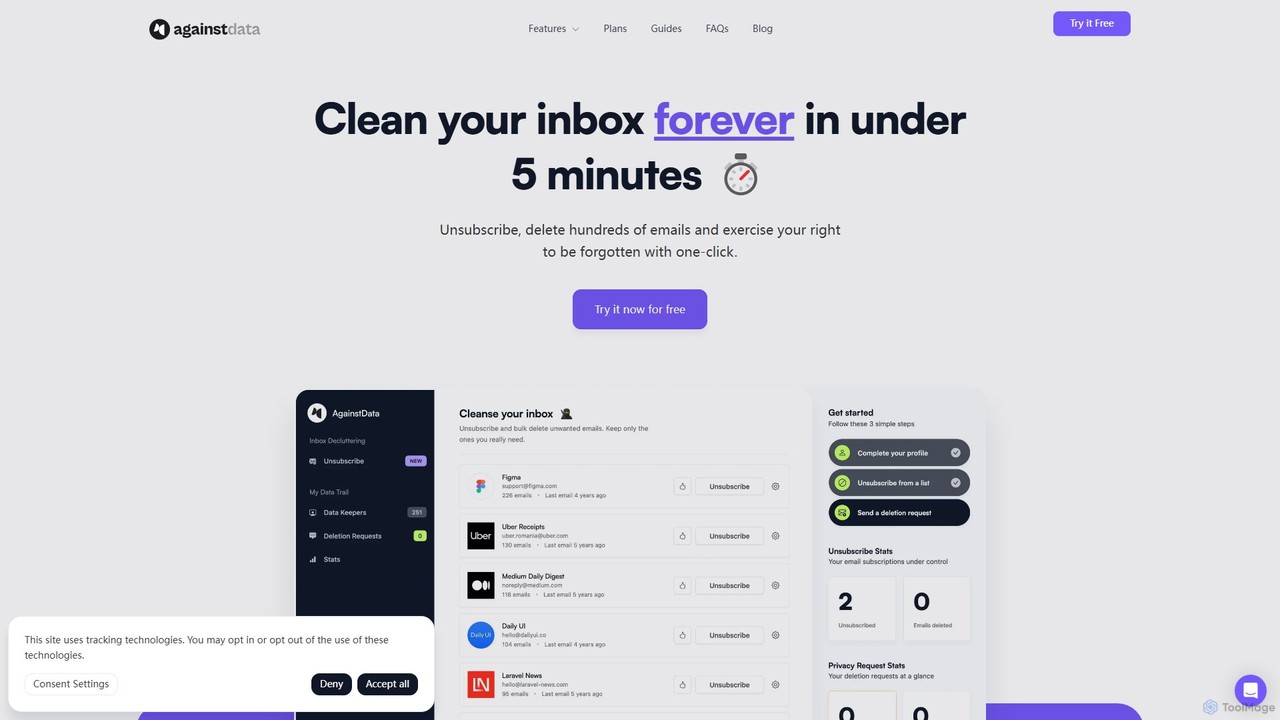
AgainstData is an AI-powered digital assistant that cleans your inbox and protects your privacy. Effortlessly unsubscribe from mailing …
AgainstData is an AI-powered digital assistant that cleans your inbox and protects your privacy. Effortlessly unsubscribe from mailing lists, bulk delete unwanted emails, and request the removal of your personal data from companies with a single click.
About Storage Management
AI Storage Management tools are a class of utilities that use artificial intelligence to intelligently organize, search, and optimize digital assets and data. These tools leverage machine learning algorithms for tasks like automatic tagging, duplicate detection, and content-based search, going far beyond simple file and folder structures. This enables users and teams to efficiently manage vast amounts of unstructured data, quickly locate specific files by their content, and automate routine storage maintenance. Unlike traditional cloud storage platforms, these tools add a layer of intelligence to existing storage, making data more accessible and valuable.
Core Features
- Intelligent Search: Search for files based on their content, objects, or concepts, not just filenames or manual tags.
- Automatic Tagging & Categorization: AI analyzes files like images and documents to automatically apply relevant keywords and sort them into logical categories.
- Duplicate & Redundancy Detection: Identifies identical or visually similar files across different folders to help users free up space and reduce clutter.
- Data Insights: Provides analytics on storage usage, file types, and access patterns to inform better data management strategies.
Use Cases
These tools are particularly valuable for creative professionals, marketing teams, researchers, and legal firms who handle large volumes of unstructured data. For instance, a marketing team can instantly find all images containing a 'logo' and a 'person smiling', or a research group can organize thousands of academic papers by topic automatically.
How to Choose
When selecting an AI Storage Management tool, consider its integration capabilities with your existing cloud storage (e.g., Google Drive, Dropbox, S3). Evaluate the range of file types it supports and the sophistication of its search and tagging features. Also, assess its collaboration features for team use and ensure its pricing model scales with your data volume.

Storage ManagementUse Cases
Managing a Large Stock Photo Library
A marketing team for a global brand manages a library of over 50,000 stock photos stored across multiple cloud drives. Manually finding a specific image is time-consuming. By using an AI Storage Management tool, the entire library is indexed automatically. The AI analyzes each image, applying tags like 'office meeting', 'laptop', 'diverse team', and 'natural light'. Now, a social media manager can simply search for 'woman smiling with coffee in a modern office' and get relevant results in seconds, instead of browsing through hundreds of folders. This drastically speeds up content creation workflows.
Organizing Academic Research Papers
A PhD student has accumulated thousands of PDF research papers for their dissertation. The files are poorly named and organized. An AI Storage Management tool connects to their Zotero or Dropbox folder, scans the content of every PDF, and automatically groups them by research topic, methodology, and cited authors. The student can then search for abstract concepts like 'machine learning applications in bioinformatics' and find all relevant papers, even if those exact keywords aren't in the filename. The tool also identifies duplicate papers downloaded from different sources, helping to clean up the research library.
Streamlining Video Production Assets
A video production agency stores terabytes of raw footage, B-roll, and final cuts. Finding a specific clip from a past project is a major challenge. An AI management tool can process all video files, creating a searchable transcript of spoken dialogue and identifying objects and scenes within the footage. An editor needing a 'drone shot of a coastline at sunset' can search for that description and instantly pull up relevant clips from multiple projects. This repurposing of assets saves significant time and money on reshoots or purchasing new stock footage.
Cleaning Up and Optimizing Cloud Storage
A small business's shared cloud drive has become cluttered over years of use, filled with duplicate files, multiple versions of the same document, and large, unused assets. An AI Storage Management tool scans the entire drive and identifies all redundancies. It presents a clear report showing, for example, '15 copies of company_logo_final_v3.png' and '20GB of video files not accessed in over two years'. The administrator can then review these suggestions and safely delete unnecessary files in bulk, freeing up significant storage space and reducing monthly cloud subscription costs.
Personal Digital Asset Archiving
A freelance photographer has over a decade's worth of photos stored on various external hard drives, making it nearly impossible to find specific shots. By consolidating their archives and running an AI storage tool, their entire life's work becomes searchable. The AI identifies faces, allowing them to find all photos of a particular family member. It recognizes locations, so they can search for 'photos from Paris trip 2015'. It even tags objects and themes like 'weddings', 'landscapes', and 'portraits', creating an intelligent, browsable archive from a chaotic collection of files.
Corporate Document Discovery for Compliance
A financial services company needs to perform an internal audit to ensure all client contracts from the last five years contain a specific compliance clause. Manually opening thousands of PDF and Word documents would take weeks. They use an AI Storage Management tool to perform a semantic search across their entire document repository. Instead of just searching for keywords, it searches for the conceptual meaning of the clause. The tool generates a report in hours, listing all contracts that contain the clause and, more importantly, flagging those that are missing it, enabling rapid remediation.