HeardThat is an AI-powered smartphone app that eliminates background noise, allowing you to hear conversations clearly in loud environments. Using your existing phone and Bluetooth listening devices, it leverages advanced machine learning to isolate speech, tackling the 'cocktail-party effect'. It's a software-based hearing-assistive tool designed for anyone who struggles to follow conversations in noisy social settings, enhancing communication and reducing listening fatigue.

IRIS provides an advanced AI-powered audio platform that delivers real-time noise cancellation and voice enhancement. Designed for mission-critical communications, it offers solutions like the Clarity app, an SDK for developers, and the VIPER embedded system for hardware, ensuring crystal-clear audio in any environment, from call centers to motorsports.
Product overview
HeardThat Product overview
HeardThat is an AI-powered smartphone app that eliminates background noise, allowing you to hear conversations clearly in loud environments. Using your existing phone and Bluetooth listening devices, it leverages advanced machine learning to isolate speech, tackling the 'cocktail-party effect'. It's a software-based hearing-assistive tool designed for anyone who struggles to follow conversations in noisy social settings, enhancing communication and reducing listening fatigue.

IRIS Product overview
IRIS provides an advanced AI-powered audio platform that delivers real-time noise cancellation and voice enhancement. Designed for mission-critical communications, it offers solutions like the Clarity app, an SDK for developers, and the VIPER embedded system for hardware, ensuring crystal-clear audio in any environment, from call centers to motorsports.
Detailed feature comparison
| Feature | HeardThat | IRIS |
|---|---|---|
| Primary category | Speech Enhancement | Noise Reduction |
| Added | 2025-08-12 | 2025-08-06 |
| Pricing | Freemium | Paid |
| Official website | heardthat.ai | iris.audio |
| Product type | App | Website |
| Performance data | ||
| User rating | Not verified | Not verified |
| Comments | 0 | 0 |
| Monthly visits | 2.8K | 14.4K |
| Monthly growth | 7.5% | -18.3% |
| Favorites | 136 | 89 |
| Details | View details | View details |
HeardThat vs IRIS monthly traffic
Compare HeardThat and IRIS by monthly reach, traffic trend, visit depth, top regions, and acquisition sources.
How to interpret the traffic data
In the HeardThat vs IRIS monthly traffic comparison, HeardThat currently shows 2.8K visits and IRIS shows 14.4K; IRIS has about 5.1 times the visible traffic of HeardThat, an absolute difference of about 11.6K visits. This reflects visible reach, not feature quality or paid users.
Both tools provide verified traffic details, so monthly trends, visit depth, regions, and acquisition sources can be compared on the same basis.
HeardThat monthly traffic:
Latest traffic
Monthly traffic trend
- 2025/9: 4.4K Monthly visits
- 2026/1: 2K Monthly visits
- 2026/2: 3.7K Monthly visits
- 2026/3: 3.5K Monthly visits
- 2026/4: 2.6K Monthly visits
- 2026/5: 2.8K Monthly visits
Top regions
Top 5 countries/regions
| Country/region | Percentage | Traffic |
|---|---|---|
| 🇺🇸United States | 100% | 2.8K |
Search keywords
IRIS monthly traffic:
Latest traffic
Monthly traffic trend
- 2025/9: 22.8K Monthly visits
- 2026/1: 28.8K Monthly visits
- 2026/2: 20K Monthly visits
- 2026/3: 22.7K Monthly visits
- 2026/4: 17.6K Monthly visits
- 2026/5: 14.4K Monthly visits
Top regions
Top 5 countries/regions
| Country/region | Percentage | Traffic |
|---|---|---|
| 🇺🇸United States | 35% | 5K |
| 🇵🇭Philippines | 21.32% | 3.1K |
| 🇬🇧United Kingdom | 20.66% | 3K |
| 🇮🇳India | 14.13% | 2K |
| 🇧🇷Brazil | 8.89% | 1.3K |
Search keywords
Usage comparison
Compare the core capabilities of HeardThat and IRIS
HeardThat Core features
IRIS Core features
Use cases
HeardThat Use cases
IRIS Use cases
HeardThat vs IRIS:In-depth comparison and selection guidance
First decide whether the products solve the same kind of need
This in-depth HeardThat vs IRIS comparison uses only the product records, taxonomy, audience, traffic, and community signals available on this page. HeardThat is primarily listed under “Speech Enhancement”, while IRIS is primarily listed under “Noise Reduction”, so the first decision is whether your actual task matches their recorded scope.
The structured fields currently show these decision-relevant differences: Primary category (HeardThat: Speech Enhancement; IRIS: Noise Reduction); Product type (HeardThat: App; IRIS: Website); Pricing (HeardThat: Freemium; IRIS: Paid); Monthly visits (HeardThat: 2.8K; IRIS: 14.4K); Monthly growth (HeardThat: 7.5%; IRIS: -18.3%). These facts are more useful for selection than brand visibility alone.
What market visibility and monthly traffic mean
In the HeardThat vs IRIS monthly traffic comparison, HeardThat currently shows 2.8K visits and IRIS shows 14.4K; IRIS has about 5.1 times the visible traffic of HeardThat, an absolute difference of about 11.6K visits. This reflects visible reach, not feature quality or paid users.
Both tools provide verified traffic details, so monthly trends, visit depth, regions, and acquisition sources can be compared on the same basis.
If public market visibility is an important first-pass criterion, investigate IRIS first. The final choice should still follow taxonomy, use case, and a real trial because higher traffic does not prove broader capabilities or better workflow fit.
Product positioning, use cases, and roles
HeardThat and IRIS currently overlap in shared categories: Noise Reduction; shared tags: noise cancellation. This can place both on the same shortlist, but it does not prove equal implementation, depth, or cost.
HeardThat's unique categories/tags are Speech Enhancement, Hearing Assistance, accessibility, audio processing, conversation clarity, hearing aid, hearing assistance, and machine learning; IRIS's are Call Center, Sdk, Communication, acoustic shock, API, audio enhancement, call center, and communication. These unique fields are the strongest differentiators: validate the product whose recorded scope matches the task instead of following traffic alone.
What ratings, comments, and favorites can tell you
HeardThat has no verified rating, 0 comments, 136 favorites, and 116 likes;IRIS has no verified rating, 0 comments, 89 favorites, and 83 likes。
Neither product has enough rating or comment samples for a credible reputation ranking.
Selection guidance by actual need
When to evaluate HeardThat first
Put HeardThat on the priority trial list when the task aligns with “Speech Enhancement” and especially Speech Enhancement, Hearing Assistance, accessibility, audio processing, conversation clarity, and hearing aid. This follows recorded positioning and does not imply unlisted capabilities are absent.
HeardThat also currently records: pricing is freemium, product type is app, 2.8K verified monthly visits, no verified user rating. Verify any hard requirement around price, platform, or reach before trial, and do not let sparse review data substitute for testing.
When to evaluate IRIS first
Put IRIS on the priority trial list when the task aligns with “Noise Reduction” and especially Call Center, Sdk, Communication, acoustic shock, API, and audio enhancement. This follows recorded positioning and does not imply unlisted capabilities are absent.
IRIS also currently records: pricing is paid, product type is website, 14.4K verified monthly visits, no verified user rating. Verify any hard requirement around price, platform, or reach before trial, and do not let sparse review data substitute for testing.
How to validate the recommendation before deciding
The available data describes positioning, public visibility, and community signals, but it cannot prove output quality, speed, integration effort, privacy, or long-term cost in your workflow. Before deciding, run the same representative tasks in HeardThat and IRIS, then record completion time, accuracy, manual corrections, and the real paid threshold. A like-for-like trial turns this comparison into a defensible adoption decision.
Comparison FAQ
How should I choose between HeardThat and IRIS?
Where does this comparison data come from?
What do unknown fields mean?
Related AI tools

Krisp
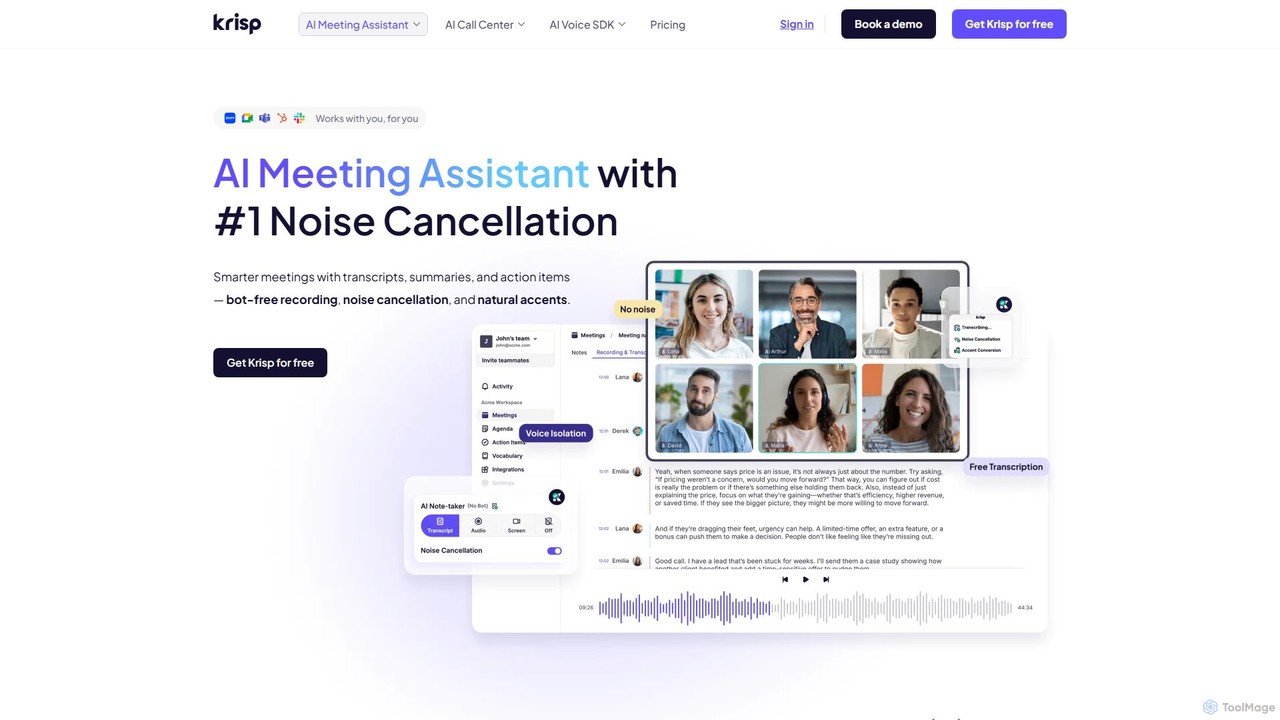
Krisp is an AI-powered meeting assistant that enhances communication clarity and productivity. It offers real-time, bi-directional noise cancellation, voice and echo removal, automated meeting transcription, and AI-generated notes, compatible with over 800 communication apps.
Noise Cancellation
CrystalSound
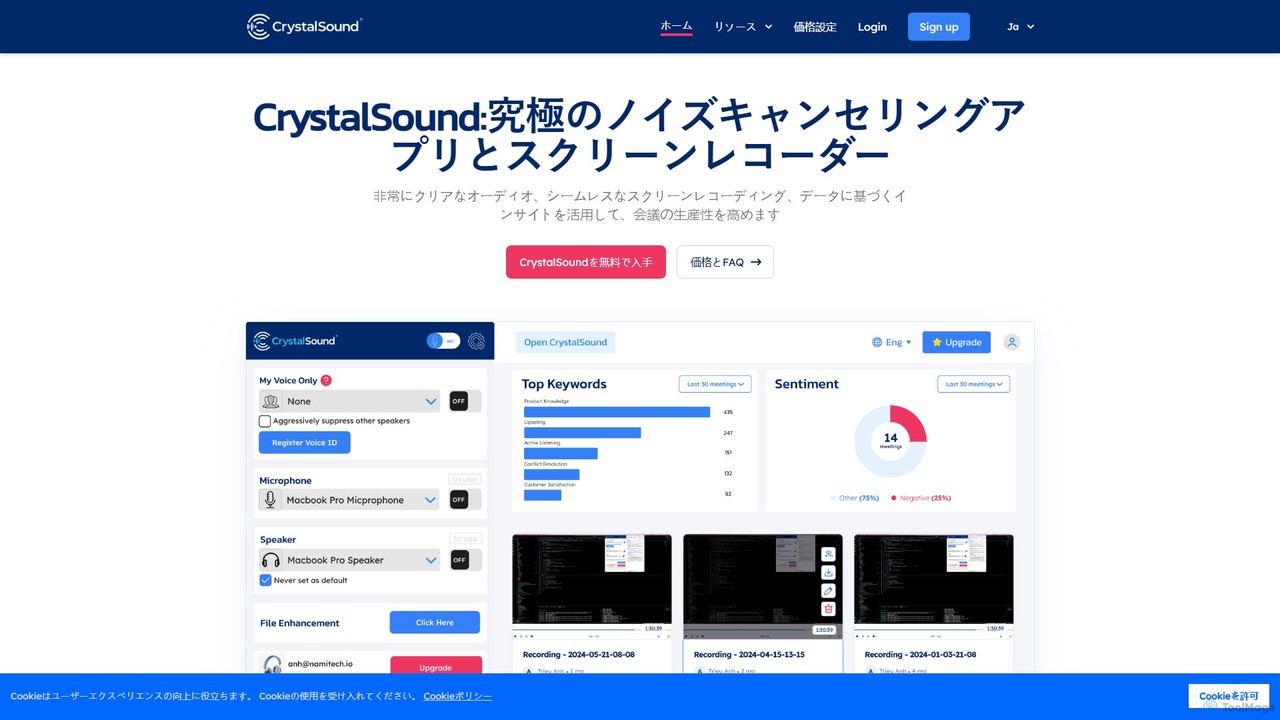
CrystalSound is an AI-powered noise-cancelling and screen recording application designed to enhance online meeting productivity. It eliminates background noise from both ends of a call, records meetings with high-definition audio, and provides AI-driven transcriptions and insights, ensuring crystal-clear communication and focused collaboration.
Noise Reduction
Hance.ai
Hance.ai offers embedded, real-time AI audio enhancement solutions for developers and manufacturers. Its lightweight and efficient models provide noise removal, echo cancellation, and stem separation directly on hardware or software, ensuring low latency and data privacy for applications ranging from video conferencing to music production.
Audio Enhancement
Music AI
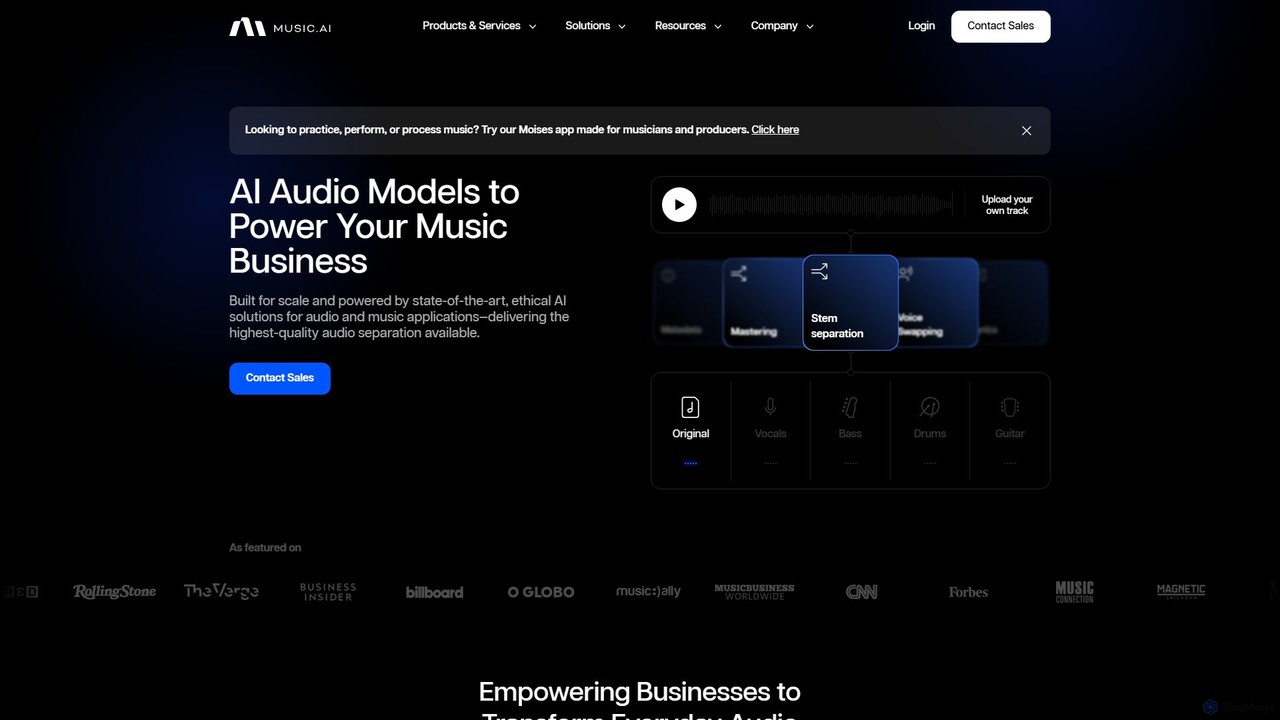
A comprehensive AI audio intelligence platform for businesses and developers. Offers a suite of tools via API and a no-code dashboard, including advanced stem separation, mastering, transcription, and metadata analysis. The core technology behind the popular Moises app.
Audio Editing
ai_coustics
ai_coustics is an AI-powered audio enhancement platform designed to automatically clean and improve audio quality. It specializes in noise reduction, speech enhancement, and dereverberation, making it ideal for podcasters, video creators, and developers who need studio-quality sound without complex editing.
Audio Editing
Kardome
Kardome provides AI-powered voice enhancement technology for smart devices. Its core Spatial Hearing software isolates target speech in noisy, multi-speaker environments, delivering crystal-clear audio to any voice recognition system. It's designed for automotive, consumer electronics, and healthcare industries, offering solutions like custom wake words and voice biometrics that operate on the edge for enhanced privacy and performance.
Voice Technology
Faim
Faim is a Model-as-a-Service platform providing zero-shot inference for time-series forecasting. It offers instant access to state-of-the-art AI models like Chronos2, TiRex, and FlowState via a simple Python SDK, eliminating the need for complex setup or model training.
Machine Learning
Levelr
Levelr is an AI-powered audio platform offering studio-grade audio restoration, voice isolation, speech enhancement, and professional music mastering. It helps filmmakers, podcasters, music producers, and live streamers achieve crystal-clear sound by removing noise, isolating vocals, and optimizing tracks for release.
Mastering
Kardome
Kardome provides advanced AI-powered voice user interface (VUI) technology for manufacturers. Its solutions use spatial hearing and deep learning to deliver crystal-clear speech recognition in noisy, multi-speaker environments. It offers features like noise cancellation, speaker isolation, custom wake words, and secure on-device voice biometrics, enhancing voice interactions in automotive, consumer electronics, and healthcare devices.
Speech Enhancement
Scematics
Scematics is an all-in-one data annotation and labeling platform that provides strategic data solutions to optimize AI models. It offers intuitive tools, expert annotation services, edge case monitoring, and synthetic data generation, enabling teams to build high-quality, scalable training datasets for various AI applications across diverse industries.
3D
Sanas
Sanas is a real-time speech understanding AI platform that offers accent translation, language translation, and omni-directional noise cancellation. It's designed for contact centers and enterprises to break down communication barriers, improve customer satisfaction (CSAT), and enhance operational efficiency by ensuring crystal-clear conversations.
Global Teams
Nonoisy
Nonoisy is an AI-powered tool that automatically removes background noise, levels volume, and enhances audio quality for video and audio files. Ideal for podcasters, video creators, and course makers, it saves time and money by automating complex audio post-production, delivering professional-sounding results quickly.
Noise Reduction
Tomato.ai
Tomato.ai is an AI-powered voice filtering solution designed for call centers. It neutralizes and reduces the accents of offshore agents in real-time, making their speech clearer to customers. This enhances communication, improves customer satisfaction (CSAT), and boosts sales metrics by reducing misunderstandings and frustration.
Voice Modulation
Actual Chat
Actual Chat is an innovative communication platform that merges real-time voice, live transcription, and AI assistance. It combines the speed of talking with the convenience of texting, allowing users to communicate faster, more expressively, and with a complete, searchable record of every conversation.
Communication
OpenAI
OpenAI is a leading AI research and deployment company dedicated to ensuring that artificial general intelligence (AGI) benefits all of humanity. It develops state-of-the-art models like GPT-5, ChatGPT for conversational AI, Sora for text-to-video, and DALL-E for image generation. Through its robust API platform, OpenAI empowers developers and businesses to integrate powerful AI capabilities into their applications, driving innovation across various industries.
Image Generation