ToolMage
Sign in

Best 2 Speech Enhancement AI tools for Audio

Popular Speech Enhancement AI tools in Audio include Kardome, helping you work more efficiently.

Kardome

Kardome

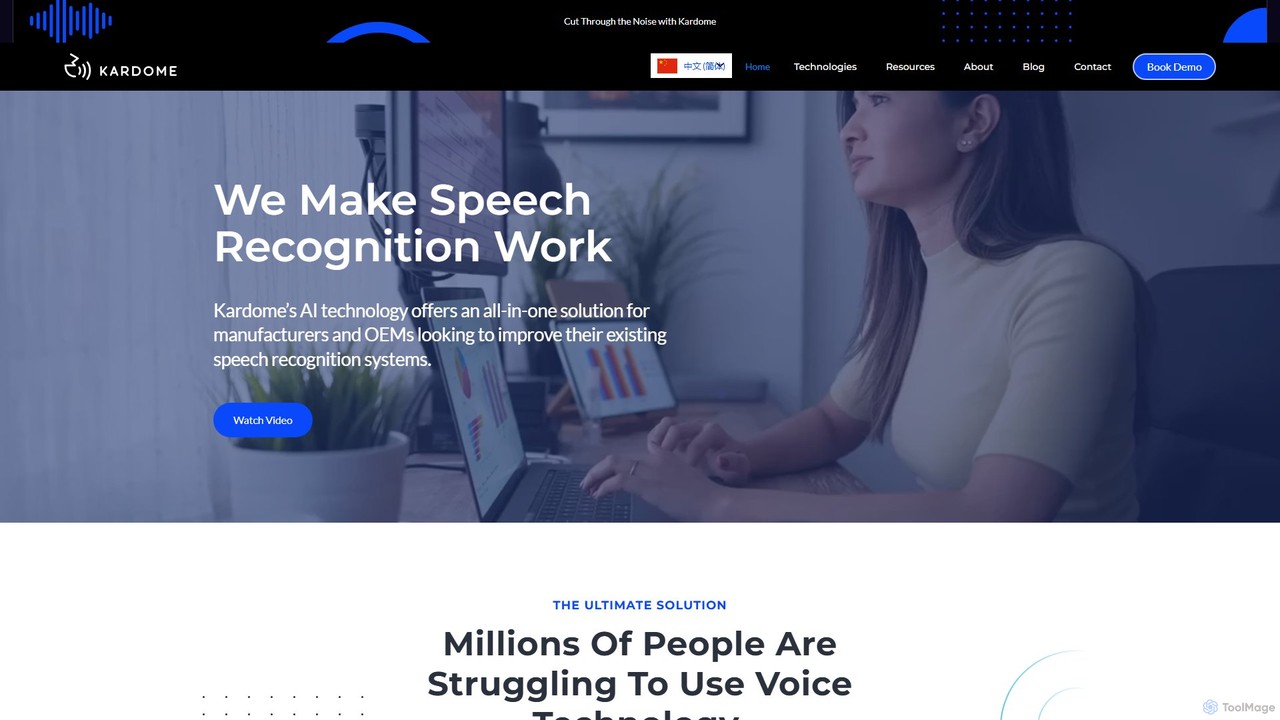
Kardome provides AI-powered voice enhancement technology for smart devices. Its core Spatial Hearing software isolates target speech in noisy, multi-speaker environments, delivering crystal-clear audio to any voice recognition system. It's designed for automotive, consumer electronics, and healthcare industries, offering solutions like custom wake words and voice biometrics that operate on the edge for enhanced privacy and performance.

Voice Technology
Visits 9.7KFavorites 106Likes 114
Kardome

Kardome

Kardome provides advanced AI-powered voice user interface (VUI) technology for manufacturers. Its solutions use spatial hearing and deep learning to deliver crystal-clear speech recognition in noisy, multi-speaker environments. It offers features like noise cancellation, speaker isolation, custom wake words, and secure on-device voice biometrics, enhancing voice interactions in automotive, consumer electronics, and healthcare devices.

Speech Enhancement
Visits 5.6KFavorites 125Likes 125

About Speech Enhancement

Speech Enhancement tools are AI-powered solutions designed to significantly improve the clarity and quality of spoken audio. These tools leverage advanced machine learning algorithms to intelligently identify and separate human speech from unwanted background noise, echoes, and reverberation. They are invaluable for ensuring crystal-clear communication and professional-grade audio in diverse applications, from live conversations to recorded content, making voices stand out distinctly.

Core Features

  • Noise Reduction: Effectively suppresses various types of background noise, such as fan hum, traffic, keyboard clicks, and general ambient sounds.
  • Echo Cancellation: Eliminates echoes that can occur in recordings or during live communication, ensuring a cleaner sound.
  • Speech Clarity Enhancement: Boosts the intelligibility and presence of the speaker's voice, making it easier to understand.
  • Reverb Suppression: Reduces the effect of room reverberation, creating a drier and more focused vocal sound.
  • Automatic Gain Control (AGC): Dynamically adjusts speech volume to maintain consistent audio levels, preventing sudden loud or quiet passages.

Applicable Scenarios

Speech Enhancement tools are crucial for professionals and individuals who rely on clear audio. They are widely used in online meetings, podcast production, and customer service centers to ensure every word is heard. Content creators utilize them for voiceovers, while gamers benefit from clearer in-game communication. These tools transform noisy recordings into pristine audio, enhancing overall listening experience.

How to Choose

When selecting a Speech Enhancement tool, consider its effectiveness in reducing various noise types without introducing artifacts. Evaluate whether you need real-time processing for live calls or post-processing for recorded audio. Check for integration capabilities with your existing software, such as conferencing platforms or digital audio workstations. Also, assess its resource usage, especially for real-time applications, and look for options that offer customization for specific audio environments.

Speech Enhancement use cases

1

Enhancing Online Meeting Clarity

Remote professionals use speech enhancement to eliminate background distractions like children playing or keyboard typing, ensuring their voice is clear and professional during virtual conferences and webinars. This allows for more focused discussions and reduces listener fatigue, making remote collaboration more effective and productive.

2

Producing Professional Podcasts and Audiobooks

Podcasters and audiobook narrators apply these tools to raw recordings to remove room echo, fan noise, and other ambient sounds, delivering high-quality, studio-like audio to their listeners. This ensures a polished final product that enhances listener engagement and maintains a professional brand image.

3

Improving Call Center Customer Service

Customer service representatives utilize real-time speech enhancement to filter out office noise from their end and reduce background noise from the customer's environment, leading to more effective and less frustrating conversations. This improves customer satisfaction and agent efficiency by ensuring clear communication channels.

4

Cleaning Voiceovers for Video Content

Video creators, YouTubers, and e-learning developers employ speech enhancement to refine voiceover tracks, removing unwanted hums or echoes, which results in crisp, engaging narration for their visual content. This elevates the overall production quality and ensures that the message is delivered with maximum clarity.

5

Accurate Transcription of Noisy Interviews

Journalists, researchers, or legal professionals use these tools to clean up audio recordings of interviews or field notes taken in challenging environments, significantly improving the accuracy of subsequent speech-to-text transcription. This saves considerable time and effort in manual correction, making data analysis more efficient.

6

Clearer In-Game Communication for Gamers

Gamers integrate speech enhancement software with their microphones to suppress background noise from their gaming setup or home environment, ensuring their teammates hear their commands and strategies without interference. This leads to better team coordination, a more immersive gaming experience, and reduced frustration from miscommunication.

Speech Enhancement FAQ

What is Speech Enhancement?

Speech Enhancement refers to AI-driven technologies that improve the quality and intelligibility of spoken audio by reducing unwanted elements. It primarily focuses on separating human speech from background noise, echoes, and reverberation, making the voice clearer and more prominent. These tools are crucial for applications where clear vocal communication is paramount, such as online meetings, podcasting, and customer service.

How does AI Speech Enhancement work?

AI Speech Enhancement typically works by employing deep learning models trained on vast datasets of speech and various noise types. These models learn to distinguish between speech signals and noise patterns. When processing audio, the AI identifies and suppresses the noise components while preserving and often enhancing the speech, resulting in a cleaner output. Some advanced models can even adapt to new noise environments in real-time.

What's the difference between Speech Enhancement and general Audio Editing?

Speech Enhancement is a specialized subset of audio processing focused specifically on improving spoken word clarity by removing noise and echoes. General Audio Editing, on the other hand, encompasses a broader range of tasks like cutting, splicing, mixing, applying effects, and mastering. While audio editing software might include basic noise reduction, dedicated AI speech enhancement tools offer more sophisticated and automated solutions for vocal clarity.

Who benefits most from using Speech Enhancement tools?

A wide range of users benefits from speech enhancement. This includes remote workers and students for clearer online meetings, podcasters and content creators for professional audio production, call center agents for improved customer interactions, and gamers for better team communication. Anyone who records or participates in voice-based communication in less-than-ideal acoustic environments can significantly benefit from these tools.

What should I look for when choosing a Speech Enhancement tool?

When selecting a tool, prioritize its effectiveness in removing specific noise types you encounter, and check for minimal speech distortion. Consider if you need real-time capabilities for live calls or if post-processing for recorded audio is sufficient. Evaluate its compatibility with your existing hardware and software, ease of use, and whether it offers customizable settings to fine-tune the enhancement to your specific needs and environment.