
ToolMage
Sign in

Best 1 Insights AI tools for Ai

Popular Insights AI tools in Ai include Mindd Wave, helping you work more efficiently.

Mindd Wave
Free

Mindd Wave

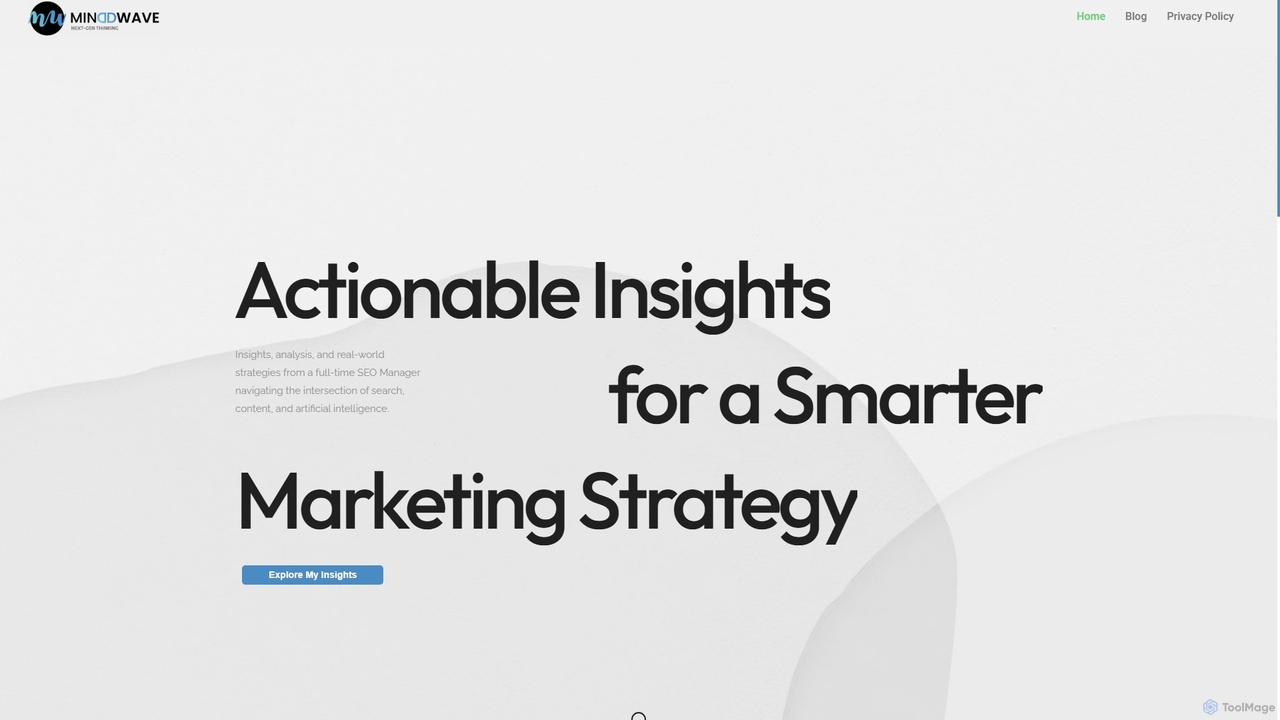
Mindd Wave is a specialized digital marketing blog and insights platform led by SEO Manager Shubham Singh. It offers actionable, AI-driven strategies, deep analysis of search trends, and comprehensive reviews of essential AI and SEO tools to empower marketers in the evolving digital landscape.

Insights
Visits 6.3KFavorites 128Likes 124

About Insights

Insights tools are AI-powered solutions designed to extract meaningful, actionable intelligence from complex data sets. Leveraging advanced machine learning and data analytics, these tools go beyond mere reporting to uncover hidden patterns, predict future trends, and provide strategic recommendations. They empower businesses and individuals to make data-driven decisions, optimize operations, and identify new opportunities.

Core Features

  • Predictive Analytics: Forecast future outcomes and trends based on historical data.
  • Pattern Recognition: Automatically identify hidden correlations and anomalies within large datasets.
  • Sentiment Analysis: Gauge public opinion and customer emotions from text data.
  • Prescriptive Recommendations: Offer data-driven suggestions for optimal actions.
  • Automated Reporting: Generate comprehensive reports and dashboards with key findings.

Use Cases

Insights tools are invaluable across various sectors. Marketing teams utilize them to understand customer behavior and personalize campaigns, while financial analysts employ them for risk assessment and market forecasting. Operations managers leverage these tools to optimize supply chains and identify efficiency bottlenecks.

How to Choose

When selecting an AI Insights tool, consider its data source compatibility, ensuring it integrates with your existing systems. Evaluate the depth of its analytical capabilities, such as predictive modeling or natural language processing. Assess the clarity and customizability of its visualization and reporting features, and consider its scalability to grow with your data needs.

Insights use cases

1

Predicting Market Trends

Marketing strategists use AI insights to analyze vast amounts of market data, social media trends, and news articles. This helps them forecast emerging consumer preferences and competitive shifts, enabling proactive product development and campaign planning. The result is a significant reduction in market research time and more accurate strategic positioning.

2

Optimizing Customer Experience

E-commerce businesses deploy insights tools to analyze customer interaction data, purchase history, and feedback. By identifying common pain points or successful engagement patterns, they can personalize recommendations, streamline user journeys, and proactively address customer needs, leading to higher satisfaction and retention rates.

3

Enhancing Operational Efficiency

Manufacturing companies leverage AI insights to monitor production lines, sensor data, and maintenance logs. The tools detect anomalies, predict equipment failures, and optimize resource allocation, minimizing downtime and reducing operational costs. This leads to more efficient production schedules and improved asset utilization.

4

Personalizing Healthcare Treatments

Medical researchers and practitioners use AI insights to analyze patient data, genetic information, and treatment outcomes. This enables the identification of personalized treatment pathways, prediction of disease progression, and optimization of drug efficacy for individual patients, leading to more effective and tailored healthcare.

5

Detecting Financial Fraud

Financial institutions utilize AI insights to analyze transaction patterns, user behavior, and network data in real-time. The tools identify suspicious activities and anomalies that deviate from normal behavior, flagging potential fraud attempts with high accuracy. This significantly reduces financial losses and enhances security measures.

6

Informing Strategic Business Decisions

Executive leadership teams employ AI insights platforms to consolidate data from various departments—sales, marketing, finance, operations. The tools provide a holistic view of business performance, identify growth opportunities, and assess potential risks, empowering leaders to make informed, data-driven strategic decisions for long-term success.

Insights FAQ

What are AI Insights tools?

AI Insights tools are advanced software solutions that use artificial intelligence, particularly machine learning and natural language processing, to analyze large and complex datasets. Their primary function is to uncover hidden patterns, predict future outcomes, and generate actionable intelligence, moving beyond simple data reporting to provide deeper understanding and strategic guidance.

How do AI Insights tools differ from traditional Business Intelligence (BI) tools?

Traditional BI tools primarily focus on reporting past and present data, answering "what happened" and "why." AI Insights tools, however, leverage AI to go further, answering "what will happen" (predictive analytics) and "what should we do" (prescriptive analytics). They automate pattern discovery and offer proactive recommendations, whereas BI often requires manual analysis.

What types of data can AI Insights tools analyze?

AI Insights tools are highly versatile and can analyze a wide array of data types, including structured data (databases, spreadsheets), unstructured data (text, audio, video), real-time streaming data (IoT sensors), and external data sources (social media, market feeds). This comprehensive capability allows for a holistic understanding of complex scenarios.

Who benefits most from using AI Insights tools?

A broad range of professionals and organizations benefit, including marketing teams seeking customer behavior predictions, financial analysts performing risk assessments, operations managers optimizing supply chains, and executive leadership making strategic decisions. Essentially, anyone needing to transform raw data into actionable intelligence for competitive advantage can benefit.

What are the key considerations when implementing an AI Insights solution?

Key considerations include ensuring data quality and accessibility, as AI insights are only as good as the data they process. Evaluate the tool's integration capabilities with existing systems, its scalability to handle growing data volumes, the level of technical expertise required for deployment and maintenance, and the clarity of its output and visualization features.