ToolMage
Sign in

Best 1 Playground AI tools for Ai Model

Popular Playground AI tools in Ai Model include AirPrompt, helping you work more efficiently.

AirPrompt
Freemium

AirPrompt

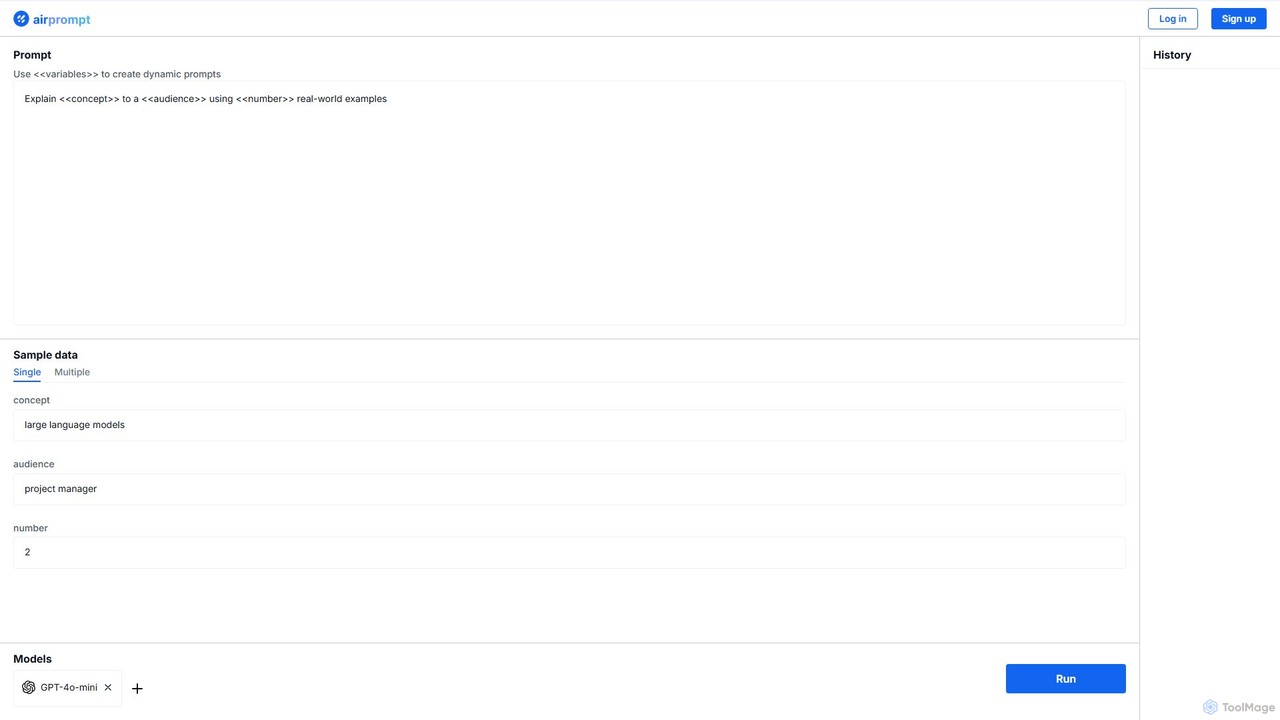
AirPrompt is a powerful prompt engineering and testing platform. It enables users to simultaneously test, compare, and optimize AI prompts across multiple models like GPT-4, Claude, and open-source alternatives. Featuring dynamic variables, bulk data uploads, and side-by-side result comparison, it streamlines the workflow for developers and content creators to build high-quality, cost-effective AI applications.

Playground
Visits 4.3KFavorites 114Likes 118

About Playground

Playground tools are interactive environments designed for users to experiment with and explore various AI models. These platforms provide intuitive interfaces that abstract away complex coding, allowing for direct interaction with AI capabilities. They enable rapid prototyping, testing, and understanding of AI model behaviors, making advanced AI accessible for learning, development, and creative exploration.

Core Features

  • Interactive Interface: Provides user-friendly visual controls for input, parameter adjustment, and output display.
  • Model Experimentation: Allows users to easily select, switch, and compare different AI models or versions.
  • Real-time Output Generation: Delivers immediate results and feedback based on user inputs and model configurations.
  • Parameter Tuning: Offers controls to fine-tune model settings such as temperature, creativity, or output length.
  • Prompt Engineering Support: Dedicated areas for crafting, testing, and refining text or image prompts to achieve desired outputs.

Use Cases

Playground tools are invaluable for individuals and teams looking to quickly understand and leverage AI without extensive technical overhead. They are used by content creators to generate creative text or images, by developers for rapid model prototyping, and by educators to demonstrate AI concepts. Businesses also utilize them to explore AI's potential for specific applications before committing to full-scale integration.

How to Choose

When selecting an AI Playground, consider the variety of AI models supported, the ease of its user interface, and the depth of parameter tuning options available. Evaluate whether it offers features like prompt history, version comparison, and integration capabilities. Pricing models, community support, and the platform's focus (e.g., text generation, image creation) are also crucial factors for making an informed decision.

Featured tool rankings

Playground use cases

1

Experimenting with AI Model Behaviors

Developers and researchers utilize AI Playgrounds to quickly test different AI model architectures or fine-tuned versions. By inputting various datasets or prompts and adjusting parameters, they can observe how models respond, identify biases, or validate new hypotheses without setting up complex local environments. This accelerates the iterative process of model development and understanding.

2

Generating Creative Content Ideas

Content creators, marketers, and writers use Playgrounds to brainstorm and generate diverse creative content. They can input initial ideas or keywords and experiment with different AI models (e.g., text, image, code generation) and prompts to produce variations of articles, social media posts, ad copy, or visual concepts. This helps overcome creative blocks and rapidly explore multiple content directions.

3

Learning and Teaching AI Concepts

Educators and students leverage AI Playgrounds as hands-on learning tools. Instead of just theoretical discussions, users can directly interact with AI models, inputting data, observing outputs, and manipulating parameters to understand concepts like prompt engineering, model bias, and the impact of different settings. This provides an intuitive and practical way to grasp complex AI principles.

4

Rapid Prototyping for AI Applications

Product managers and innovators use Playgrounds to quickly prototype AI-driven features or applications. They can simulate user interactions with an AI model, test different input scenarios, and evaluate the quality of outputs to assess feasibility and gather early feedback. This allows for agile development and validation of AI product ideas before significant resource investment.

5

Optimizing Prompts for Specific Tasks

Users focused on specific AI tasks, such as generating code snippets or translating text, use Playgrounds to refine their prompts. By iteratively adjusting prompt wording, adding context, or specifying output formats, they can systematically improve the AI's performance and accuracy for their particular needs. This process, known as prompt engineering, is crucial for maximizing AI utility.

6

Exploring AI's Potential for Business Solutions

Business leaders and strategists use AI Playgrounds to explore how AI can address specific business challenges or create new opportunities. They can test AI models with proprietary data (if supported) or simulate business scenarios to understand AI's capabilities in areas like customer service, data analysis, or process automation, guiding strategic AI adoption decisions.

Playground FAQ

What is an AI Playground?

An AI Playground is an interactive, often web-based, environment that allows users to experiment with and test various artificial intelligence models without requiring extensive coding or setup. It provides a user-friendly interface to input data, adjust model parameters, and observe real-time outputs, making AI exploration accessible for a wide range of users.

How does an AI Playground differ from a full AI development environment?

An AI Playground focuses on experimentation and interaction with existing or pre-trained AI models, offering simplified interfaces for prompt engineering and parameter tuning. In contrast, a full AI development environment provides comprehensive tools for building, training, and deploying AI models from scratch, requiring deeper technical expertise and infrastructure management. Playgrounds are for exploration; development environments are for creation.

Who can benefit from using an AI Playground?

A diverse range of users can benefit from AI Playgrounds. This includes content creators seeking inspiration, developers and researchers for rapid prototyping and testing, educators and students for hands-on learning, marketers for generating ad copy variations, and business professionals exploring AI's potential for their specific needs. It lowers the barrier to entry for AI interaction.

What types of AI models can I experiment with in a Playground?

AI Playgrounds typically support experimentation with various types of AI models, depending on the platform's focus. Common types include large language models (LLMs) for text generation and understanding, image generation models (text-to-image), code generation models, and sometimes models for audio processing or data analysis. Users can often switch between different models or versions to compare their outputs.

What should I look for when choosing an AI Playground?

When selecting an AI Playground, prioritize ease of use and an intuitive interface. Consider the variety and quality of AI models available, the flexibility of parameter tuning options, and features like prompt history or version comparison. Also, evaluate the cost, community support, and whether the platform aligns with your specific use cases, such as text generation, image creation, or code assistance.